Best Data Lineage Solutions for Enterprise: Top 7 in 2026
What Is an Enterprise Data Lineage Solution?
An enterprise data lineage solution is a specialized platform that allows organizations to track the flow of data throughout their systems, from its source to its final destination. This includes recording every transformation, movement, and interaction that data undergoes as it moves between databases, applications, and business processes.
By mapping these pathways, organizations gain transparency into how data is created, modified, and consumed, which is essential for maintaining data quality and compliance. These solutions often combine automated discovery with visual interfaces, making it possible for data engineers, analysts, and compliance officers to trace data dependencies quickly.
The goal is to eliminate blind spots in the data lifecycle, enabling teams to identify root causes of errors, understand the impact of changes, and ensure that data remains trustworthy. Enterprise data lineage solutions are crucial tools for data governance, regulatory reporting, and risk management.
This is part of a series of articles about data lineage.
Why Enterprises Need Data Lineage Solutions
A data lineage solution becomes critical as data environments grow in size and complexity. Enterprises deal with multiple systems, frequent data changes, and strict regulatory requirements. Without clear visibility into data movement, teams struggle to maintain trust and control over their data assets:
- Improves data quality: Lineage shows where data originates and how it changes. Teams can trace errors back to the source and fix issues faster.
- Supports regulatory compliance: Regulations require clear audit trails. Lineage provides documented evidence of data flow for audits and reporting.
- Enables impact analysis: Before making changes, teams can see which systems, reports, or processes depend on specific data.
- Increases transparency across teams: Engineers, analysts, and business users can understand how data moves.
- Speeds up root cause analysis: When issues occur, lineage helps pinpoint where things went wrong.
- Strengthens data governance: Lineage is part of governance frameworks and helps enforce policies.
- Builds trust in data: Users can see data origins and transformations.
- Supports complex data environments: Connects cloud and on-prem systems into a single view.
Key Features to Look For in an Enterprise Data Lineage Solution
1. End-to-End Lineage Coverage for the Modern Data Stack
End-to-end coverage means the solution can track data across the full stack, including ingestion tools, data lakes, warehouses, transformation layers, and BI tools. It should support both batch and real-time pipelines. Coverage must extend across cloud and on-prem systems without gaps.
This ensures that lineage is not fragmented: Teams can follow data from raw ingestion to final reports in a single view. Without full coverage, blind spots remain, which reduces trust in lineage outputs and limits their usefulness for governance and debugging.
2. Column-Level Granularity with Impact Analysis
Column-level lineage tracks how individual fields move and change across systems. This is more precise than table-level lineage, which can hide important details. It shows how specific columns are derived, joined, filtered, or transformed.
With this level of detail, teams can perform accurate impact analysis. If a column changes, users can see exactly which dashboards, models, or downstream processes are affected. This reduces risk when making schema or logic updates.
3. Transformation Logic Visibility
A strong lineage solution exposes the logic used to transform data. This includes SQL queries, ETL scripts, and data pipeline code. Users should be able to inspect how inputs are converted into outputs at each step.
This transparency helps teams validate data correctness and understand business logic. It also reduces dependency on tribal knowledge. Engineers and analysts can quickly debug issues by reviewing transformation steps instead of tracing them manually.
4. Contextual Lineage Views
Contextual views allow users to explore lineage based on their role or task. For example, a data engineer may need system-level flows, while a business user may want report-level lineage. The solution should support filtering, zooming, and different perspectives.
These views make lineage easier to use: Instead of overwhelming users with complex graphs, the system presents relevant information. This improves adoption across teams and helps users find answers faster.
5. AI-Assisted Lineage Discovery
AI-assisted lineage discovery uses machine learning algorithms to automate the detection and mapping of data flows across complex environments. Traditional lineage discovery can be labor-intensive, especially in organizations with undocumented data assets. AI-driven tools can parse SQL code, scan logs, and interpret data movements, surfacing lineage relationships that might otherwise go unnoticed.
By reducing manual effort, AI-assisted solutions improve speed and accuracy. They can identify hidden dependencies, suggest lineage paths, and detect anomalies in data movement. For enterprises facing rapid growth or frequent changes in their data landscape, AI-powered lineage discovery helps keep lineage maps current.
6. Business Context with Domains and Data Products
Lineage becomes more useful when tied to business context. This includes organizing data into domains, tagging data products, and linking technical assets to business definitions. Users can see not just how data moves, but what it represents.
This alignment supports data mesh and domain-driven design approaches: It helps business users understand lineage without needing deep technical knowledge. It also improves communication between technical and non-technical teams.
7. Scalability, Security, and Deployment for Large Enterprises
Enterprise environments require solutions that scale with data volume and system complexity. The platform should handle large metadata volumes, frequent updates, and concurrent users without performance issues. Distributed architecture and efficient metadata storage are key.
Security is also critical: The solution must support role-based access control, data masking, and integration with enterprise identity systems. Deployment flexibility matters as well, with options for cloud, hybrid, or on-prem setups to meet regulatory and operational needs.
Notable Enterprise Data Lineage Solutions
Modern and Cloud-Native Data Lineage Platforms
1. Collate

Collate is the enterprise, managed version of OpenMetadata, the open context layer that unifies lineage, discovery, quality, and governance in one metadata graph. It automatically builds end-to-end and column-level lineage across the modern data stack by parsing SQL, pipelines, dbt, and BI tools, so teams trace any asset from source to dashboard in one view. Built on an open standard with 130+ connectors, it scales to millions of assets and relationships across hybrid and multi-cloud environments.
General features include:
- End-to-end coverage: Tracks data across ingestion, warehouses, transformation layers, and BI in a single view
- Column-level granularity: Maps how individual fields are derived and transformed for precise impact analysis
- Automated discovery: Builds lineage from SQL parsing, pipelines, dbt, and 130+ native connectors
- Business context: Organizes assets into domains and data products, linking technical lineage to business meaning
- Interactive graph: Filter, zoom, and explore lineage by role, from system flows to report-level views
Enterprise features include:
- Enterprise scale: Handles millions of assets and relationships with distributed metadata storage
- AI-assisted lineage: Uses automated parsing and agents to surface hidden dependencies and keep maps current
- Impact and root-cause analysis: Traces issues upstream and flags affected downstream assets before changes deploy
- Governance and quality propagation: Extends classifications, PII tags, and quality signals across the graph
- Security and deployment: RBAC, SSO, masking, and cloud, hybrid, or BYOC deployment with SOC 2

2. Atlan Data Lineage
Atlan Data Lineage is a platform that reconstructs and connects metadata across an organization’s data ecosystem to create a unified, column-level view of data flow. It combines SQL parsing, API integrations, and pipeline event ingestion to map how data moves and transforms across systems. This helps teams trace issues, understand dependencies, and maintain visibility into how data is used across analytics and operations.
General features include:
- Automated metadata collection: Collects metadata from SQL queries, pipelines, and APIs to build lineage
- SQL parsing engine: Analyzes SQL queries to extract transformation logic between source and target datasets
- Column-level lineage: Tracks how individual columns move and transform across tables, models, and dashboards
- Cross-system lineage graph: Connects datasets, models, and BI assets into a unified lineage graph
- Native integrations: Integrates with platforms like Snowflake, BigQuery, Redshift, and Databricks
Enterprise features include:
- Multi-system coverage: Supports lineage across 80+ systems
- Root cause analysis: Traces data issues upstream across the lineage graph
- Data quality propagation: Detects upstream quality failures and flags downstream affected assets
- Governance propagation: Extends classifications like PII across dependent datasets
- Impact analysis: Shows downstream dependencies before changes are deployed

3. Marquez

Marquez is an open-source data lineage and metadata service built around the OpenLineage standard. It collects, stores, and visualizes metadata from jobs, datasets, and pipelines to provide a unified view of how data is produced and consumed. As a central metadata store and lineage service, Marquez helps teams track dataset provenance, monitor job activity, and understand dependencies across their data ecosystem.
General features include:
- OpenLineage integration: Collects lineage metadata using the OpenLineage standard
- Real-time metadata collection: Provides an API server that receives lineage events from running jobs and applications
- Centralized metadata store: Aggregates dataset, job, and run metadata into a single system
- Dataset provenance tracking: Maintains records of how datasets are produced, transformed, and consumed
- Unified lineage graph UI: Offers a web interface to visualize dependencies between datasets and jobs
Enterprise features include:
- Broad ecosystem compatibility: Works with OpenLineage integrations such as Apache Airflow, Spark, Flink, dbt, and Dagster
- Cross-pipeline dependency tracking: Enables tracing of data flows across orchestration tools and pipelines
- Root cause analysis support: Allows traversal of lineage graphs to identify upstream sources of data issues
- Impact analysis capabilities: Helps assess downstream dependencies when datasets or jobs change
- Data governance enablement: Centralizes lineage and dataset lifecycle information
 ### Enterprise Data Governance and Lineage Platforms
4. Alation Data Lineage

Alation Data Lineage is a data lineage solution that provides visibility into how data moves across an organization’s data ecosystem. It helps users understand data flows, relationships, and dependencies through end-to-end lineage views that connect technical and business context. By leveraging metadata and lineage information, the platform supports impact analysis, collaboration, and trust in data used for analytics, governance, and AI initiatives.
General features include:
- End-to-end lineage visualization: Provides visibility into data flows and relationships across the data lifecycle.
- Data flow mapping: Helps users understand how data moves between systems, datasets, and processes.
- Metadata-driven lineage: Uses metadata to connect lineage information with broader data intelligence capabilities.
- Business lineage visibility: Makes lineage information accessible to both technical and business users.
- Integrated data catalog support: Connects lineage with data catalog and discovery capabilities for additional context.
Enterprise features include:
- Impact analysis: Identifies downstream assets and processes that may be affected by data changes.
- Data health visibility: Provides insight into the condition and reliability of data assets across lineage paths.
- Collaborative data understanding: Enables teams across the organization to work from a shared view of data relationships.
- Governance integration: Supports governance initiatives by linking lineage information with data governance processes.
- Trusted data enablement: Helps organizations improve confidence in analytics, reporting, and AI initiatives through greater transparency into data origins and transformations.

5. Collibra Data Lineage
Collibra Data Lineage is a platform that provides visibility into how data moves, transforms, and is used across an organization. It automatically maps data flows across systems, pipelines, and analytics tools, creating a complete view of the data lifecycle. By combining automated lineage extraction with visual exploration, it helps teams understand dependencies, trace issues, and ensure trust in data used for analytics and AI.
General features include:
- Automated lineage extraction: Maps data flows across sources, ETL processes, and BI tools
- Lineage visualization: Shows how data moves from source to consumption
- Column-level visibility: Enables tracing of data at the table, column, and report level
- AI-powered lineage discovery: Uses AI to detect and document data transformations and dependencies
- Ecosystem integrations: Connects with nearly 40 data sources, including SQL databases, ETL tools, and BI platforms
Enterprise features include:
- Root cause analysis: Identifies the source of data issues by tracing lineage upstream
- Impact analysis: Visualizes downstream dependencies
- Reduced operational risk: Helps identify and resolve issues
- Proactive data management: Detects potential issues
- Data trust and decision support: Provides visibility into data origins and transformations

6. Informatica Enterprise Data Catalog

Informatica Enterprise Data Catalog is an AI-based data catalog that enables organizations to discover, understand, and manage data assets across complex environments. It scans and indexes metadata from cloud and on-premises systems, creating a centralized view of data with detailed lineage, profiling, and relationships. With a machine learning engine, it improves data discovery, automates classification, and provides context for governance and analytics.
General features include:
- Automated metadata scanning and cataloging: Scans and indexes metadata across enterprise systems
- AI-powered discovery engine: Uses machine learning to identify data domains, relationships, and patterns
- Semantic search with intelligent facets: Enables search with filters to find relevant datasets
- End-to-end data lineage: Provides lineage from system-level views down to column-level detail
- Data profiling and quality insights: Displays profiling statistics and quality scorecards alongside metadata
Enterprise features include:
- Enterprise-scale metadata management: Handles large volumes of datasets across hybrid and multi-cloud environments
- Connectivity across systems: Supports databases, data lakes, BI tools, ETL platforms, and enterprise applications
- Lineage and impact analysis: Enables upstream and downstream analysis with column-level detail
- Collaboration and social curation: Allows users to annotate, rate, review, and certify datasets
- Integrated data quality management: Embeds data quality rules and metrics into the catalog

7. IBM Watson Knowledge Catalog
 IBM Watson Knowledge Catalog is a [data governance](https://www.getcollate.io/learning-center/data-governance) and cataloging platform that connects users to trusted data assets across the enterprise. It combines cataloging, lineage, data quality, and data protection within a unified governance framework. The platform uses AI to enrich metadata, align business terminology with technical data, and enable secure, compliant access to data for analytics and AI use cases.
General features include:
- Centralized data catalog: Provides a shared environment where users can discover and manage data assets
- AI-augmented metadata enrichment: Uses pretrained models to generate descriptions and assign business terms
- Business glossary and governance artifacts: Manages business terms, data classes, and classifications
- Data asset metadata management: Stores metadata including format, access details, and classifications
- Search and recommendation engine: Enables discovery through metadata-based search and recommendations
Enterprise features include:
- Data governance framework: Enforces policies for data access, quality, protection, and compliance
- Automated data quality management: Defines rules and monitors quality
- Data protection and masking: Applies rules to mask sensitive data based on content or user roles
- Policy-based access control: Enforces security and privacy policies across catalogs
- Lifecycle management of governance artifacts: Supports approval workflows and versioning
 Related content: Read our guide to [data lineage tools](https://www.getcollate.io/learning-center/data-lineage-tools)
Conclusion
Enterprise data lineage solutions provide the visibility needed to manage complex data environments. By tracking how data moves and transforms, they help teams maintain data quality, assess impact, and support governance requirements. As data ecosystems continue to grow across cloud and on-prem systems, lineage becomes a foundational capability for ensuring that data remains reliable, auditable, and usable across the organization.
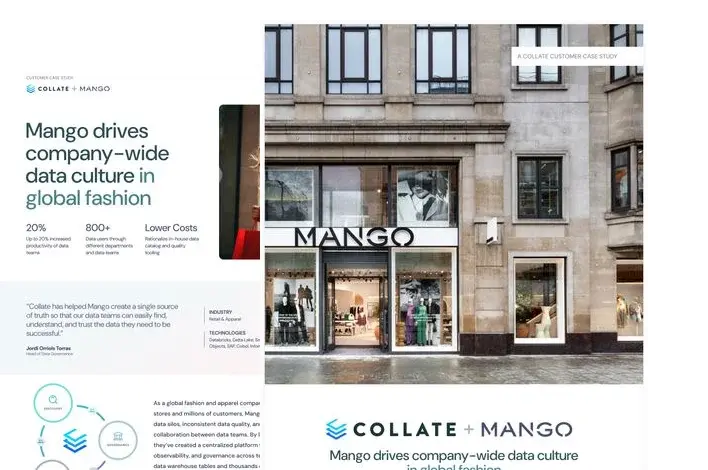
Fashion Retailer Mango’s Data Journey with Collate
Read the case study
Sign up to receive updates for Collate services, events, and products.
Share this article


Ready for trusted intelligence?
See how Collate helps teams work smarter with trusted data