Best Data Lineage Visualization Tools in 2026
What Are Data Lineage Visualization Tools?
Data lineage visualization tools automatically map, track, and visualize the flow of data from source to destination, providing critical insights for governance and impact analysis. Key tools include enterprise solutions like Collate, Collibra, and Informatica, along with modern open-source options such as OpenMetadata and OpenLineage/Marquez. They enable column-level, table-level, and end-to-end visualization of data transformations.
Practically, data lineage visualization tools provide a graphical representation of how data moves and transforms across systems, applications, and processes. By rendering data flows visually, they allow users to track the path of specific data elements, see how they interact with other datasets, and understand the dependencies and transformations involved.
These tools are especially useful in complex data environments where data passes through multiple pipelines, integrations, and storage layers. They help stakeholders, including data engineers, analysts, and compliance officers, get a clear view of data’s lifecycle. This visibility supports both technical tasks, like troubleshooting data errors, and business needs, such as demonstrating data compliance or verifying data accuracy.
In this article:
- Why Data Lineage Visualization Matters
- Key Features of Data Lineage Visualization Tools
- Types of Data Lineage Visualization Tools
- Notable Data Lineage Visualization Tools
Why Data Lineage Visualization Matters
Trust and Transparency in Data
Data lineage makes it clear where data comes from and how it changes over time. Users can trace metrics back to their source systems and understand each transformation step. This reduces ambiguity and builds confidence in reports and dashboards. When teams trust the data, they spend less time validating and more time using it.
Lineage also exposes hidden assumptions in data pipelines. For example, derived fields or business logic applied in transformations become visible instead of buried in code. This helps teams align on definitions of key metrics like revenue or active users. It also reduces duplicate logic across teams, since transformations can be discovered and reused instead of recreated.
Faster Incident Response and Impact Analysis
When data issues occur, lineage helps identify the root cause quickly. Engineers can trace broken pipelines, failed jobs, or incorrect transformations across systems. It also shows downstream dependencies, so teams know which reports, models, or services are affected. This shortens resolution time and limits the blast radius of incidents.
Lineage tools often integrate with monitoring and alerting systems. When a data quality check fails, teams can immediately see upstream sources and recent changes. This context reduces guesswork during debugging. It also supports proactive impact analysis, where teams can assess the effect of schema changes or pipeline updates before deploying them.
Compliance and Auditability
Regulatory requirements often demand clear records of how data is processed and used. Lineage tools provide an auditable trail of data movement and transformation. This helps organizations demonstrate compliance with standards like GDPR, HIPAA, and SOX. Auditors can verify data handling practices without relying on manual documentation.
In addition, lineage supports data classification and policy enforcement. Sensitive fields, such as personal or financial data, can be tracked across systems. Teams can verify that masking, encryption, or access controls are applied consistently. This reduces the risk of data exposure and simplifies responses to audit requests or regulatory inquiries.
AI/ML Provenance, Explainability and Trust for Models
For machine learning systems, lineage tracks how training data is sourced and transformed. It links features, datasets, and models, making it easier to explain model behavior. This is critical for debugging, bias detection, and reproducibility. Clear provenance also supports governance requirements for responsible AI and model validation.
Lineage also helps manage model lifecycle and versioning. Teams can trace which dataset versions were used for training and compare outputs across model iterations. If a model degrades in production, lineage makes it easier to identify whether the issue comes from data drift, feature changes, or training logic. This improves reliability and supports continuous model improvement.
Key Features of Data Lineage Visualization Tools
Visual Data Flow Mapping
Visual data flow mapping is the core feature of lineage visualization tools. It allows users to see the movement of data across sources, processing steps, and destinations in an intuitive, graphical format. These visual maps often use nodes and edges to represent datasets, processes, and the relationships between them, making it easy to grasp complex data pipelines at a glance.
Such visualizations help teams spot bottlenecks, redundant processes, or broken links in their data pipelines. By providing a bird’s-eye view of data architecture, they make it easier to communicate data flows to both technical and non-technical stakeholders, facilitating better collaboration and decision-making.
Automated Lineage Tracking
Automated lineage tracking minimizes manual effort by continuously capturing metadata about data movements and transformations. Modern tools can automatically scan databases, ETL pipelines, and other data systems to detect changes and update lineage diagrams in real time or on a scheduled basis. This ensures that the visualization always reflects the current state of the data ecosystem.
Automation also reduces the risk of human error in documenting data flows. By programmatically collecting lineage information, these tools provide a reliable, up-to-date map of data dependencies, which is essential for troubleshooting, impact analysis, and compliance reporting.
Column-Level vs. Table-Level Lineage
Lineage visualization tools can operate at different levels of granularity. Table-level lineage shows how entire tables or datasets are related, which is useful for high-level architecture and dependency mapping. However, column-level lineage goes deeper by tracking individual fields or attributes within tables, revealing exactly how each piece of data is sourced and transformed.
Column-level lineage is particularly valuable for data quality initiatives and detailed impact analysis. It enables organizations to trace the origin and transformations of specific data points, identify the source of errors, and assess the downstream impact of changes at the most granular level.
Real-Time vs. Batch Lineage Updates
Some data lineage tools offer real-time updates, capturing changes as they occur in the data ecosystem. This approach is essential for environments with frequent data updates, as it ensures the lineage view is always current. Real-time lineage tracking helps teams respond quickly to issues, such as data pipeline failures or unauthorized changes.
Other tools operate in batch mode, updating lineage information at scheduled intervals. Batch updates may be sufficient for environments with less frequent data changes or where real-time tracking is not critical. Organizations should choose the update mode that matches their data velocity and operational needs.
Impact Analysis and Dependency Tracking
Impact analysis capabilities allow users to assess the potential consequences of changes to data sources, pipelines, or schema elements. By visualizing data dependencies, teams can predict which downstream processes, reports, or applications will be affected by a change, reducing the risk of unintended disruptions.
Dependency tracking also aids in troubleshooting and root cause analysis. When data issues arise, lineage visualization tools help pinpoint where the problem originated and which components were affected, enabling faster resolution and minimizing business impact.
Metadata Management and Catalog Integration
Integrating data lineage visualization with metadata management and data catalogs enhances both discovery and governance. These integrations allow users to search for datasets, view their lineage, and access detailed metadata - all from a single interface. This unified view streamlines data discovery, improves transparency, and simplifies compliance efforts.
Metadata integration also supports better data stewardship by connecting lineage information with business glossaries, data quality metrics, and ownership details. This context helps organizations establish trust in their data and ensure that users have the information needed to use data appropriately.
Collaboration and Annotations
Effective data lineage tools support collaboration by allowing users to add annotations, comments, and documentation directly within the lineage maps. This feature enables teams to capture tribal knowledge, document exceptions, and share insights about data flows, transformations, or business logic.
Annotations also improve onboarding and knowledge transfer. New team members can quickly understand data processes and their rationale by reviewing documented lineage diagrams, reducing ramp-up time and helping organizations retain critical institutional knowledge.
Lineage-Based Automations
Lineage-based automations use dependency information to trigger actions across the data stack. Instead of relying on static schedules, pipelines and workflows can adapt based on upstream or downstream changes. For example, a transformation job can automatically run when its source data is updated, or pause if a dependency fails. This improves pipeline reliability and reduces unnecessary compute usage.
These automations also support data quality and governance workflows. If a critical dataset fails a validation check, lineage can trigger alerts, block downstream consumption, or initiate remediation processes. Similarly, schema changes can automatically notify affected teams or create review tasks. This reduces manual coordination and ensures that issues are handled consistently.
In more advanced setups, lineage integrates with orchestration and CI/CD systems. Teams can use lineage to validate changes before deployment, ensuring that updates will not break downstream dependencies. This enables safer releases and more resilient data systems, especially in complex environments with many interconnected pipelines.
Types of Data Lineage Visualization Tools
Enterprise-Grade Platforms
Enterprise platforms for data lineage visualization are designed to handle large-scale, complex data ecosystems with robust integration, governance, and security requirements. These tools often offer deep connectivity to a wide range of data sources, support for granular lineage tracking, and advanced features like automated discovery, policy enforcement, and workflow management. They are built to meet the needs of large organizations with strict compliance, audit, and data management demands.
Such platforms are typically part of broader data governance or data intelligence suites. They provide centralized control, access management, and collaboration features tailored to enterprise environments. While these solutions are comprehensive, they may require significant investment in terms of licensing, implementation, and ongoing management, making them best suited for organizations with mature data governance programs.
Open Source and Emerging Options
Open source and emerging lineage tools offer flexible, cost-effective alternatives to enterprise platforms. These tools are often community-driven, with active development and contributions from users and organizations. They provide core lineage visualization features and can be customized or extended to fit specific technical environments or integration needs.
While open source tools may lack some of the advanced features or enterprise-grade support found in commercial platforms, they are attractive for organizations seeking agility, lower costs, or the ability to tailor solutions to their unique requirements. Many emerging tools are also cloud-native, designed to integrate with modern data stacks and support rapid innovation in data engineering and analytics.
The Role of Open Standards
Open standards like OpenLineage define a common framework for capturing and sharing lineage metadata across tools and platforms. Instead of each system producing lineage in its own format, OpenLineage standardizes how events such as job runs, dataset inputs, and outputs are recorded. This creates a consistent way to track data flows across heterogeneous environments.
This standardization improves interoperability between tools. For example, orchestration systems, data warehouses, and transformation tools can all emit lineage events in the same format. These events can then be collected and visualized in compatible platforms like Marquez or other lineage backends. As a result, organizations can build lineage systems that span multiple technologies without tight vendor lock-in.
Open standards also simplify adoption and integration. Teams can incrementally add lineage tracking by instrumenting pipelines with OpenLineage-compatible libraries, rather than deploying a full platform upfront. This approach fits well with modern, distributed data stacks where components are loosely coupled.
Related content: Read our guide to data lineage tools
Notable Data Lineage Visualization Tools
Enterprise-Grade Platforms
1. Collate

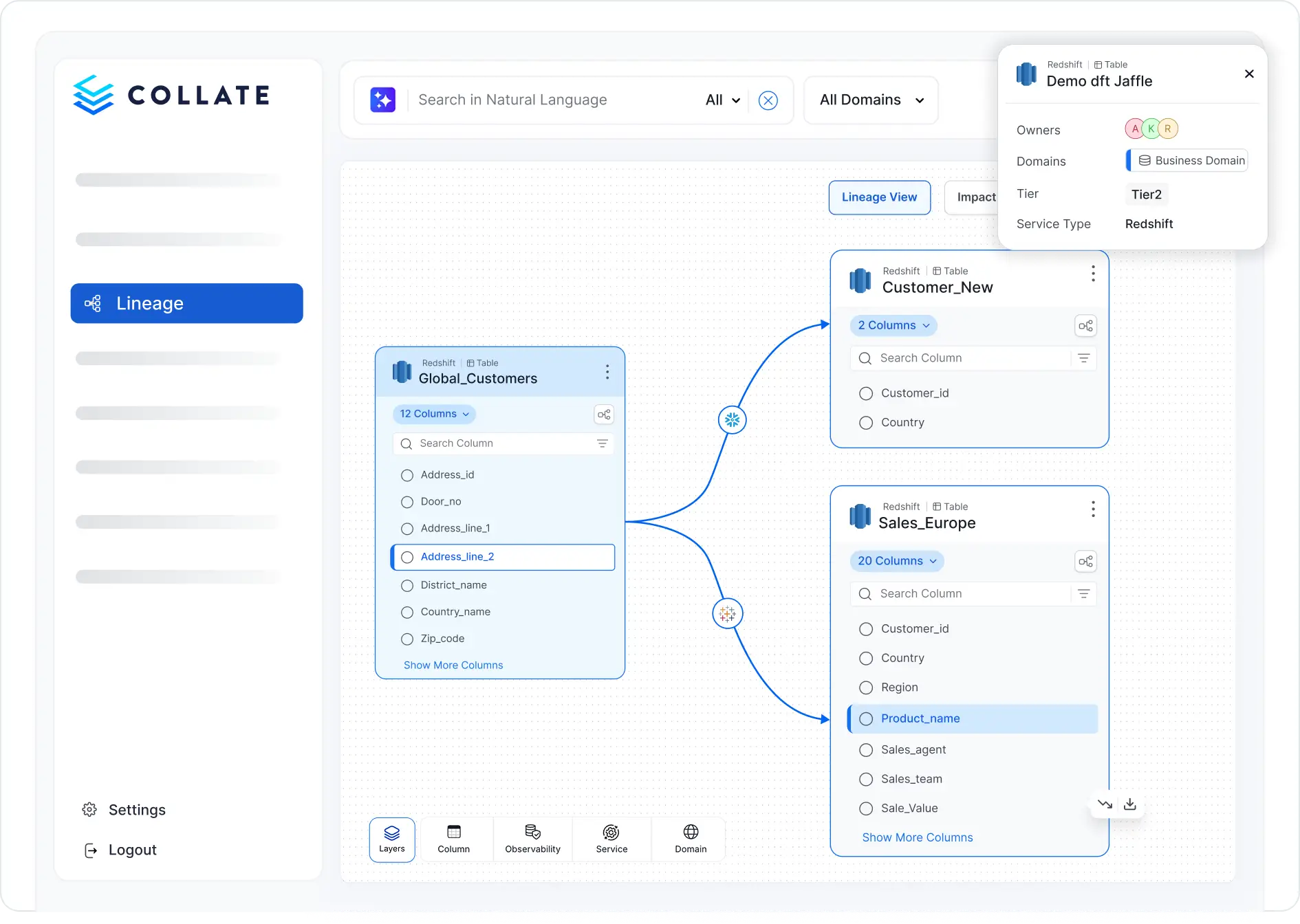
Collate is an enterprise managed service of OpenMetadata, adding AI agents, advanced governance workflows, managed deployment, and enterprise support on top of the open-source foundation. Lineage in Collate inherits OpenMetadata's open lineage model - end-to-end visibility, column-level tracking, impact analysis - and extends it with AI agents that enrich lineage with automated descriptions and classifications, no-code automation that propagates metadata along lineage paths, and governance workflows that orchestrate review and approval for lineage-affecting changes.
General features include:
- Managed, enterprise OpenMetadata service: Combines the OpenMetadata open source project with managed deployment, security, support, enterprise features, and enhanced AI capabilities
- AI agents and conversational intelligence: Includes AskCollate for natural-language data access (with Slack and Teams integration), AI Studio for building custom agents, and AutoPilot agents for documentation, tiering, and data quality
- Lineage-driven metadata automation: No-code automations propagate owners, descriptions, and tiers along lineage paths, scaling governance without manual effort
- Custom Governance Workflow Builder: Drag-and-drop builder with conditions, automated actions, and human-in-the-loop reviews for lineage-affecting changes
- MCP support with enterprise security: Provides LLM agents access to Collate's semantic context graph with enterprise security and zero infrastructure overhead
Visualization-related features include:
- End-to-end lineage graph: Visualizes data flow from source systems through transformations to downstream consumers across the entire data estate
- Column-level and table-level lineage: Granular tracking with interactive drill-down between system, table, and column-level views
- Service-, Domain-, and Product-Level Lineage: Deeper impact analysis and lineage architecture visualizations without custom development
- Impact analysis: Surfaces upstream and downstream dependencies to assess the effect of schema changes, pipeline updates, or data incidents
- AI-enriched lineage: AutoPilot agents auto-generate descriptions, propose classifications, and tier assets - enriching lineage views with context that would otherwise require manual stewardship
2. Collibra Data Intelligence Platform
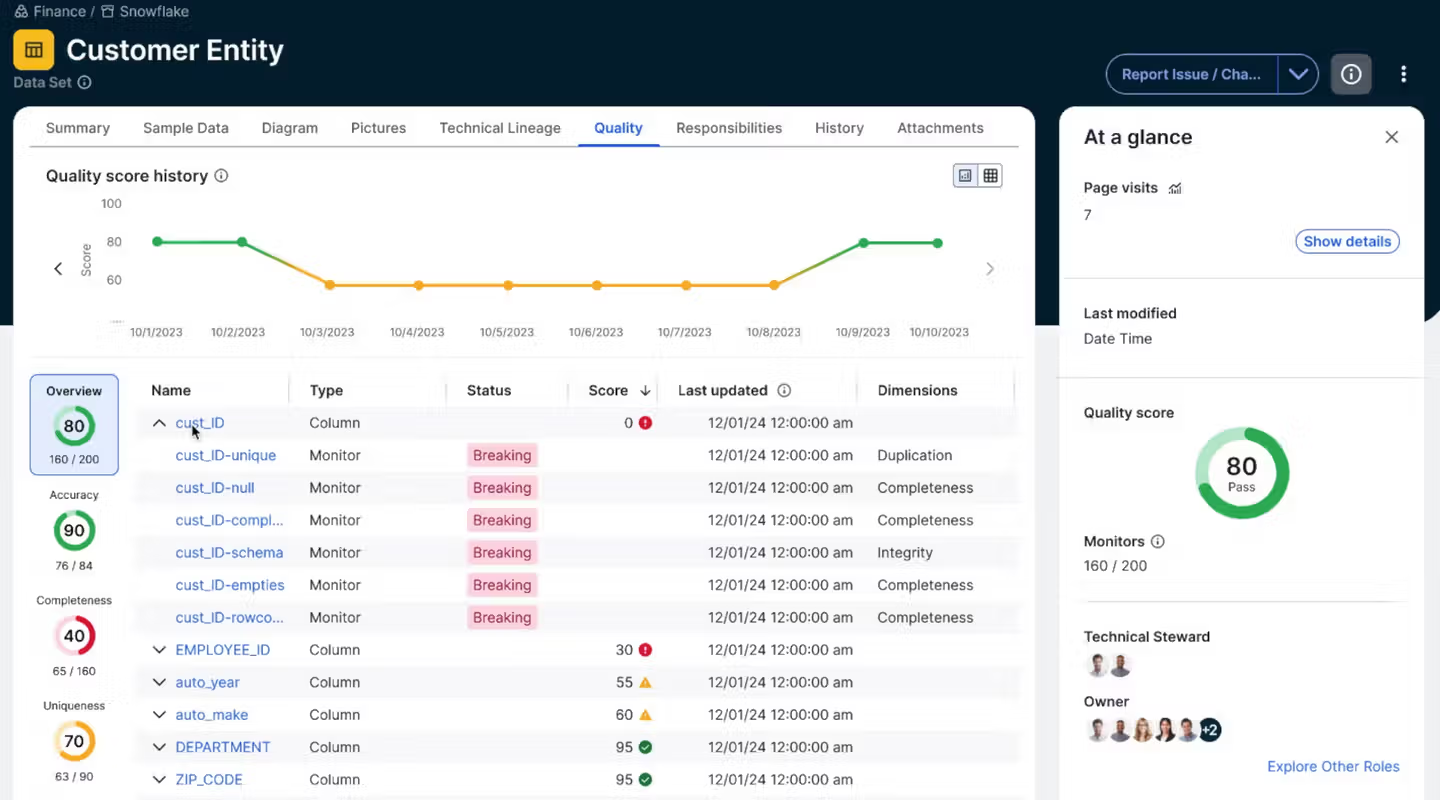
Collibra Data Intelligence Platform delivers data lineage visualization as part of a unified governance system that connects data assets, users, and processes across the enterprise. It builds a contextual view of data by automatically mapping how it moves between systems, applications, and reports, while also linking that flow to business meaning through a semantic layer.
General features include:
- Unified data governance platform: Combines lineage, catalog, data quality, privacy, and AI governance into a single system, reducing the need for separate tools
- Cross-environment connectivity: Links data producers and consumers across different teams, tools, and platforms, creating a shared data ecosystem
- Support for diverse data types: Handles both structured and unstructured data, enabling consistent governance across varied data sources
- Semantic graph layer: Connects raw technical data with business terms, helping users understand the meaning and relevance of data assets
- Automated governance workflows: Provides workflow automation tools to standardize processes, reduce manual work, and improve consistency in data management
Visualization-related features include:
- Automated relationship mapping: Builds visual representations of how data flows between systems, applications, and reports without manual input
- Enterprise-wide lineage view: Provides a centralized, high-level perspective of data movement across the entire organization
- Context-rich lineage visualization: Enhances visual flows with business context using semantic mapping, making diagrams more meaningful to non-technical users
- Cross-platform traceability: Tracks and visualizes data movement across multiple platforms and environments, ensuring full visibility of data paths
- Integration-driven visualization: Embeds lineage and data context directly into external tools and workflows through extensions and integrations
3. Informatica Enterprise Data Catalog
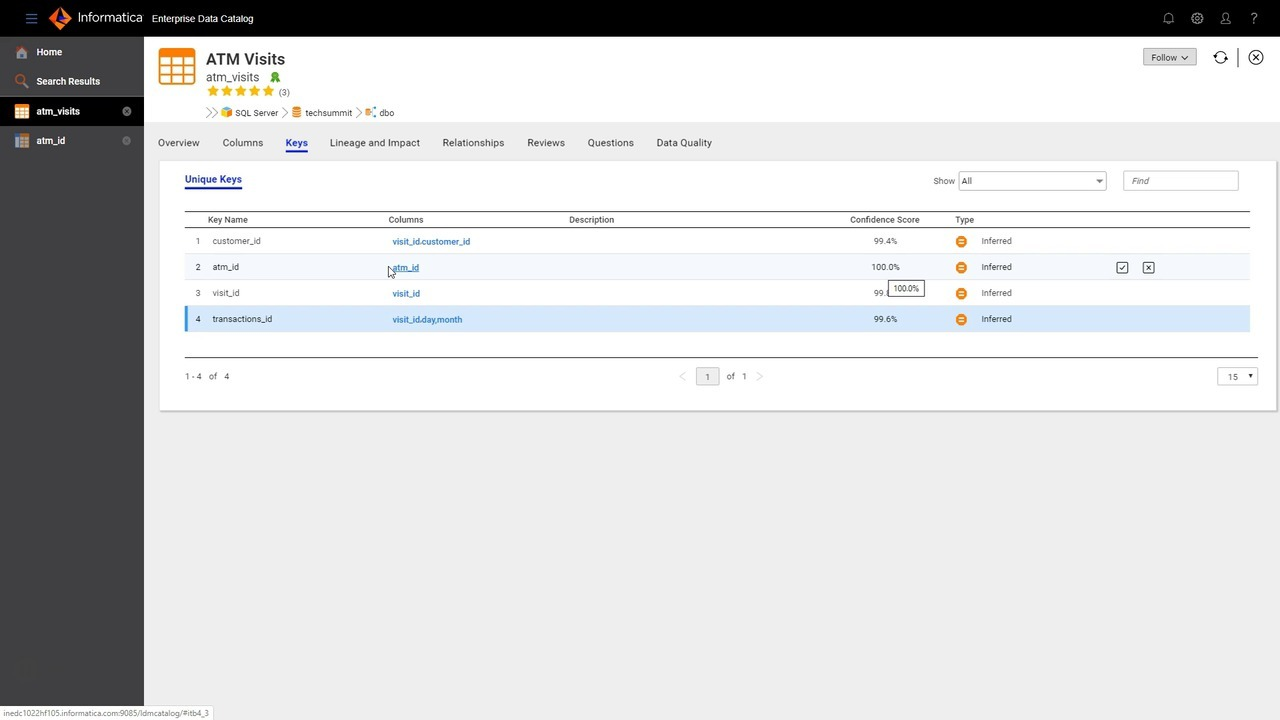
Informatica Enterprise Data Catalog is an AI-powered data catalog that includes advanced data lineage visualization as part of a broader metadata-driven discovery and governance system. It scans and catalogs data assets across on-premises and multi-cloud environments using a machine learning engine, then builds lineage views that trace data from origin to consumption.
General features include:
- AI-powered data discovery engine: Uses machine learning to automatically scan, identify, and catalog data assets across distributed environments
- Multi-cloud and on-premises support: Connects to data across cloud platforms, data lakes, warehouses, and legacy systems for a unified catalog
- CLAIRE engine intelligence: Leverages metadata to provide recommendations, automate tasks, and improve data management efficiency
- Centralized metadata system: Acts as a “catalog of catalogs,” storing and indexing metadata from multiple enterprise sources
- Semantic search with intelligent facets: Enables Google-like search using business terms, with dynamic filters to refine results
- Automated data classification: Identifies domains and entities (e.g., customer, product) at column, field, and table levels using rules and ML
Visualization-related features include:
- End-to-end data lineage visualization: Provides both high-level and detailed views showing how data flows from source to destination
- Multi-level lineage exploration: Supports system-level views for business users and deep column-level lineage for technical users
- Interactive lineage drill-down: Allows users to expand lineage paths to inspect transformations, metrics, and intermediate steps
- Impact analysis capabilities: Identifies upstream and downstream dependencies to assess the effect of changes across data pipelines
- Holistic relationship views: Uses a knowledge graph to visualize relationships between datasets, reports, users, and systems
4. Alation

Alation provides data lineage visualization as part of its broader data intelligence platform, combining cataloging, governance, and metadata management. Its lineage capabilities focus on making data flows easier to understand for both technical and business users by presenting relationships, dependencies, and data health in an accessible, layered format.
General features include:
- Integrated data intelligence platform: Combines catalog, governance, lineage, analytics, and metadata management in a unified system.
- Active metadata graph: Connects datasets, users, and processes to provide a continuously updated view of data relationships.
- Search and discovery capabilities: Enables users to find and understand data assets across the organization.
- Workflow automation support: Standardizes governance and data management processes through automated workflows.
- Open integration framework: Connects with external tools and systems to extend metadata and governance capabilities.
Visualization-related features include:
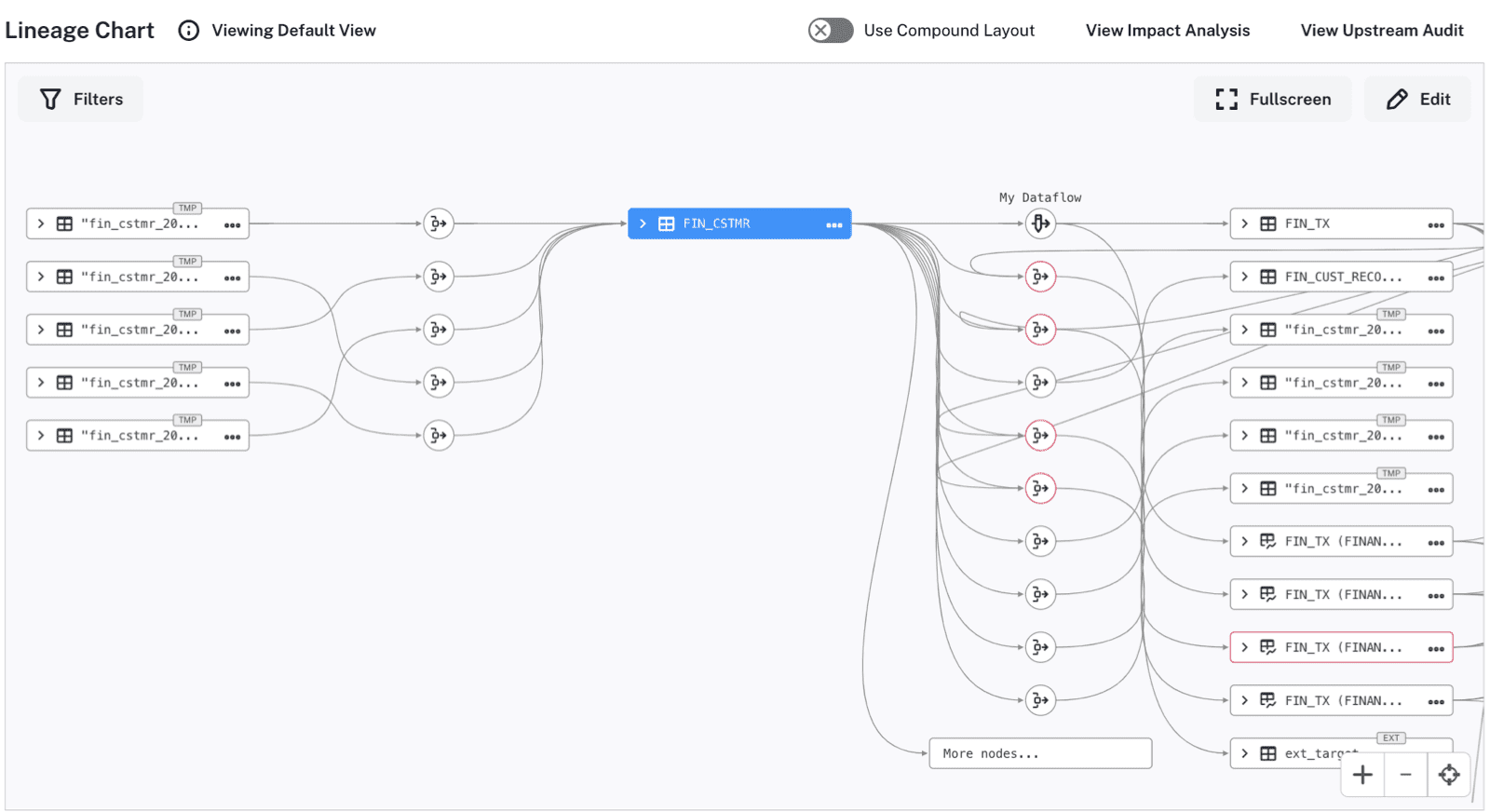
- End-to-end lineage visibility: Displays complete data flows from source to consumption across systems.
- Layered lineage views: Allows users to toggle overlays such as data quality, trust indicators, and business metadata.
- Business-friendly lineage interface: Presents lineage in an intuitive, map-like format to simplify understanding for non-technical users.
- Contextual asset insights: Provides information panels showing relationships, dependencies, and metadata for each asset.
- Impact and relationship analysis: Helps users understand how data changes affect downstream systems and processes.
5. Atlan
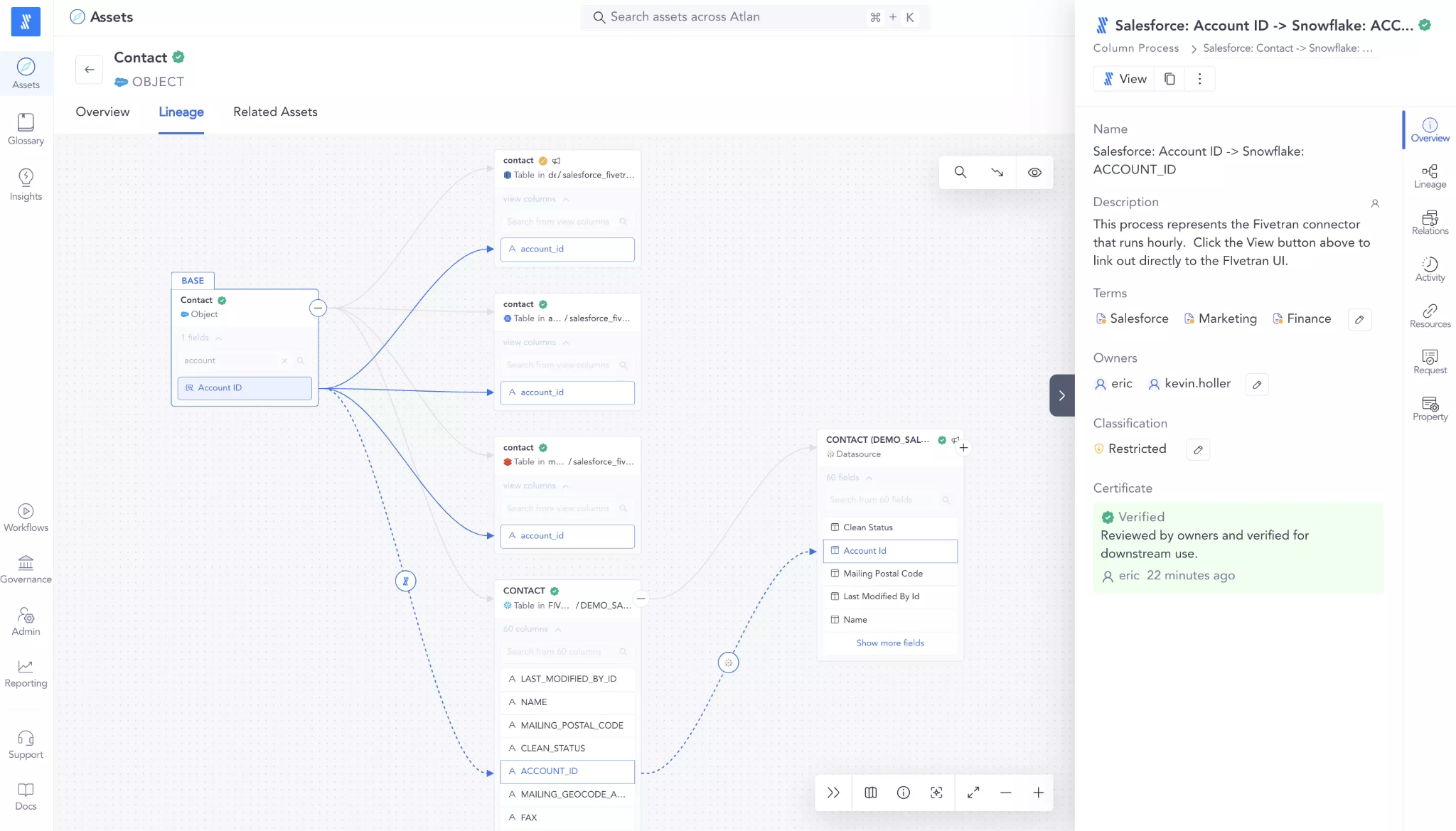
Atlan provides data lineage visualization through a metadata-driven platform that builds a unified graph of data assets, transformations, and dependencies across data stacks. It reconstructs lineage using multiple methods, including SQL parsing, API integrations, and event-based ingestion, enabling visibility into how data moves and changes across systems.
General features include:
- Enterprise data graph: Connects metadata from across systems into a unified, continuously updated graph.
- Wide integration support: Connects with databases, warehouses, BI tools, and pipeline systems across cloud and on-premises environments.
- Open and extensible architecture: Supports APIs, SDKs, and open standards for custom lineage ingestion and integration.
- AI and context integration: Provides contextual metadata such as quality, ownership, and governance alongside data assets.
- Multi-source metadata ingestion: Combines SQL parsing, API crawling, and event ingestion to build a complete metadata layer.
Visualization-related features include:
- Column-level lineage tracking: Provides fine-grained visibility into transformations and dependencies at the field level.
- End-to-end lineage graph: Visualizes full data flows across pipelines, datasets, and downstream applications.
- Automated lineage reconstruction: Builds lineage automatically from queries, pipelines, and APIs without manual mapping.
- Impact analysis visualization: Shows downstream effects of data issues or schema changes across dashboards and systems.
- Lineage-driven root cause analysis: Enables tracing issues back through upstream dependencies to identify causes quickly.
 ### Open Source and Emerging Options
6. OpenMetadata

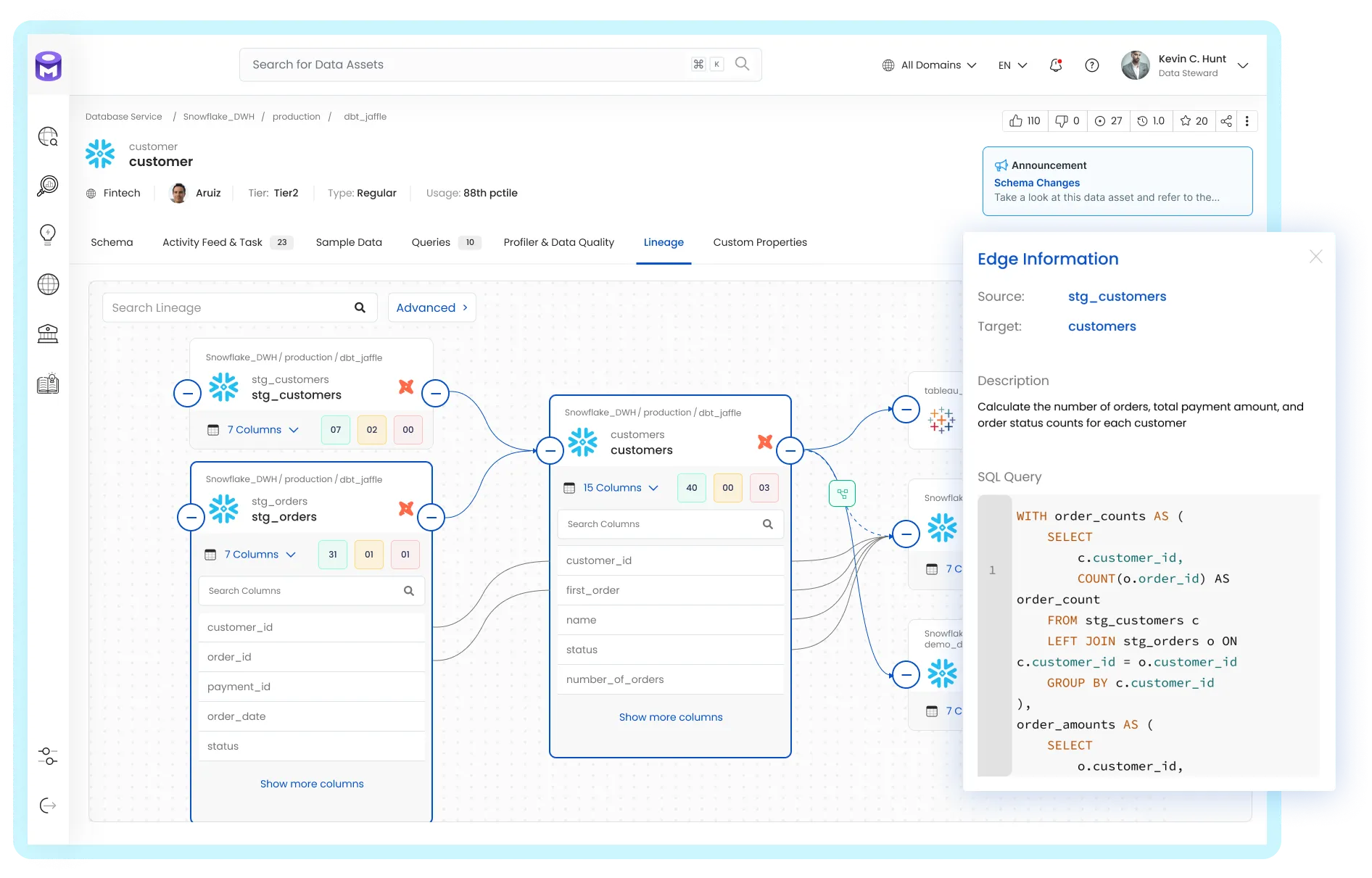
OpenMetadata is the largest and fastest growing open source project for metadata, data management, and context. Its lineage capabilities are core to the platform, automatically captured from databases, warehouses, pipelines, dashboards, and ML systems through 130+ open connectors and exposed through an interactive graph, open APIs, and native Model Context Protocol (MCP) support for AI agents. A managed, enterprise OpenMetadata service is available from Collate
General features include:
- Open-source metadata standard: Community-driven platform under Apache License, providing a vendor-neutral foundation for metadata and context
- Native OpenLineage support: Standards-based lineage capture, alongside alignment with JSON Schema, DCAT, DPROD, ODCS, and MCP for open interoperability
- Wide open connector ecosystem: 130+ open connectors spanning databases, warehouses, data lakes, dashboards, ML platforms, and orchestration tools
- Knowledge graph: Stores knowledge as relationships between tables, metrics, glossary terms, and governance policies - the foundation for context, semantics, and memory
- Native MCP support : Connects LLM agents directly to OpenMetadata's knowledge graph through the Model Context Protocol
Visualization-related features include:
- Interactive lineage graph: Dynamic visualizations of data flow from source systems through transformations to consumers across heterogeneous data systems
- Column-level and table-level lineage: Field-level tracking automatically discovered from SQL query parsing, exposing transformations and derivations
- Pipeline lineage: Native integrations with Airflow, Prefect, Dagster, and dbt provide visibility into job-level data flow alongside dataset lineage
- Upstream and downstream impact analysis: Allows users to trace dependencies in both directions to evaluate change impact and troubleshoot incidents
- Knowledge Graph view: Interactive visual graph showing every relationship, governance rule, and dependency surrounding any data asset
7. OpenLineage + Marquez

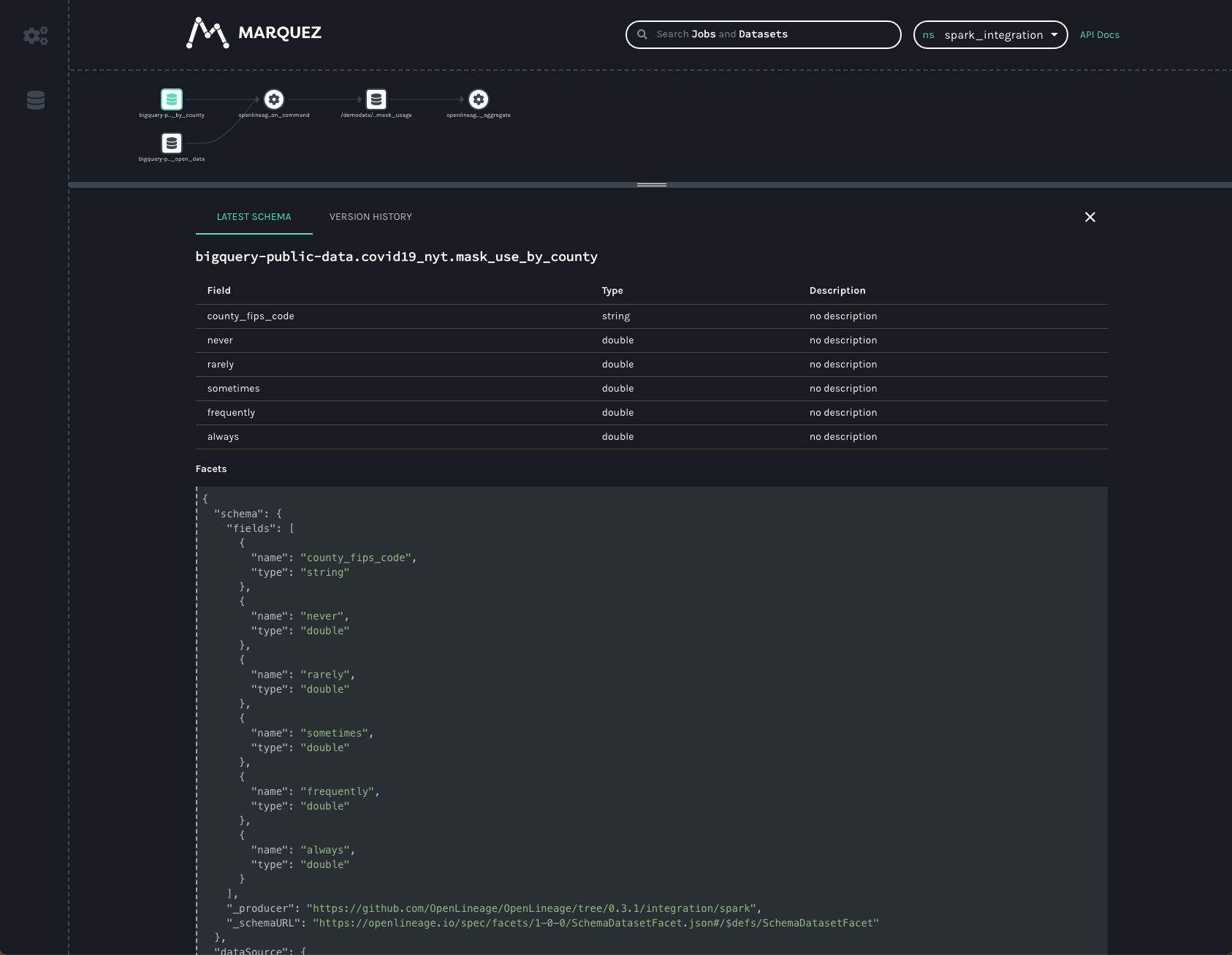
OpenLineage combined with Marquez provides an open-source solution for collecting, storing, and visualizing data lineage metadata across modern data stacks.
OpenLineage defines a standard for capturing lineage events from data processing systems, while Marquez acts as the central service that ingests this metadata in real time, stores it, and exposes it through APIs and a web interface. Together, they create a unified view of data pipelines by tracking jobs, datasets, and their relationships over time.
General features include:
- Open standard for lineage (OpenLineage): Defines a consistent format for collecting metadata about jobs, runs, inputs, and outputs across different data systems
- Centralized metadata service (Marquez): Acts as a single system to ingest, store, and manage lineage metadata from across the organization
- Real-time metadata collection: Captures lineage events from running jobs via an OpenLineage-compatible HTTP endpoint
- Broad ecosystem integration: Works with tools such as Apache Airflow, Spark, Flink, dbt, and Dagster through community-built integrations
- Normalized metadata model: Stores lineage data in a structured format that represents pipelines, jobs, and datasets with clear relationships
Visualization-related features include:
- Unified lineage graph UI: Displays a visual map of datasets and jobs, showing how data flows and dependencies are structured
- Interactive exploration of pipelines: Allows users to browse jobs and datasets, inspect inputs and outputs, and navigate across dependencies
- End-to-end lineage tracing: Enables tracking of data from source datasets through multiple jobs to final outputs
- Granular metadata visibility: Provides access to run-level details, including execution history and performance metrics within the UI
- Dependency graph traversal: Supports navigating upstream and downstream relationships to understand impact and data flow context
8. Apache Atlas

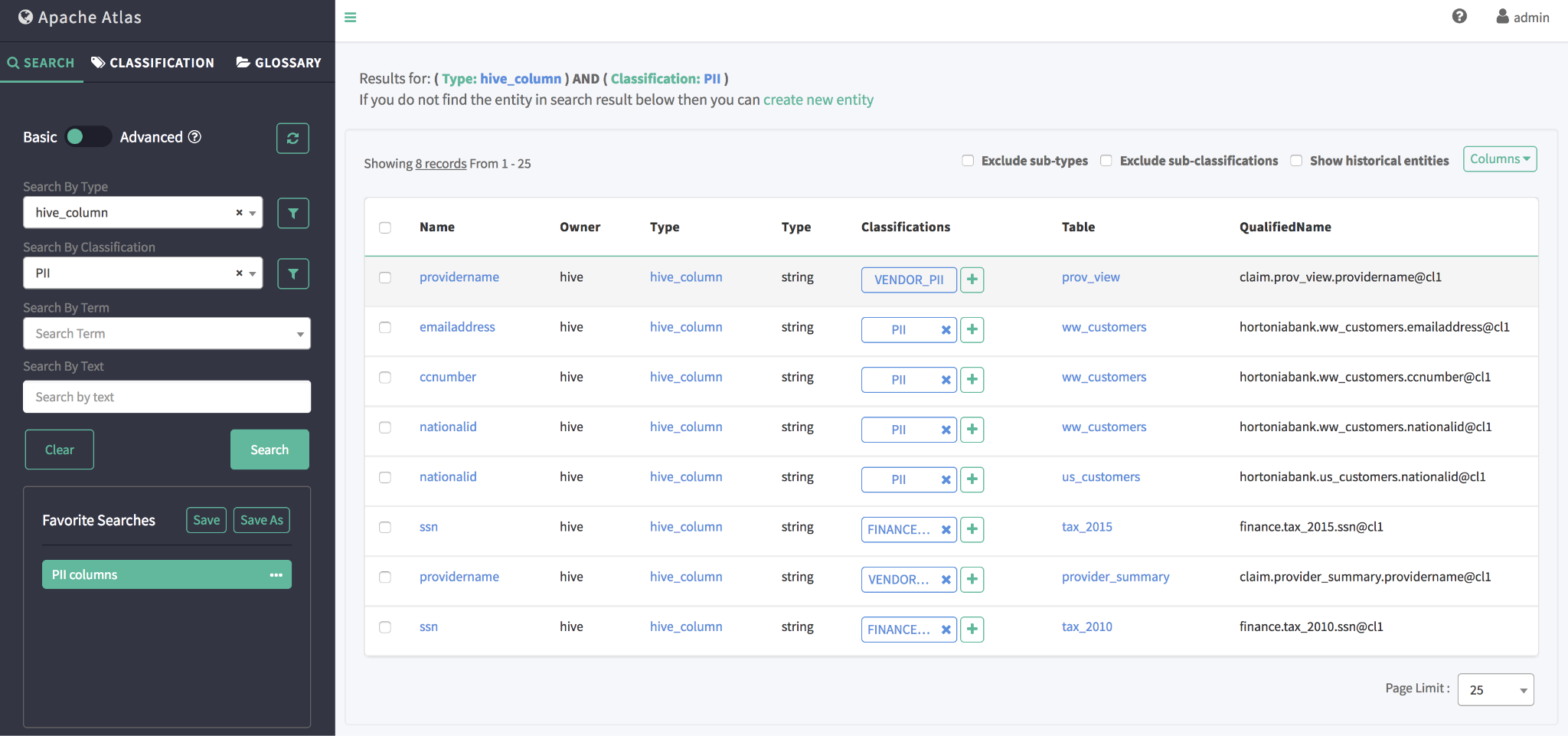
Apache Atlas is an open-source metadata management and governance platform designed to provide visibility, control, and lineage tracking across data ecosystems, particularly within Hadoop environments. It enables organizations to define, classify, and manage data assets while capturing the relationships between them.
General features include:
- Open metadata management framework: Provides a centralized system to define, store, and manage metadata for data assets across Hadoop and external systems
- Extensible type system: Supports predefined metadata types and allows users to create custom types with attributes, relationships, and inheritance
- Entity-based modeling: Represents real data objects (tables, files, processes) as entities with detailed attributes and relationships
- Dynamic classification system: Enables tagging of data assets with labels such as PII, sensitive, or data quality, including custom attributes for each classification
- Classification propagation: Automatically applies classifications to downstream data as it flows through pipelines, ensuring consistent governance
Visualization-related features include:
- Interactive lineage UI: Provides a graphical interface to view how data moves through processes and systems
- End-to-end lineage tracking: Captures data flow across multiple transformations, showing upstream and downstream dependencies
- Classification-aware lineage visualization: Displays how tags (e.g., PII, sensitive) propagate along data pipelines
- Entity relationship mapping: Visualizes connections between datasets, processes, and systems through linked entities
- API-accessible lineage data: Enables external tools to query and visualize lineage using REST APIs
 ## Conclusion
Data lineage visualization is indispensable for navigating the complexities of modern data environments. It provides essential transparency, building trust, speeding up incident response, and ensuring compliance across all data assets. By offering features like automated tracking and detailed impact analysis, these systems transform raw metadata into actionable governance insights.