DataHub for Data Lineage: Features, Limitations, and Alternatives
What Is DataHub?
DataHub is an open-source metadata platform developed by LinkedIn and later contributed to the community. It helps organizations collect, manage, and leverage metadata for their data assets. By centralizing metadata from various tools, databases, and warehouses, DataHub creates a catalog that allows users to search, discover, and understand datasets across their data ecosystem. This capability assists organizations in maintaining data quality, trust, and compliance while enhancing collaboration among data teams.
The core of DataHub lies in its extensibility and integration capabilities. It supports metadata ingestion from popular data storage, processing, and analysis tools such as Apache Kafka, Snowflake, BigQuery, and more. DataHub also provides APIs and SDKs for customizing metadata models, enriching metadata, and integrating with existing workflows.
This is part of a series of articles about data lineage.
Key Features of DataHub Data Lineage
DataHub offers lineage tracking across datasets, jobs, dashboards, and charts, supporting both table-level and column-level granularity. It currently supports five types of lineage connections:
- dataset to dataset
- dataJob to dataset
- dataJob to dataFlow
- chart to dashboard
- chart to dataset
These connection types allow DataHub to capture lineage across a range of tools. For supported platforms like Snowflake, Databricks, and BigQuery, lineage can be extracted automatically. For unsupported platforms, lineage can be added programmatically using the DataHub SDK or API.
Column-level lineage is supported but limited to certain platforms. For platforms without native support (e.g., Athena, ClickHouse, Hive, Kafka), lineage must be added manually. Column-level lineage can be configured with different matching strategies—fuzzy, strict, or custom mappings—giving flexibility in how transformations between datasets are represented.
Recent enhancements to DataHub lineage include:
- Support for OpenLineage via Spark plugin
- Incremental column-level lineage tracking
- A revamped UI with improved lineage propagation views
- Native query extractors (e.g., for BigQuery)
- Iceberg table support for Snowflake access history
- Enhanced SQL parsing with custom dialect support using SQLGlot
DataHub Data Lineage Limitations
DataHub is a useful platform for capturing and analyzing data lineage, but there are some limitations to be aware of. These constraints mainly relate to scalability, integrations, and available support resources. The limitations were reported by users in the G2 platform:
- Performance: Some users noted performance degradation when working with very large datasets, making lineage handling slower and less efficient.
- Limited integration with tools like dbt, including lack of native support for test execution and data quality checks.
- Fewer analytics tool integrations compared to some alternatives, which can restrict end-to-end visibility in diverse environments.
- Lacking support: Documentation and support resources can be difficult to navigate, and delays in support response times may affect production workflows.
- Column-level lineage is not fully supported across all platforms, requiring manual setup or custom development.
- Cluttered visualizations of complex lineage graphs can be difficult to interpret at scale.
- Real-time lineage updates are limited, with some ingestion pipelines operating on batch schedules instead of continuous sync.
- Governance features are not fully mature. For example, automated policy enforcement or impact analysis are less developed than competing specialized tools.
- Resource-intensive setup and configuration, particularly when customizing metadata models or ingestion pipelines.
- Self-hosted deployments may require significant infrastructure management and monitoring effort to ensure stability.
Notable DataHub Data Lineage Alternatives
1. OpenMetadata

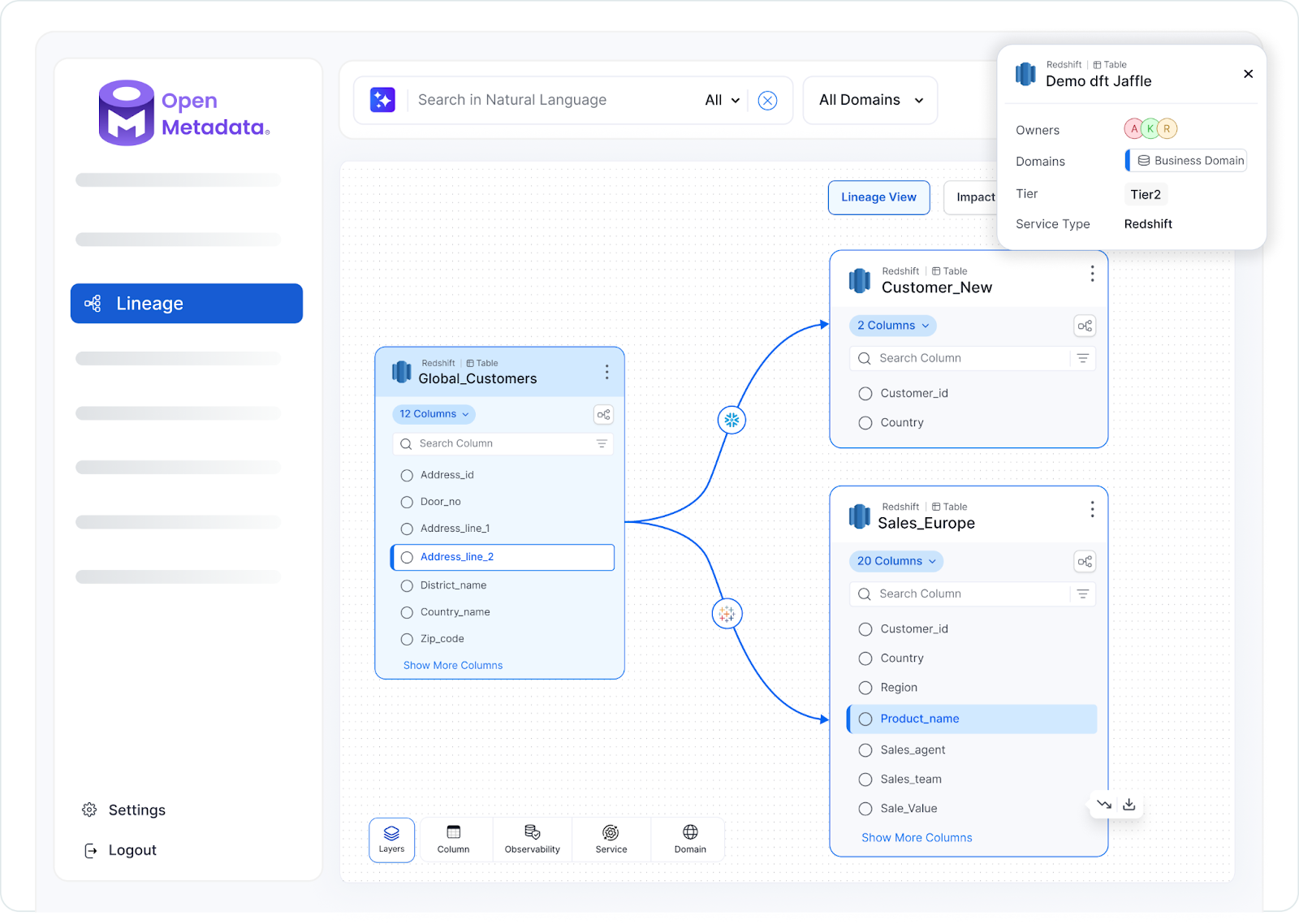
OpenMetadata is an open-source metadata platform designed to centralize metadata management and enable data discovery, collaboration, and governance across the modern data stack. Built with an API-first architecture, it provides automated lineage extraction, collaborative documentation, and data quality enforcement. The platform emphasizes ease of deployment and user experience while maintaining technical depth for enterprise environments, with only four system components for easy setup and high scalability.
Key features include:
- Automated lineage extraction: 100+ native connectors for platforms like Snowflake, BigQuery, Databricks, dbt, and Airflow enable automatic lineage capture without manual configuration.
- Table & column-level lineage: Tracks transformations at the column level by parsing SQL queries and transformation logic, showing how individual fields are derived across pipeline stages.
- Impact analysis: Identifies upstream and downstream dependencies at table and column-level granularity, enabling teams to assess change impacts and prevent production incidents before modifying schemas or pipelines.
- Visual layers and search: Google Maps-type layers offer lineage views across data services, domains, products, and observability, with search and detailed filters for rapid navigation.
- Unified workflows: Users navigate business context, descriptions, quality test results, and ownership information alongside lineage graphs, bridging technical and business understanding of data flows.
2. Apache Atlas

Apache Atlas is an open-source metadata and governance platform designed to manage and secure enterprise data assets. Originally developed for Hadoop environments, it has grown into a flexible solution that can integrate across the broader enterprise data ecosystem.
Atlas helps organizations build and maintain a metadata catalog, apply consistent classifications, and enforce governance policies. Its extensibility allows teams to define custom metadata types, establish relationships, and propagate classifications as data moves through pipelines.
Key features include:
- Metadata modeling: Supports predefined metadata types for Hadoop and non-Hadoop assets, with the ability to define new custom types, attributes, and inheritance structures.
- Metadata instances: Entities represent metadata objects and their relationships, with full lifecycle management through REST APIs.
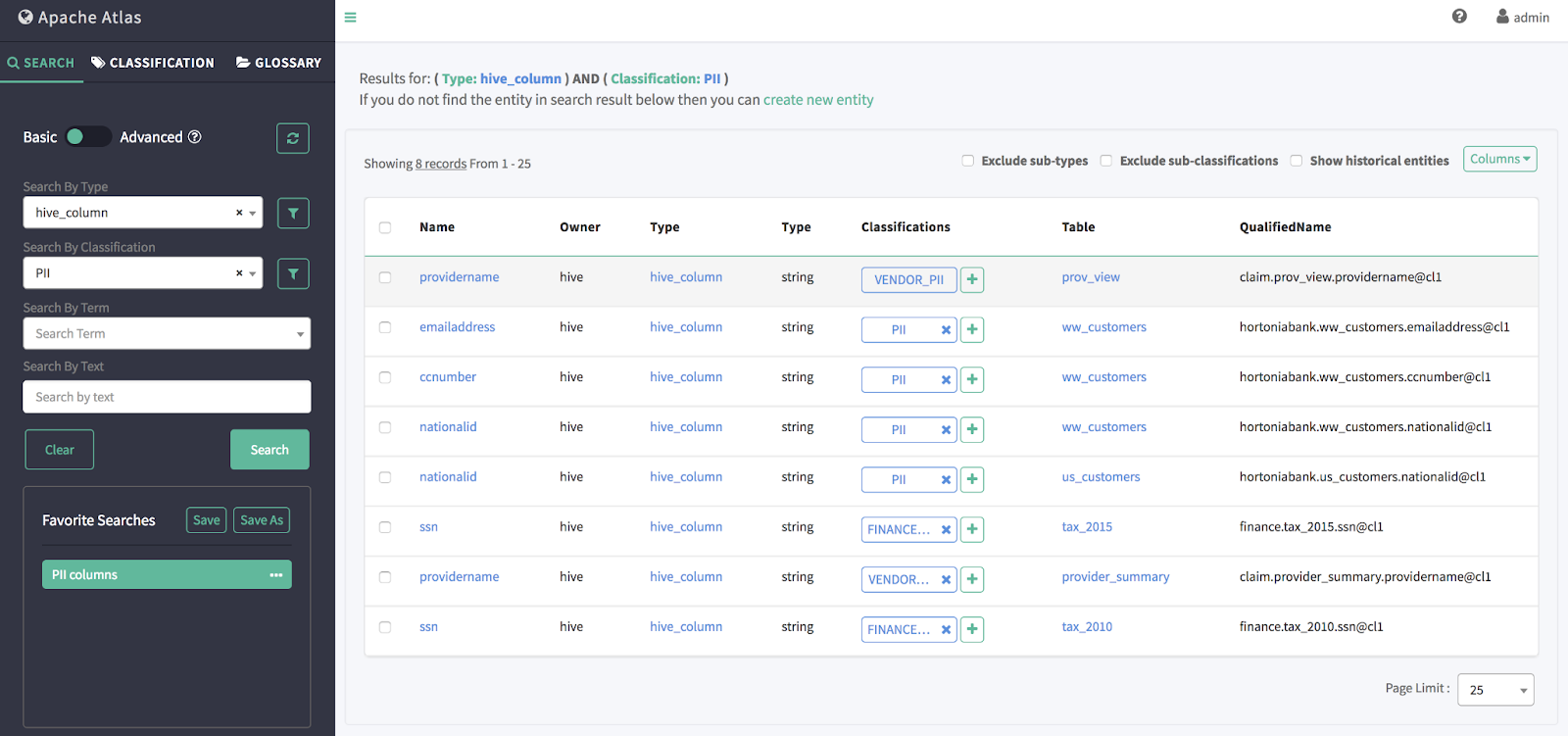
- Classification system: Allows creation of custom classifications (e.g., PII, sensitive data), including attributes like expiry dates, which can be dynamically assigned and propagated via lineage.
- Lineage tracking: Provides an intuitive UI and APIs to visualize and manage lineage as data flows through processes. Search and discovery: Offers search by type, classification, attributes, or free text, with advanced query support through a domain-specific language (DSL).
3. Amundsen

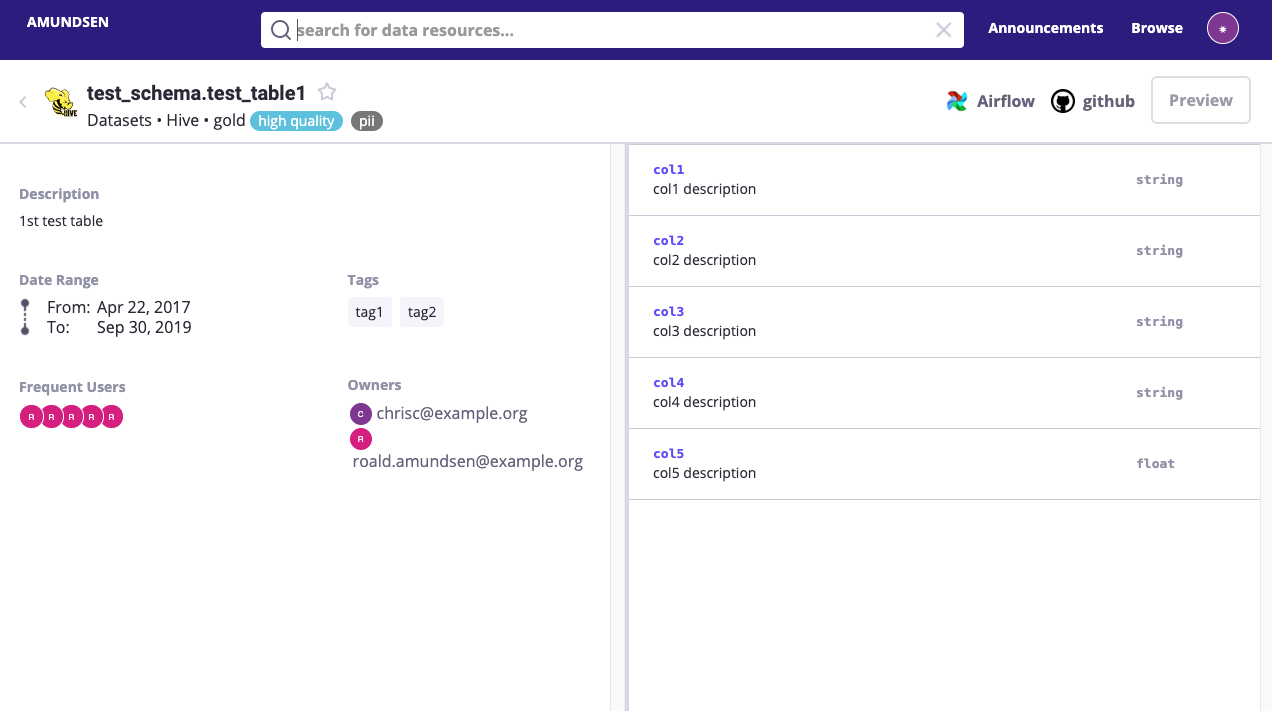
Amundsen is an open-source metadata management platform created by Lyft to address data discovery and governance challenges. It supports data lineage by integrating with tools like dbt and OpenLineage to extract and visualize metadata from modern data stacks. With Amundsen, teams can trace how data flows through models, understand dependencies, and track upstream and downstream tables, making it easier to audit, debug, and manage data pipelines.
Key features include:
- Lineage extraction with dbt: Amundsen uses dbt’s manifest and catalog files to build lineage graphs based on transformation models and database metadata.
- Lineage visualization: The UI displays both upstream and downstream relationships for tables, allowing users to explore dependencies and data flows in a graph view.
- Custom metadata loading: Metadata can be loaded into Amundsen using its dbt extractor and loader scripts, which parse JSON files and populate search indexes for discovery.
- Configurable lineage support: Developers can enable table and column lineage in the frontend configuration, making lineage available directly within the Amundsen interface.
- Search and navigation: Once lineage is enabled, users can explore metadata by searching for tables and navigating their relationships via the Lineage and Upstream tabs.
4. Alation

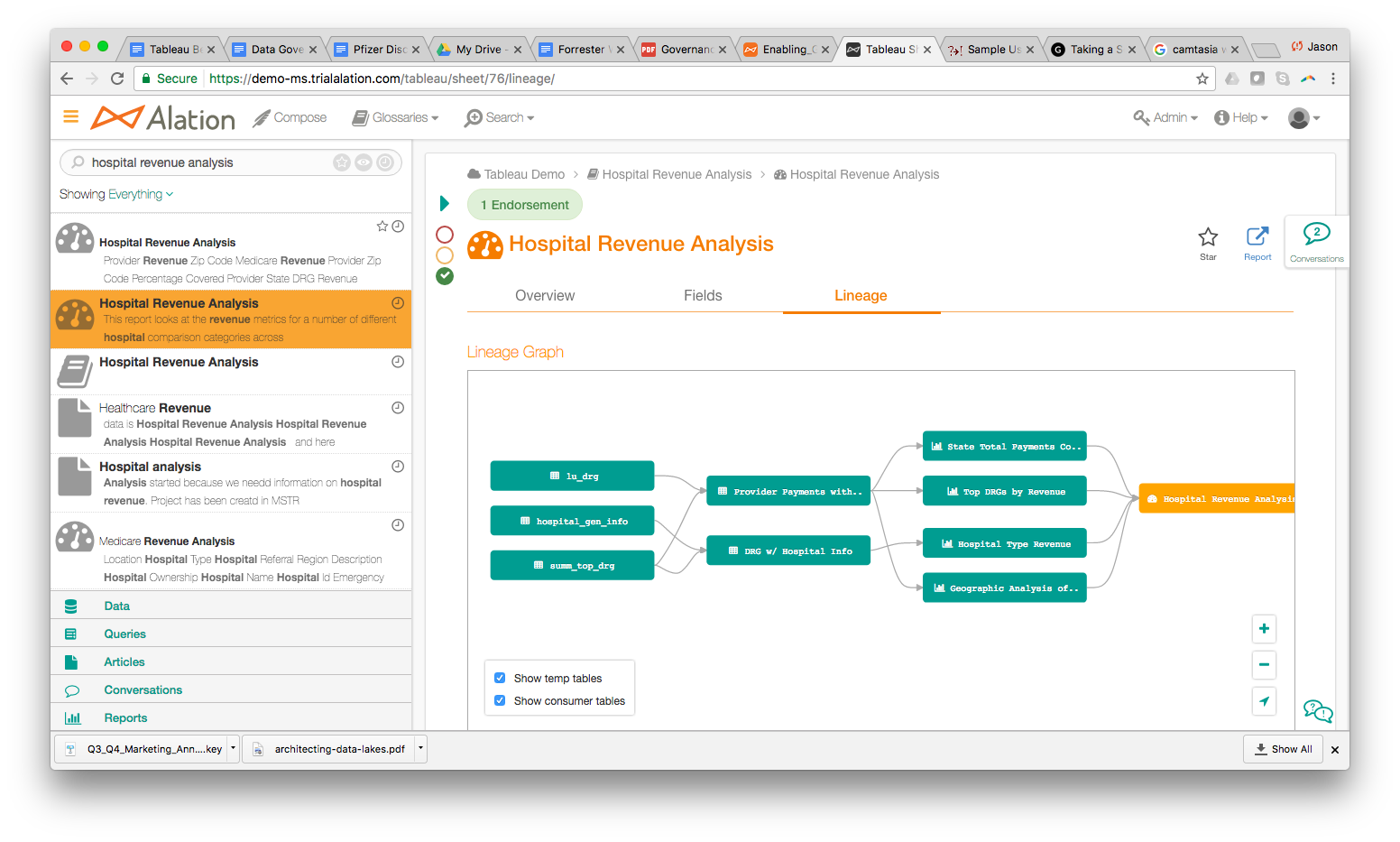
Alation is a commercial solution that offers a collaborative data lineage solution as part of its broader data intelligence platform. Designed to be intuitive and user-friendly, Alation’s lineage experience allows users across the organization to understand data flows, assess data quality, and evaluate downstream impacts. Its visual interface layers technical and business metadata, making it easier to grasp data relationships and dependencies without deep technical expertise.
Key features include:
- Intuitive visual interface: Alation Business Lineage presents data flows in a map-like interface. Users can toggle overlays for trust indicators, data quality, and business metadata, making lineage exploration as simple as switching map layers.
- Business and technical overlays: Lineage diagrams combine technical flow mapping with business context. Filters and groupings allow users to tailor views based on role or need, helping both technical and non-technical users understand data usage.
- Impact analysis: Users can trace downstream effects of data changes, helping teams reduce risk during schema updates, deprecations, or cloud migrations.
- Transparency tools: Features like trust flags, policy details, and deprecation indicators give users the confidence to identify reliable and compliant data for decision-making.
- Operational efficiency: Alation’s lineage tools help eliminate redundant processes and reduce time spent on root cause analysis, lowering costs and improving data pipeline reliability.
5. Collibra
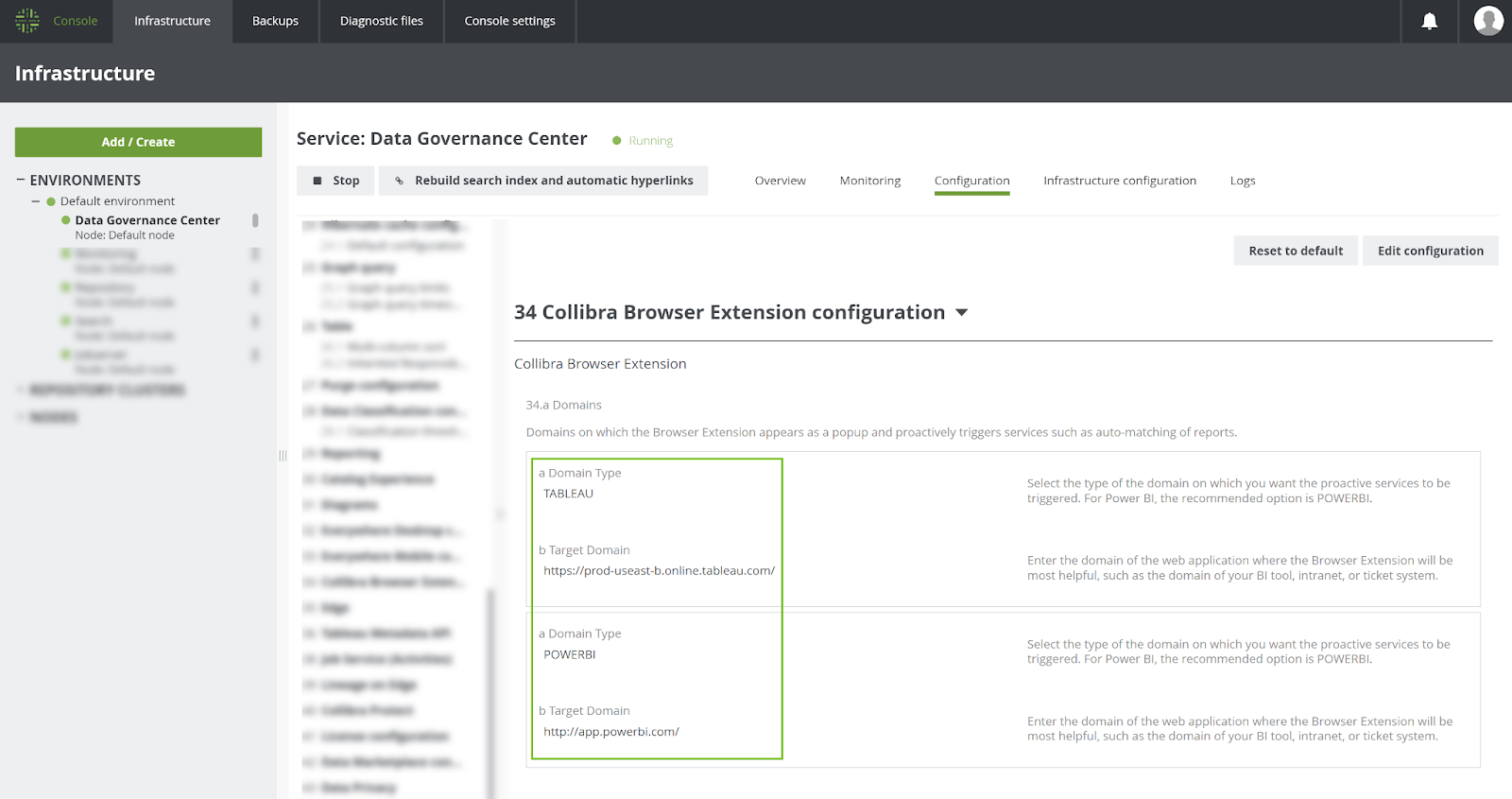
Collibra is a commercial solution that delivers enterprise-grade data lineage capabilities that help organizations visualize how data moves, transforms, and is consumed across systems. Designed to support governance, compliance, and operational efficiency, Collibra’s automated lineage tools give teams a clear view into data dependencies, transformations, and impact paths.
Key features include:
- Automated lineage extraction: Collibra uses native integrations and AI to automatically map data flows from source to destination, saving time and reducing manual effort.
- Root cause and impact analysis: Lineage diagrams help trace data issues to their origin and evaluate downstream effects, enabling faster resolution and better risk management.
- Context-rich exploration: Users can view technical and business metadata, compliance rules, and data quality information alongside lineage, supporting deeper data understanding and faster analysis.
- Code-level visibility: Diagrams include in-line code views at the table and column level, allowing users to see how data is transformed at each step.
- Search and filtering tools: Intelligent filtering helps narrow down lineage views to only what’s relevant, making it easier to locate assets and reduce noise.
6. Select Star

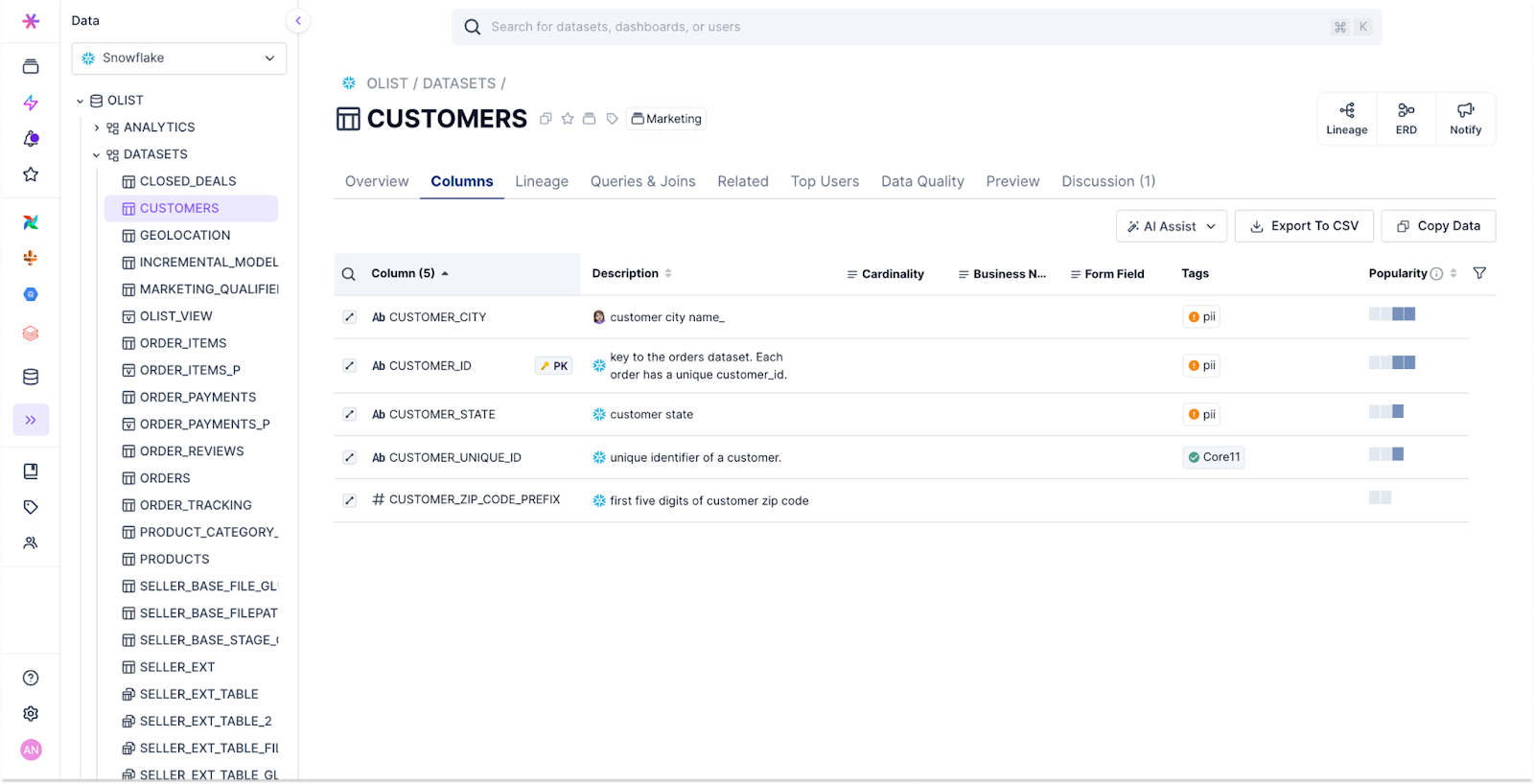
Select Star is a commercial data discovery and catalog platform that automates metadata analysis and documentation. By connecting directly to data warehouses and BI tools, it ingests metadata, query history, and activity logs to build a unified view of enterprise data. Its query parser analyzes usage patterns to highlight dataset popularity, showing which assets are most valuable across the organization.
Key features include:
- Automated metadata capture: Connects to warehouses and BI tools to ingest metadata and query history into a centralized store.
- Data lineage: Provides column-level lineage by parsing SQL queries, showing upstream and downstream dependencies, including dashboards.
- Multiple lineage views: Supports four perspectives—Upstream, Downstream, Downstream Dashboards, and Explore (graph-based navigation).
- Lineage graph: Interactive visualization of upstream sources and downstream targets, with search and filtering for large datasets.
- Lineage filtering: Allows filtering by data type, search terms, or exclusions to narrow down dependencies.
Related content: Read our guides to data lineage tools and data lineage examples
Conclusion
While DataHub provides a capable foundation for metadata management and lineage tracking, its limitations in performance, integrations, and governance maturity can restrict its effectiveness in complex or fast-growing environments. Organizations seeking more complete or easier-to-manage lineage solutions should evaluate alternatives such as OpenMetadata, Apache Atlas, or commercial tools like Collibra and Alation, which offer broader integrations, better visualization, and more mature governance features.
Fashion Retailer Mango’s Data Journey with Collate
Read the case study
Sign up to receive updates for Collate services, events, and products.
Share this article


Ready for trusted intelligence?
See how Collate helps teams work smarter with trusted data