


Deliver Governance with Agility
Agentic controls and workflows boost data team productivity

Transform Policy into Practice
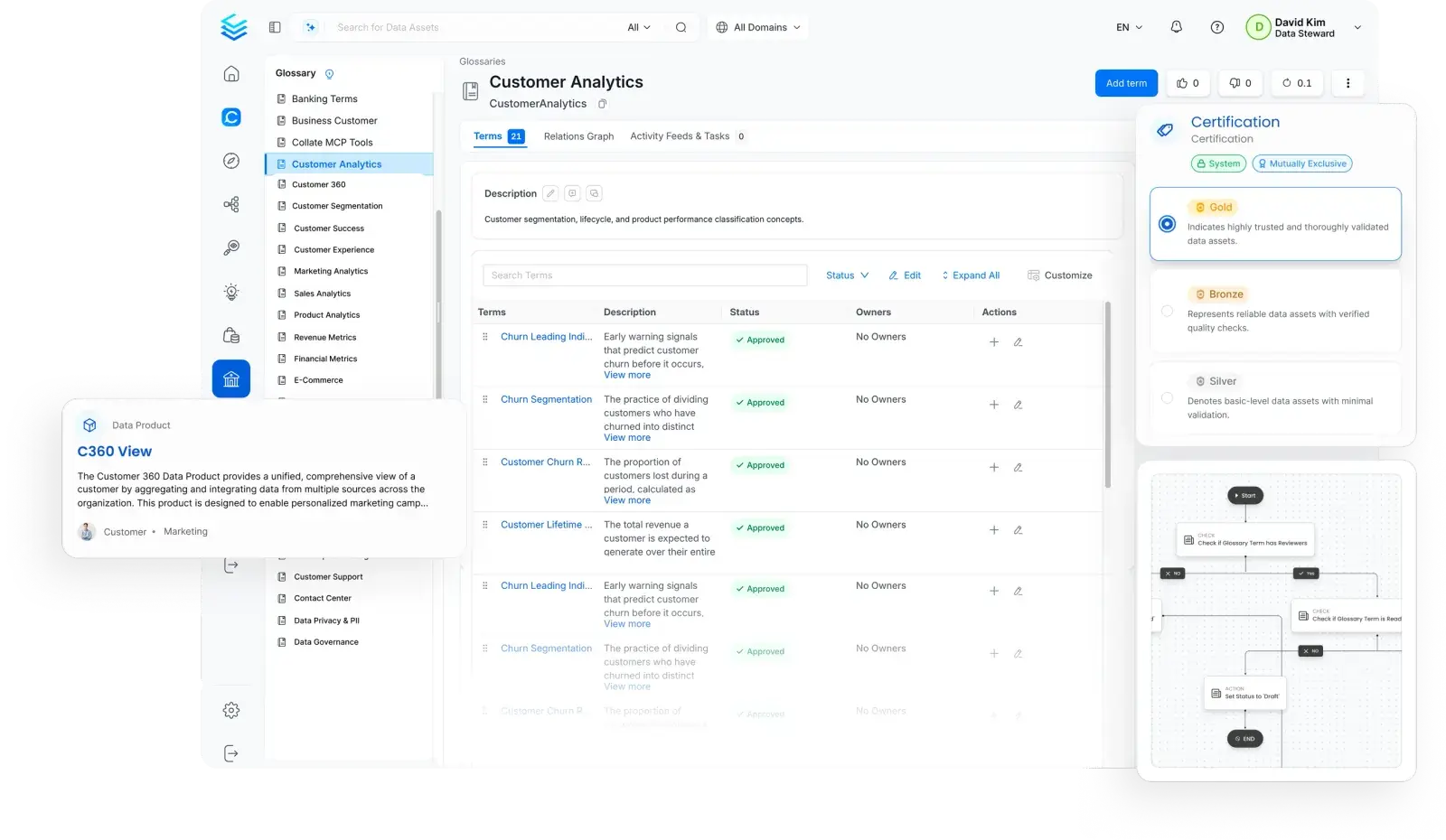
Connect data sources to business context, governance strategy to daily operations

Demonstrate Compliance Impact
Quantify your governance program’s value with executive-ready dashboards
AI-Native Governance for Modern Data Teams
Intelligent automation to manage your data more easily
![[object Object]](/_next/image?url=%2Fimages%2Fdata-governance%2Fai_powered_data_classification.svg&w=3840&q=75)
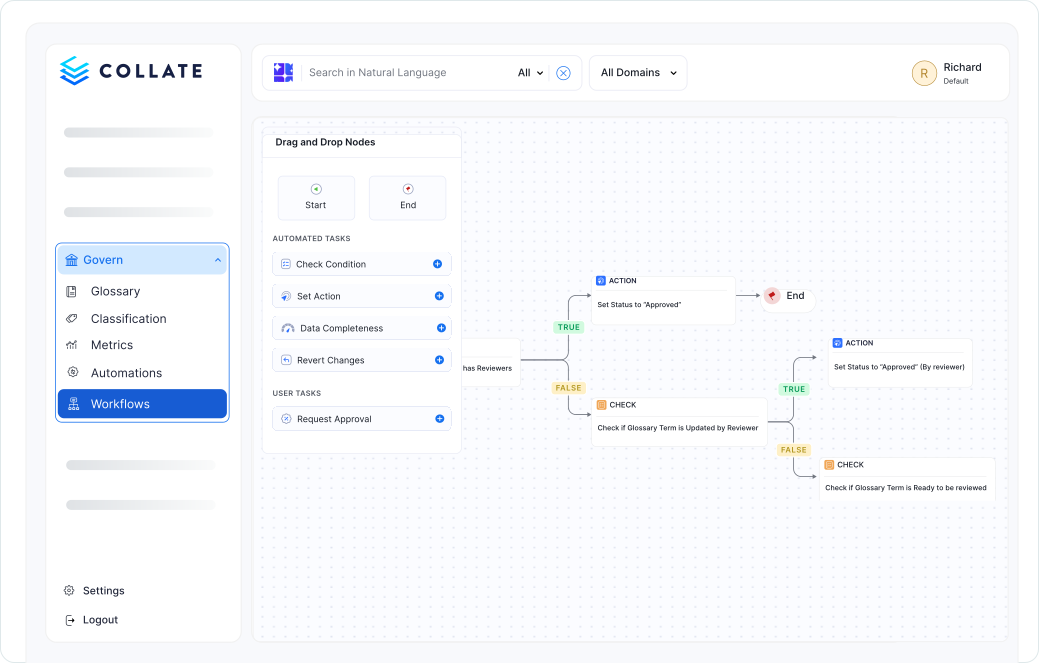
Drag-and-drop workflows with custom conditions, automated actions, and human approvals for consistent governance

Find Data That Drives Decisions
Bridge the gap between technical assets and business meaning
![[object Object]](/_next/image?url=%2Fimages%2Fdata-governance%2Fbusiness_glossary.svg&w=3840&q=75)
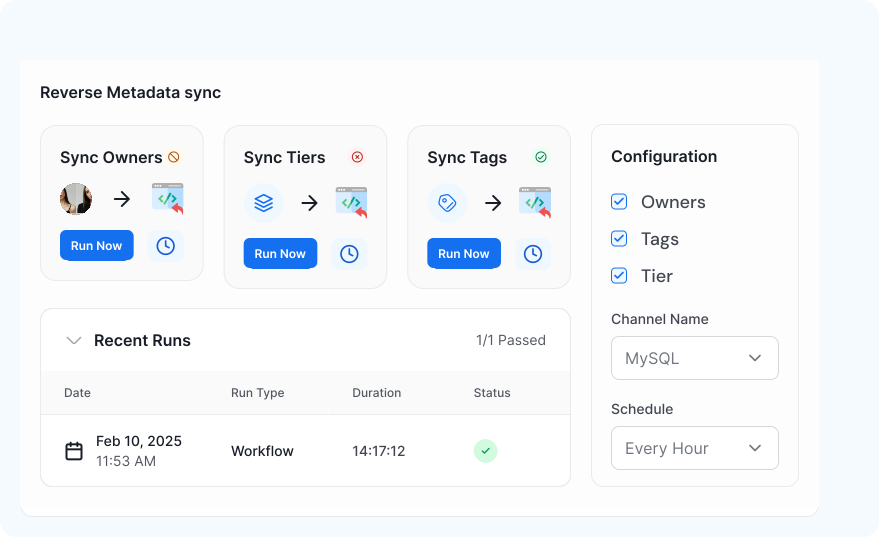
Push governance decisions from Collate® to source systems for automated and consistent policy enforcement
Empower Everyone in Your Data Ecosystem
Organize, secure, and open up your data to the right people
![[object Object]](/_next/image?url=%2Fimages%2Fdata-governance%2Fpersona_customization.svg&w=3840&q=75)
Governance That Scales With Your Organization
Automate governance workflows and track program impact over time
![[object Object]](/_next/image?url=%2Fimages%2Fdata-governance%2Fcustomizable_kpi_dashboards.svg&w=3840&q=75)
Built for modern data & AI practices
Designed for changing needs of data & AI teams
AI-Driven Automation
Improve productivity, enforce governance and reduce costs with AI driven automation
Unified Platform
One platform for all your teams for data discovery, observability and governance
Collaborate Around Data
Accelerate development of data assets with social workspaces and knowledge centers
Get started with Collate today for free
Get Collate FreeManaged Service for Production Data Teams
Book a DemoFAQs
The Custom Governance Workflow Builder lets you design governance processes using a drag-and-drop, no-code interface built on BPMN standards. You can create multi-stage workflows with condition checks (validate tags, ownership, metadata completeness), automated actions (apply tiers, assign owners, add certifications), and human approval gates with configurable consensus thresholds.
Workflows can trigger automatically when data assets change, run on a schedule, or be launched on demand. Every action is logged in a full audit trail for compliance.
Data Certification and Glossary Approval Workflows are both built on this same engine, so the logic you define is composable and consistent across your governance program.
Collate uses ML models and AI agents to automatically detect and tag PII and other sensitive data at the column level during profiling. Tags can be auto-applied or surfaced as suggestions for human review. Your team controls the threshold.
Two detection methods run in combination: column name pattern matching (using regex against a library of common sensitive data structures) and entity recognition against actual column values via Microsoft Presidio. You can also define custom classification taxonomies, use tiers to indicate business criticality, and bulk-apply tags to assets via metadata automations or lineage propagation.
Lineage Propagation automatically flows metadata (tags, descriptions, glossary terms, ownership, and tiers) from upstream data assets to downstream ones based on your data lineage graph.
It is useful when you want a tag applied at the source table to automatically appear on all derived tables, reports, and dashboards without manual updates. You can configure propagation depth, set stop conditions at specific boundaries, and run it on a schedule or on demand.
When a new glossary term is created, it enters a Draft state and can be submitted for review. Collate routes it to designated reviewers, who can approve or reject with comments. You can configure multi-stage approvals, require multiple approvers, and set automatic re-review triggers when a term is updated after approval.
The entire process is built on the Custom Governance Workflow Builder, so you can customize the approval logic to match your organization's terminology governance process.
Yes. Reverse Metadata Sync lets you push tags, descriptions, and ownership from Collate back to your source systems including Snowflake, BigQuery, Databricks, Redshift, and more. This enables centralized policy management in Collate that automatically enforces at the source.
A common use case: tag a column as PII in Collate, and Snowflake's masking policy automatically enforces access controls at the source with no manual coordination required.
The Business Glossary is where your organization defines, manages, and governs shared business terminology with terms like 'revenue,' 'active customer,' or 'churn rate,' along with their definitions, synonyms, related terms, and owners.
Glossary terms link directly to data assets through the semantic metadata graph. When an asset is tagged with a glossary term, that relationship propagates through lineage, appears in search results, and is available to AI agents querying the platform. This means the definition your governance team maintains in the glossary is the same definition driving analytics and AI outputs downstream.
Collate's RBAC controls let administrators define roles with specific permissions for reading, editing, and acting on data assets. Permissions apply at the platform, domain, and asset level, so you can give a data steward edit access to a specific domain without granting broader rights across the platform.
Search results are also permission-scoped, so users only see assets they are authorized to access. This makes self-service discovery practical in environments where not everyone should have visibility into all data.
Data Contracts are formal agreements between data producers and data consumers that define what a dataset should look like, e.g., its schema, freshness expectations, and quality commitments. When those expectations break, Collate triggers an alert automatically.
They are useful when downstream teams depend on data from another team and need a reliable way to be notified of breaking changes before they affect pipelines or reports. Contracts connect directly to lineage and quality monitoring rather than existing as a separate document outside the system.
Persona Customization lets administrators configure tailored landing pages, navigation, and search results for different types of users, so that data engineers, business analysts, data stewards, and executives each see a view of the platform relevant to their role.
This matters for governance because adoption often fails when a platform feels like it was built for one type of user and is hard to navigate for everyone else. By surfacing the right assets and actions for each persona, Collate reduces friction for non-technical users without simplifying the experience for power users.
Governance in Collate is not just documentation, it is machine-readable infrastructure that AI agents can operate on. Classification tags, business glossary terms, lineage, ownership, and quality signals are all encoded in the semantic metadata graph, which means AI agents querying the platform inherit the same governed understanding of data that your human teams use.
Practically, this means an AI agent generating SQL will resolve the governed definition of 'revenue' before generating a query, rather than guessing from column names. It also means classification tags applied in Collate propagate to downstream systems automatically, so AI workflows do not bypass the policies your governance team has defined.