
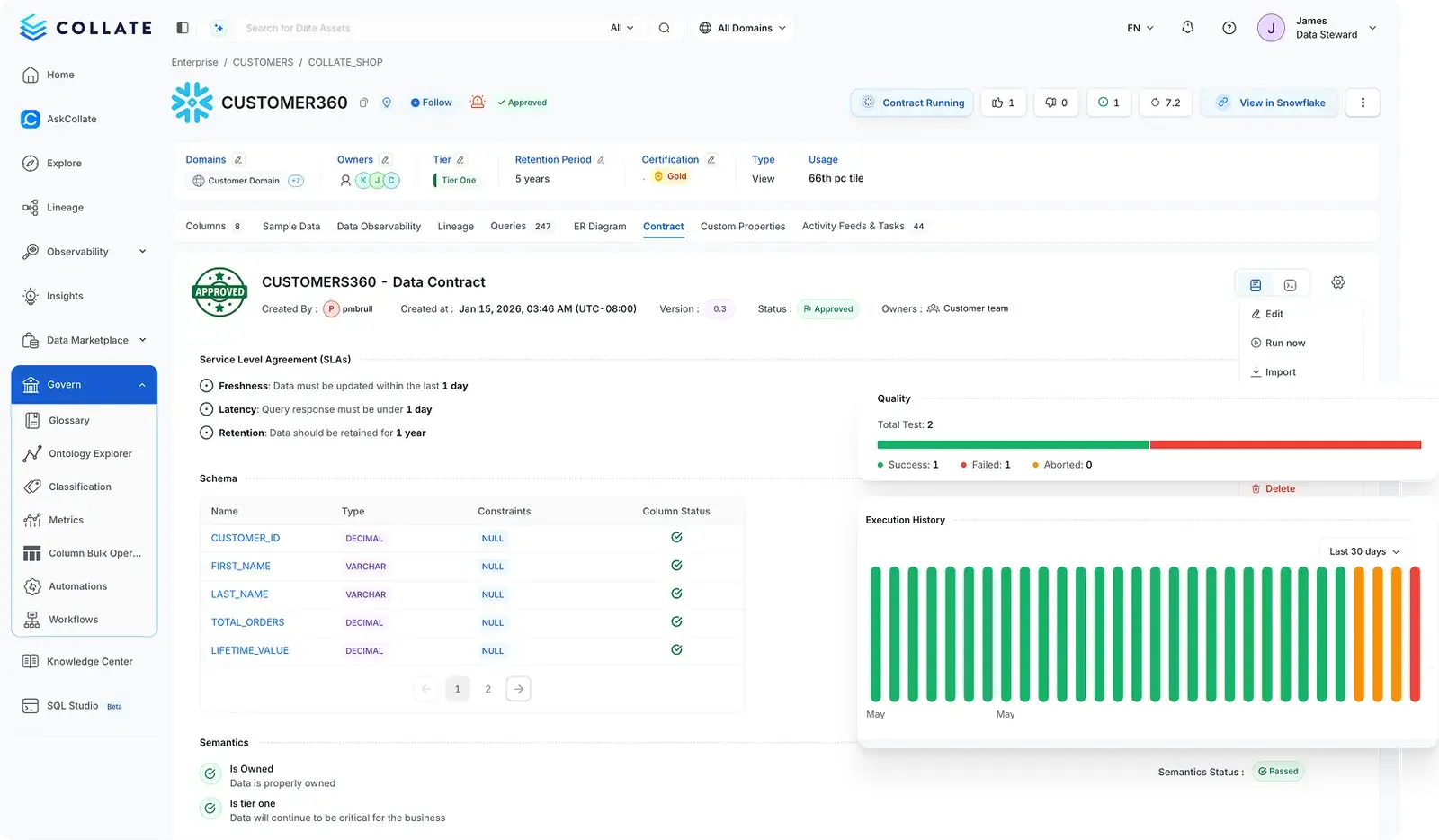


Prevent late night production fires
Catch breaking schema, quality, and SLA changes before they reach production

Contracts for your whole team
Technical users work in YAML, business users in no-code UI, on the same contract

Open standard portability
Import and export contracts in Open Data Contract Standard (ODCS) 3.1, no lock-in
Prevent late night production fires
Validated continuously against your live data with no extra infrastructure
![[object Object]](/_next/image?url=%2Fimages%2Fdata-contracts%2Fcatch-breaks-before-they-reach-you.png&w=3840&q=75)
Contracts for your whole team
YAML for engineers, no-code UI for everyone else, on one shared contract
![[object Object]](/_next/image?url=%2Fimages%2Fdata-contracts%2Fdefine-once-agree-as-a-team.png&w=3840&q=75)
Open standard portability
Built on ODCS 3.1 and ready to extend from tables to your whole platform
![[object Object]](/_next/image?url=%2Fimages%2Fdata-contracts%2Fopen-standard-across-your-estate.png&w=3840&q=75)
Built for modern data & AI practices
Designed for changing needs of data & AI teams
AI-Driven Automation
Improve productivity, enforce governance and reduce costs with AI driven automation
Unified Platform
One platform for all your teams for data discovery, observability and governance
Collaborate Around Data
Accelerate development of data assets with social workspaces and knowledge centers
Get started with Collate today for free
Get Collate FreeManaged Service for Production Data Teams
Book a DemoFAQs
A data contract is a formal, versioned agreement about what a data asset will deliver: its schema, semantics, quality, SLAs, security, and terms of use. In Collate, a contract is not a static document. It is a tracked object validated continuously against your live data, so producers and consumers share one enforceable definition instead of an informal assumption.
Most tools force a choice between technical rigor and business accessibility. YAML-only tools exclude the domain experts who understand what data should mean. Editable documents include everyone but have no enforcement mechanism. Collate closes both gaps: engineers work in YAML while business users work in the no-code UI, on the same contract. And every contract is continuously validated against live data, so it actively catches violations instead of sitting in a wiki as static documentation.
Any Collate user can draft a contract. Engineers use YAML or the REST API and Python and Java SDKs, and domain experts and analysts use the no-code UI. Both paths edit the same contract, share one validation history, and produce one enforcement record.
Before a contract goes into enforcement, it goes through the same approval workflow and review process used for glossary terms. This ensures contracts carry real sign-off from the teams accountable for the data. Approvers are configured per domain or asset type, keeping governance consistent without centralizing every decision through a single team.
When a quality test fails or the schema is improperly modified, Collate marks the contract as violated, automatically opens an incident, and notifies owners through their existing channels: Slack, Teams, email, or webhooks. Stakeholders get context on what broke and which downstream assets are affected, so a violation becomes a fast fix instead of a 2 a.m. surprise.
Contracts start with tables, where Collate validates schema, quality, and semantics in full. Semantics and schema rules also extend to topics, API endpoints, and dashboard data models. Semantics rules reach across dashboards, charts, pipelines, ML models, containers, and more. Coverage continues to expand release over release.
Contracts also apply at the data product level. When a data product has a contract, every asset inside it inherits the contract's semantics, SLA, terms of use, and security rules. An individual asset can still carry its own contract, which takes precedence over the inherited one, making contracts a natural fit for a data mesh, where guarantees follow the domain.
Yes. Collate imports and exports contracts in ODCS version 3.1, in both JSON and YAML, with smart-merge and full-replace modes. Collate's contract model is a superset of ODCS 3.1, so you can export in portable ODCS format for use across tools or in native format to keep the extra detail Collate captures.
Data contracts are built on top of native Collate Data Quality capabilities, not a separate engine. When you add quality assertions to a contract, you select from the same test framework used everywhere else in Collate: uniqueness, null checks, referential integrity, and custom business rules. Results appear in the same dashboards, and a failing test escalates straight to the contract.
When a contract is violated, Collate uses lineage to show which downstream assets are affected, such as dashboards, pipelines, ML models, and other tables that depend on the breached asset. This means stakeholders don't just learn that something broke; they see what's at risk. Platform teams can prioritize resolution based on actual downstream impact rather than guessing which consumers matter most.