

Question to Dashboard in Minutes
Turn plain-English questions into governed charts grounded in your semantic context

Transparent AI Reasoning
Review every step the AI took before you trust the result

Dashboards That Stay Current
Pin answers, schedule refresh, and email reports to any distribution list
Ask in plain English, get governed answers
Natural language analytics grounded in your semantic context
![[object Object]](/_next/image?url=%2Fimages%2Fai-analytics%2Fask-in-plain-english.webp&w=3840&q=75)
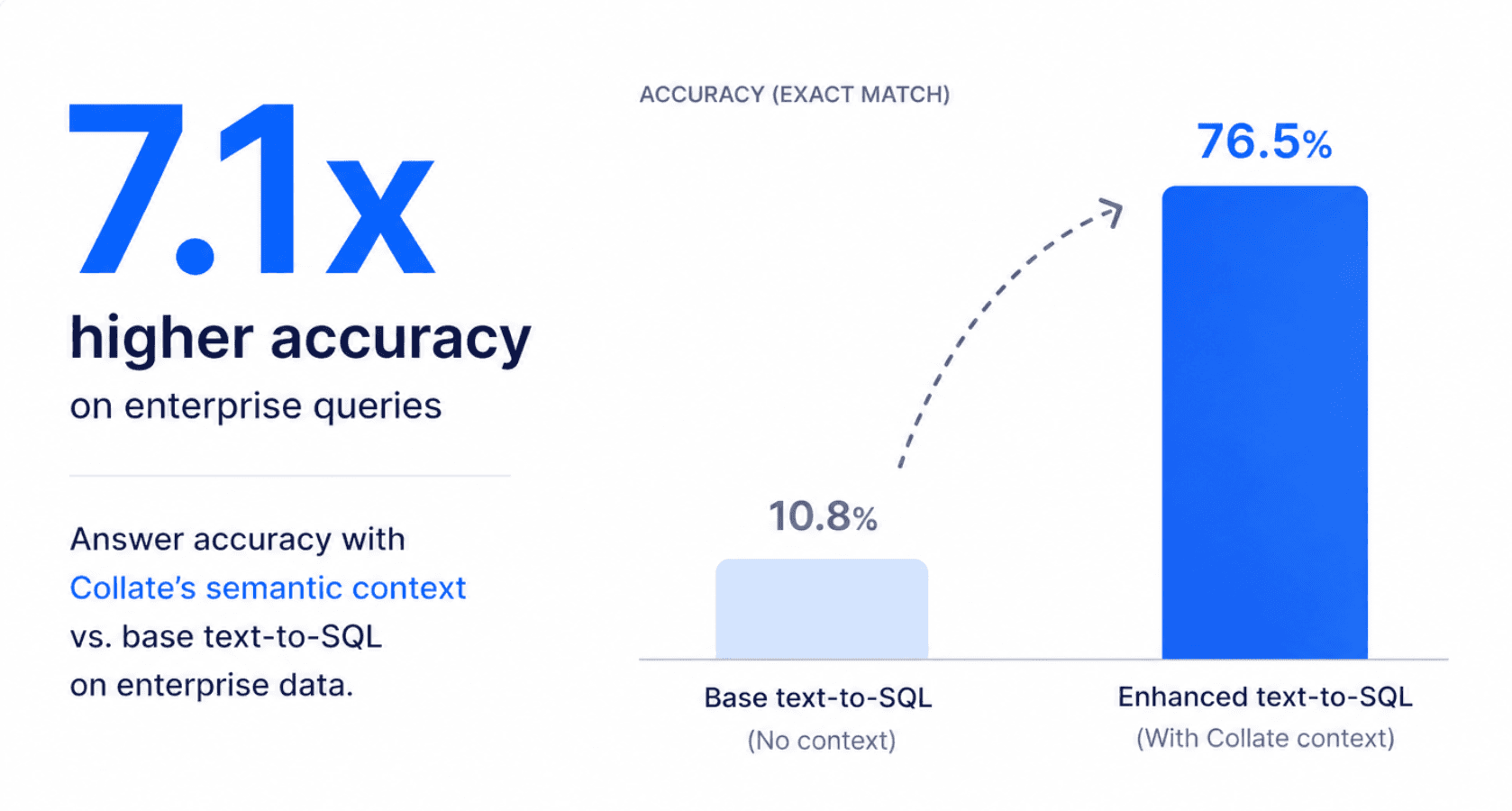
Collate's Semantic Context Graph transforms accuracy on Spider 2.0-Snow from 10.8% to 76.5% — the foundation grounding Collate AI Analytics.
Read the benchmark
See every reasoning step before you act
Full transparency from question to chart to underlying SQL
![[object Object]](/_next/image?url=%2Fimages%2Fai-analytics%2Fsee-every-reasoning-step.webp&w=3840&q=75)
Pin, schedule, and share with your team
Turn any answer into a persistent asset your team returns to weekly
![[object Object]](/_next/image?url=%2Fimages%2Fai-analytics%2Fpin-schedule-share.webp&w=3840&q=75)
Built for modern data & AI practices
Designed for changing needs of data & AI teams
AI-Driven Automation
Improve productivity, enforce governance and reduce costs with AI driven automation
Unified Platform
One platform for all your teams for data discovery, observability and governance
Collaborate Around Data
Accelerate development of data assets with social workspaces and knowledge centers
Get started with Collate today for free
Get Collate FreeManaged Service for Production Data Teams
Book a DemoFAQs
Collate AI Analytics is an AI data analyst native to the Collate platform. Ask a question in plain English, and the AI finds the right data, creates the correct SQL query by applying your governed metric definitions and business vocabulary, and returns a chart with a written summary of the findings. Results can be pinned to shared dashboards, scheduled to refresh automatically, and emailed to distribution lists, all without leaving Collate.
Most AI analytics tools query your schema and infer meaning from column names. AI Analytics is grounded in the governed semantic context your team already maintains in Collate: metric definitions, glossary terms, classifications, and table lineage. That means results use your company's standard business vocabulary. Every reasoning step is also visible in the reasoning trace before any result is acted on. This results in high quality and more trustworthy results, dashboards, and analytics.
No. AI Analytics is designed for business analysts and data consumers who need answers without writing queries. You type a question in plain English, and the AI handles table selection, query construction, and visualization. If you want to inspect the SQL, it is always visible in the SQL view, but you never need to write it yourself.
AI Analytics is rooted in the semantic context that powers Collate. Every answer is cross-checked against profiler data, lineage, quality results, and related assets, and the AI preferentially selects Tier 1 or Gold Certified tables when available. On top of that, the reasoning trace shows every step (tables searched, definitions applied, query logic) and the chart, data, and SQL audit views let you inspect the result at any layer.
Yes. Any answer can be pinned to a persistent shared dashboard that your team can access, return to, and build on. You can also schedule dashboards to refresh on a cadence you set, and send formatted reports by email to any distribution list directly from Collate. The system resolves team members automatically.
AI Analytics works with any data source connected to your Collate platform, with over 130 native connectors including Snowflake, Databricks, Redshift, BigQuery, and more. Any table that is cataloged and governed in Collate is available for analysis.
AskCollate is Collate's conversational AI interface for discovery, governance, and data management. AI Analytics is the analytics-focused capability under the Collate AI umbrella: natural language to governed dashboard with charting, pinning, scheduling, and email delivery.
You can ask data questions ("What is revenue by customer tier this quarter?"), governance questions ("Which Tier 1 tables have failing quality tests?"), and coverage questions ("What percentage of tables in the Finance domain have owners assigned?"). AI Analytics works across all asset types in your catalog: tables, dashboards, data products, glossary terms, and more. AI Analytics understands both your data and your metadata, to answer all these different types of questions.
Collate AI Analytics is not a BI replacement. It is the exploration layer that comes before BI. You discover what is worth operationalizing, validate metric definitions, and confirm query logic. When an analysis is ready for production, the hard discovery work is already done and the pipeline gets built faster. Traditional BI tools require data engineering to build and certify data sources first; AI Analytics requires none of that upfront work because the semantic context graph is already there.
AI Analytics operates entirely within your existing security boundaries. At the metadata level, it respects Collate's role-based access controls (RBAC) so it can only surface assets the user is already permitted to see. At the data level, when querying underlying sources, it impersonates the user's own credentials rather than running under elevated service permissions. Existing data access controls remain fully in effect. No user can query data through AI Analytics that they could not access directly. Data-level access is enabled only when explicitly permitted by a service administrator.