Best Data Lineage Solution for Regulatory Reporting: Top 7 in 2026
What Are Data Lineage Solutions?
Data lineage solutions are tools and platforms that map, visualize, and track the flow of data throughout its lifecycle in an organization. They provide a comprehensive view of how data moves from its sources, through various transformations, and ultimately to its destinations.
By documenting each step, data lineage solutions help organizations understand the origins, transformations, and usage of their data, offering clarity on how data is processed and used across different systems. They are useful in modern data ecosystems, where data often passes through numerous applications, databases, and processing layers.
The complexity of these environments makes manual tracking impractical and error-prone. Data lineage solutions automate the capture and representation of data flows, making it easier for organizations to maintain transparency, trace errors, and quickly respond to data quality issues or regulatory inquiries.
This is part of a series of articles about data lineage.
Regulations Requiring Data Lineage
Several regulations require organizations to demonstrate where data comes from, how it changes, and how it is used. These rules focus on auditability, transparency, and data quality. Data lineage helps meet these requirements by providing a traceable record of data movement and transformation across systems.
- In financial services, BCBS 239 (Basel Committee on Banking Supervision) requires banks to ensure strong risk data aggregation and reporting. This includes clear visibility into data sources and transformations. Similarly, the Sarbanes-Oxley Act (SOX) requires controls over financial reporting, where data lineage supports audit trails and validation of reported figures.
- In healthcare, HIPAA mandates strict controls over patient data. Organizations must show how sensitive data is accessed, processed, and shared. Data lineage helps track this flow and supports compliance during audits or breach investigations.
- Data privacy regulations such as GDPR and CCPA/CPRA also rely on data traceability. Organizations must be able to identify where personal data originates, how it is processed, and where it is stored or shared. This is essential for handling data subject requests, such as deletion or access requests.
- Other frameworks, such as Solvency II in insurance and FDA 21 CFR Part 11 in life sciences, also require data traceability and integrity. In all these cases, data lineage solutions reduce manual effort and provide a reliable way to document and verify data flows.
Why Data Lineage Is Essential in Ensuring Compliance and Reducing Risk
Data lineage helps organizations prove where data comes from, how it changes, and where it is used. This visibility is required to meet regulatory requirements and limit operational and legal risks:
- Supports regulatory compliance: Tracks data from source to destination, which helps meet requirements from regulations such as GDPR, HIPAA, and CCPA. Auditors can verify how sensitive data is collected, processed, and stored.
- Improves audit readiness: Provides a clear record of data flows and transformations.
- Enhances data transparency: Makes it easier to understand how data moves across systems.
- Reduces risk of data errors: Helps trace the root cause of data quality issues.
- Strengthens data governance: Supports enforcement of data policies by showing how data is handled.
- Enables impact analysis: Shows how changes to one dataset or system affect others.
- Protects sensitive data: Identifies where sensitive data flows and where controls are needed.
- Builds trust in data: Clear lineage increases confidence in data accuracy and reliability.
Key Features of Data Lineage Solution for Regulatory Reporting
1. End-to-End Data Traceability
End-to-end data traceability allows organizations to visualize the lifecycle of their data, from initial ingestion to final reporting or storage. This capability ensures that every data movement and transformation is documented, making it possible to trace the origin of any data element used in regulatory reports. With this visibility, organizations can validate the accuracy and integrity of their reporting outputs.
Traceability also supports impact analysis when changes are made to data sources or processing logic. By understanding how data flows through the system, teams can assess the downstream effects of any modification, reducing the risk of unintended consequences in regulatory submissions.
2. Column-Level (Granular) Lineage
Column-level lineage provides tracking of data at a granular level, capturing how individual fields or columns are derived, transformed, and used. This granularity is important for regulatory reporting, where specific data attributes often require justification or auditability. By mapping each column's lineage, organizations can demonstrate how reported figures are calculated and which data sources contribute to them.
Detailed lineage also supports troubleshooting and root cause analysis. When discrepancies or errors are identified in reports, column-level lineage allows data teams to pinpoint the transformation or data source responsible.
3. Automated Lineage Discovery and Mapping
Automated lineage discovery uses algorithms and system integrations to detect data flows and transformations without manual intervention. This automation saves time in large-scale environments with complex data pipelines. Automated mapping keeps lineage up to date, reflecting changes in data sources, processing logic, and reporting outputs.
Automated lineage capture reduces the risk of human error and gaps in documentation. By monitoring systems and updating lineage diagrams, organizations can maintain an accurate view of their data landscape.
4. Integrated Data Quality Evidence on Lineage
This feature links data quality metrics directly to lineage flows. It shows validation rules, test results, and quality scores at each step in the pipeline. Users can see where data passed or failed checks, and how those results affect downstream datasets and reports.
By embedding quality evidence into lineage, teams can prove that controls are applied consistently. It also speeds up root cause analysis. When a report is incorrect, users can trace back through the lineage and identify where quality checks failed or were missing.
5. Business Glossary and Regulatory Term Mapping
A business glossary defines standard terms used across the organization, such as “customer,” “exposure,” or “net revenue.” Data lineage solutions link these terms to physical data assets, such as tables and columns. This mapping ensures that everyone interprets data consistently.
Regulatory term mapping extends this by aligning internal data elements with regulatory definitions. For example, a field used in a capital adequacy report can be tied to the exact regulatory requirement. This helps demonstrate that reported values are calculated using approved definitions and supports audit and compliance reviews.
6. Metadata Management Integration
Integration with metadata management systems allows data lineage solutions to use contextual information about data assets, such as data definitions, ownership, and quality metrics. This integration enriches lineage diagrams with business and technical metadata, making them more informative for different stakeholders.
By connecting lineage with metadata management, organizations can link data flows to data policies, classifications, and compliance requirements. This alignment helps enforce governance standards, track data usage, and ensure that regulatory reporting is based on documented data assets.
7. Governance Workflows, Audit Trails and Compliance Reporting
Governance workflows allow organizations to manage changes to data pipelines, lineage, and metadata in a controlled way. This includes approvals, versioning, and role-based access. Changes to data logic or mappings can be reviewed and validated before they are applied.
Audit trails record all actions taken within the lineage system, such as updates to transformations, data definitions, or access permissions. These logs provide a history of who changed what and when. Compliance reporting uses this information to generate evidence for audits, showing that proper controls and processes are in place.
Evaluating a Solution for Your Regulatory Environment
Evaluating a data lineage solution requires a clear understanding of regulatory needs, data complexity, and existing architecture. Not all tools provide the same depth of lineage, automation, or governance support. The right choice depends on how well the solution can align with compliance requirements while fitting into current data workflows:
- Regulatory coverage and alignment: Check if the solution supports specific regulations relevant to your industry, such as BCBS 239, GDPR, or HIPAA. It should allow mapping between data flows and regulatory requirements.
- Depth of lineage (table vs. column level): Ensure the tool provides column-level lineage if detailed traceability is required for audits and reporting validation.
- Automation capabilities: Look for automated lineage discovery and updates. Manual lineage tracking does not scale and often leads to gaps.
- Integration with existing systems: The solution should connect easily with your data sources, ETL pipelines, BI tools, and metadata platforms without heavy customization.
- Data quality and governance support: Evaluate whether the tool links lineage with data quality checks, policies, and governance workflows.
- Scalability and performance: It should handle large volumes of data and complex pipelines without performance issues.
- Auditability and reporting features: Built-in audit trails and compliance reporting are important for demonstrating control during regulatory reviews.
- User accessibility and usability: Both technical and business users should be able to navigate lineage views and understand data flows without deep technical knowledge.
- Security and access control: The solution must support role-based access and protect sensitive metadata and lineage information.
- Vendor support and roadmap: Consider the maturity of the vendor, support quality, and how the product is evolving to meet new regulatory and technical demands.
Notable Data Lineage Solution for Regulatory Reporting
Modern Metadata and Lineage Platforms
1. OpenMetadata

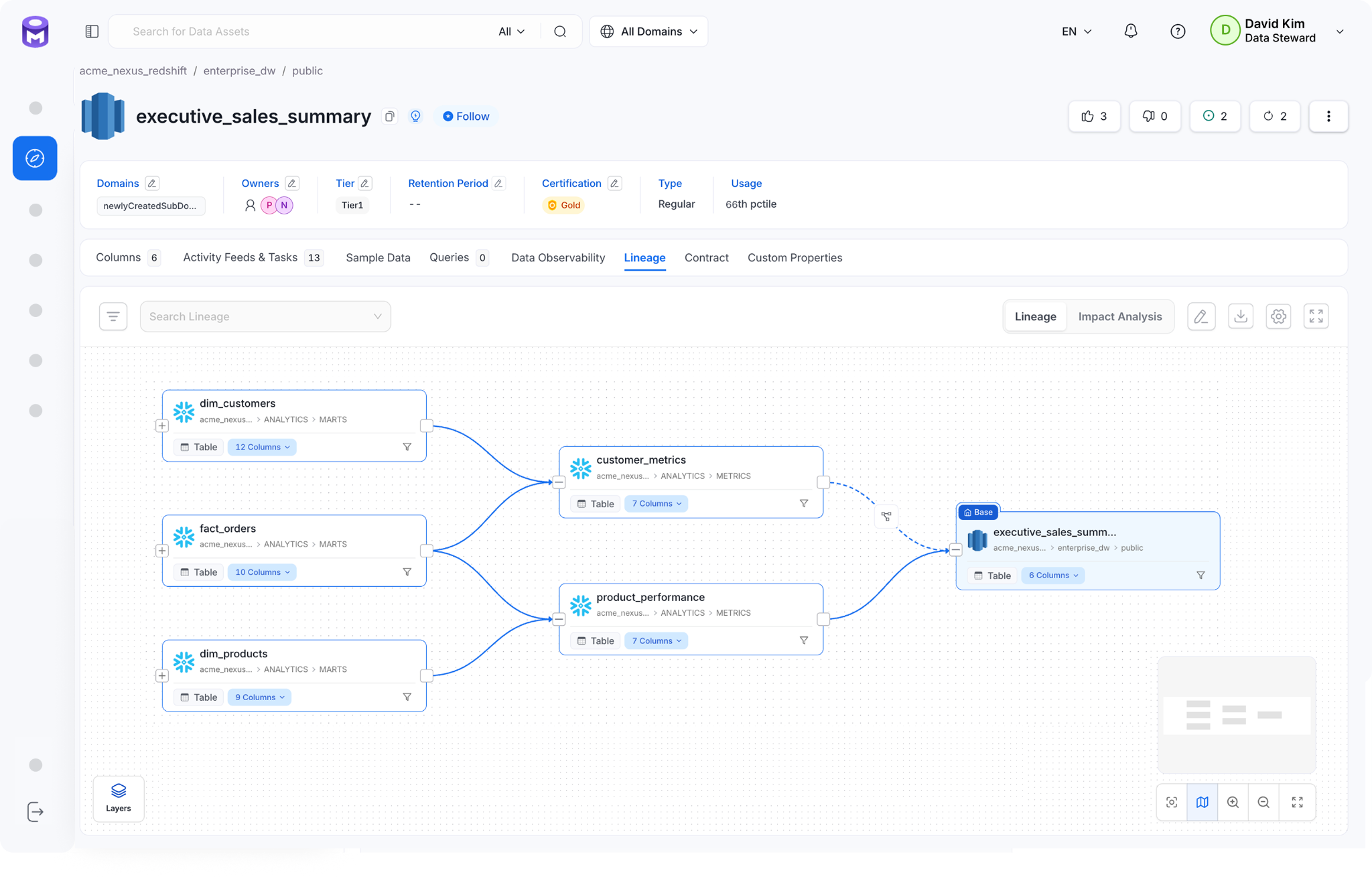
OpenMetadata is an open context layer 4,000+ enterprises run on, with data lineage at its core. It automatically reconstructs end-to-end and column-level lineage by parsing SQL, pipelines, dbt, and BI tools, rendering it as an interactive graph tied to governance context. For regimes like BCBS 239, SOX, and GDPR, this turns lineage into auditable evidence of data provenance. Collate is the managed, enterprise-grade version of this open source project.
General features include:
- Column-level lineage: Traces how individual columns are derived, joined, and transformed for field-level audit trails
- Automated SQL parsing: Reconstructs lineage from query history, ETL/ELT jobs, and dbt models without manual mapping
- End-to-end coverage: Connects sources, warehouses, transformation layers, and BI tools through 130+ connectors
- Interactive lineage graph: Visualizes upstream and downstream dependencies with drill-down at table and column level
- Governance context: Links lineage to classifications, ownership, glossary terms, and data-quality signals
Features related to regulatory reporting include:
- Impact analysis: Shows every downstream report or model affected before a schema or logic change ships
- Classification propagation: Extends PII and sensitivity tags across dependent assets for compliance tracking
- Data contracts and quality: Ties lineage to contract enforcement and test results to prove data reliability
- Access control and masking: Enforces RBAC, SSO, and column masking to meet audit and privacy requirements
- Audit trails: Logs every change to lineage, definitions, and access with a who-changed-what-when history for compliance reviews
2. OpenLineage + Marquez

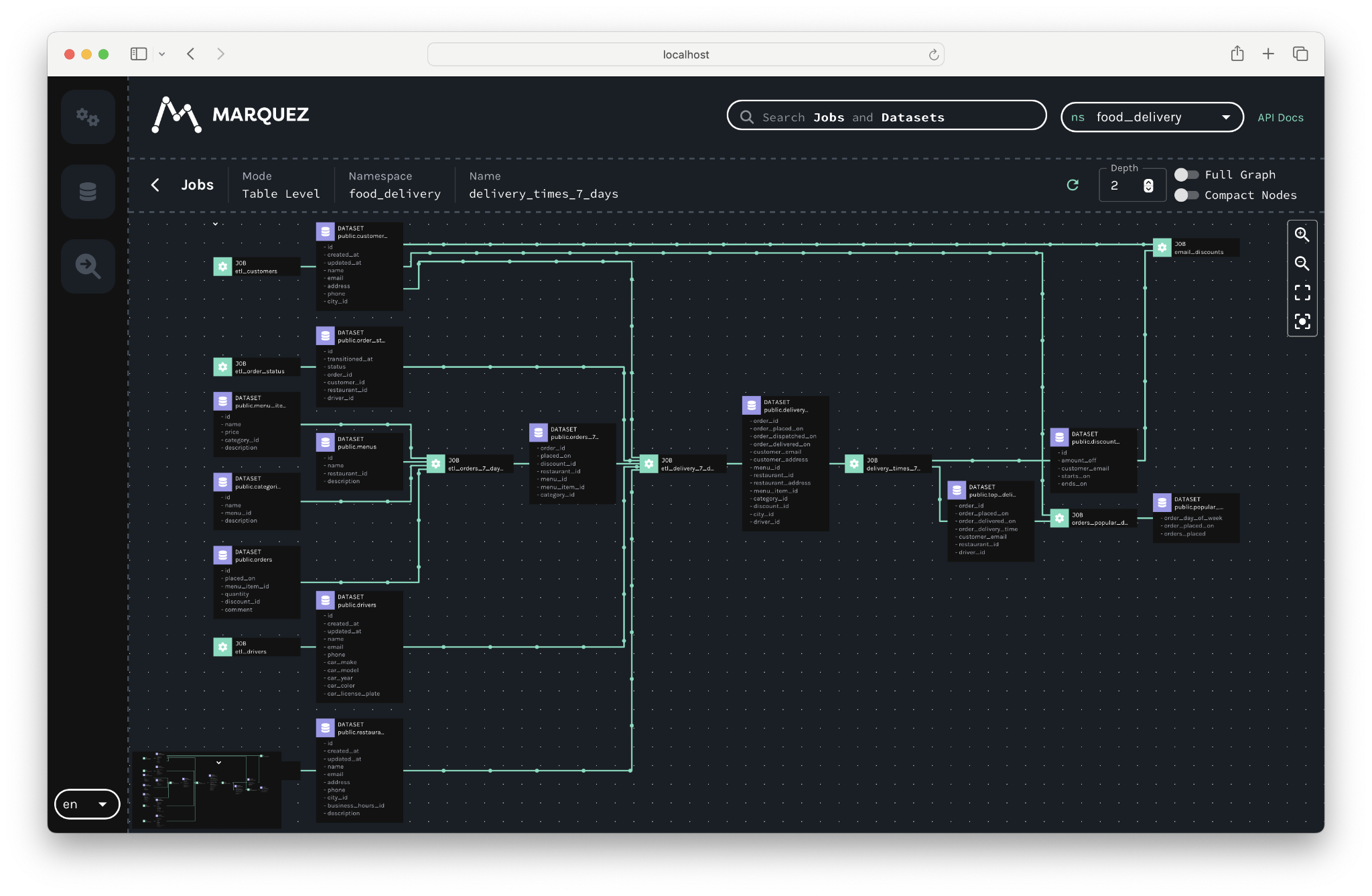
OpenLineage with Marquez provides an open framework for capturing and analyzing data lineage by collecting metadata from data processing systems and storing it in a centralized platform. Marquez ingests this metadata through OpenLineage-compatible APIs, organizes it in a repository, and exposes it through APIs and a web interface.
General features include:
- Centralized metadata repository: Stores information about datasets and jobs, including schemas, ownership, versions, and historical run data.
- Real-time metadata collection: Provides an OpenLineage-compatible API endpoint that captures lineage data from running jobs as they execute.
- Broad ecosystem integrations: Works with data processing and orchestration tools such as Apache Airflow, Apache Spark, Apache Flink, dbt, and Dagster.
- Interactive lineage visualization (UI): Offers a web-based interface that displays a unified graph of datasets and jobs.
- Flexible lineage query API: Enables programmatic access to lineage data, allowing users to traverse upstream and downstream dependencies.
Features related to regulatory reporting include:
- Lineage traceability across pipelines: Captures how datasets are created, transformed, and consumed across multiple jobs.
- Historical version tracking for auditability: Maintains versions of datasets and jobs, allowing teams to reconstruct past states of data.
- Time-ordered record of data changes: Records dataset updates and job execution events in sequence.
- Dependency mapping for impact analysis: Links upstream and downstream datasets and jobs.
- Queryable lineage for investigation and validation: Allows teams to query lineage data to trace reported values back to their origin.
3. Atlan Data Lineage
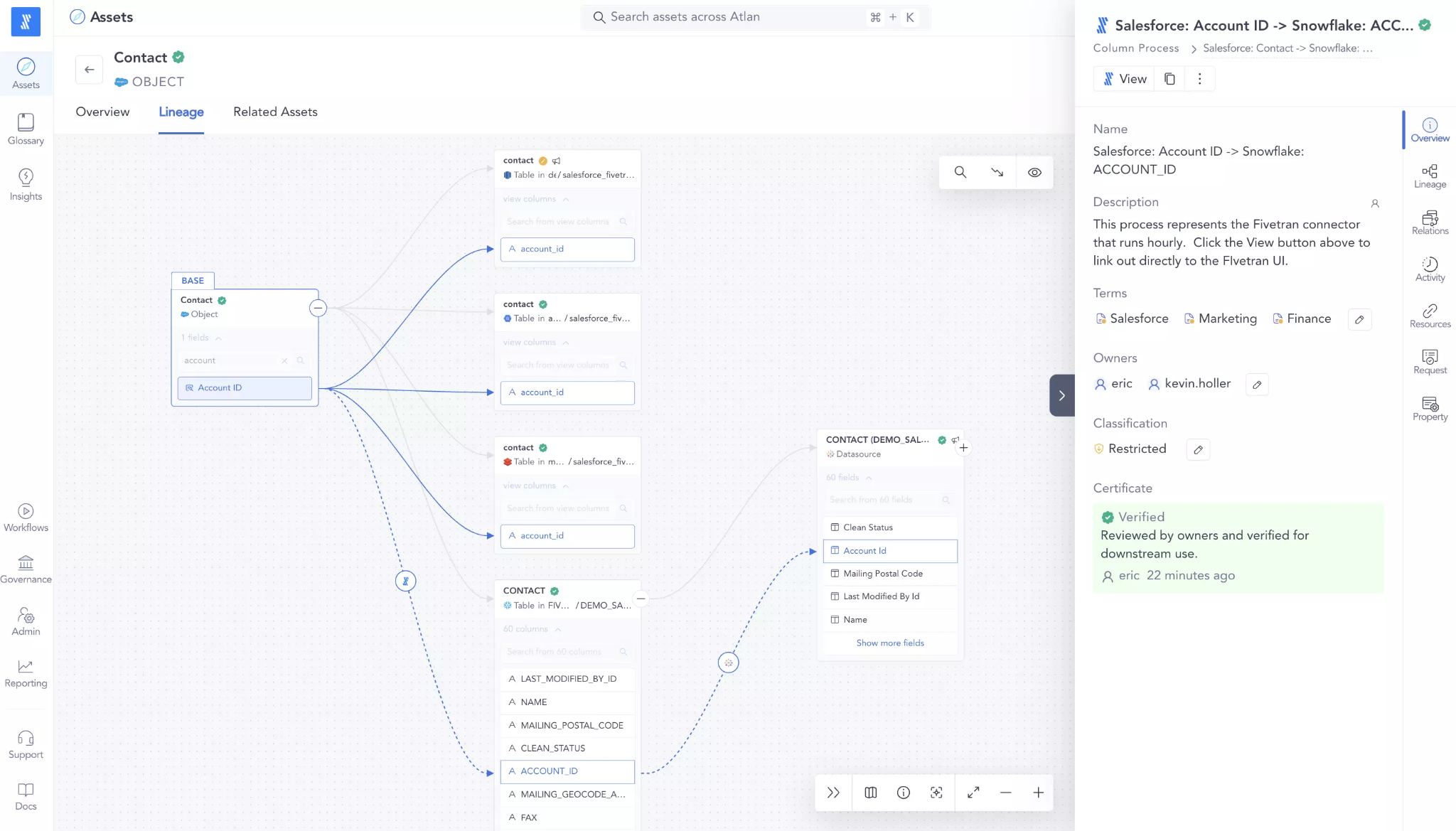
Atlan Data Lineage provides an automated view of how data moves and transforms across data stacks by reconstructing metadata across tools. It builds a lineage graph using SQL parsing, native integrations, OpenLineage events, and APIs to capture column-level provenance across more than 80 systems.
General features include:
- Column-level lineage across systems: Tracks data at the field level across 80+ tools.
- Automated SQL parsing: Processes SQL queries from systems like Snowflake, BigQuery, Redshift, and Databricks to extract transformation logic and reconstruct lineage relationships.
- Native tool integrations: Connects directly to data platforms and BI tools via APIs to capture metadata and dependencies.
- OpenLineage event ingestion: Consumes runtime lineage data from tools such as Airflow, Spark, dbt Cloud, and Astronomer.
- Unified lineage graph visualization: Builds a graph that links datasets, models, pipelines, and dashboards.
Features related to regulatory reporting include:
- Traceability to reporting outputs: Enables tracing of metrics from dashboards and reports back to source data.
- Column-level provenance for auditability: Provides visibility into how reporting fields are derived.
- Root cause analysis across lineage graph: Identifies upstream issues and traces their impact on downstream reports.
- Impact analysis before data changes: Shows the downstream impact of schema or logic changes.
- Data quality propagation: Links quality issues detected upstream to dependent datasets and reports.
 ### Enterprise Data Lineage Platforms
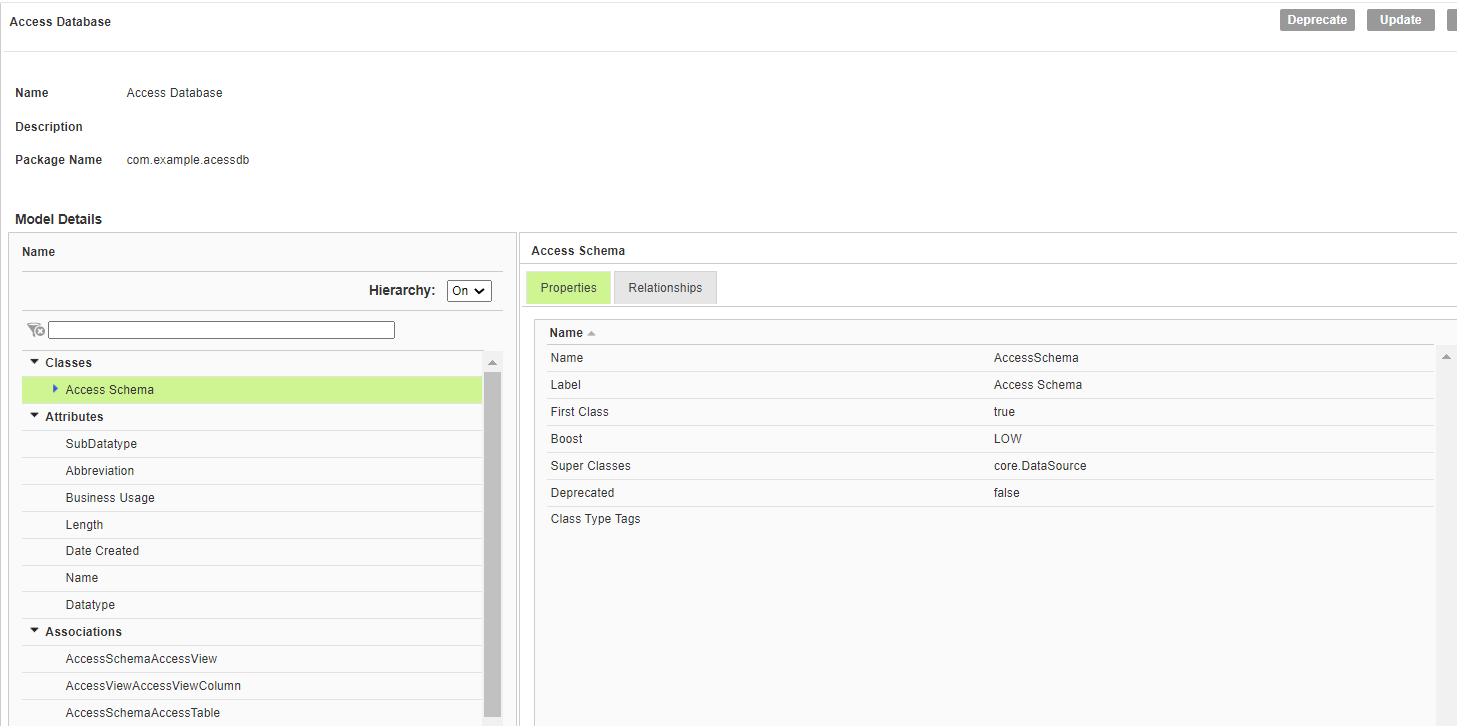
4. Informatica Metadata Management
Informatica Metadata Management, part of Intelligent Data Management Cloud (IDMC), collects, manages, and analyzes metadata across an organization’s data landscape. It aggregates metadata from cloud, on-premises, and hybrid systems into a centralized repository and enriches it using the CLAIRE engine.
General features include:
- Centralized metadata repository: Consolidates metadata from cloud platforms, databases, BI tools, ETL systems, and enterprise applications.
- Broad and deep metadata connectivity: Supports integration with sources including AWS, Azure, Google Cloud, Snowflake, Databricks, SAP, Salesforce, Tableau, and Power BI.
- Metadata management: Combines data cataloging, governance, data quality, lineage, profiling, and business glossary capabilities.
- AI-powered automation with CLAIRE engine: Uses AI and machine learning to automate data discovery, classification, and relationship mapping.
- Automated data classification and discovery: Provides classifications and identifies sensitive data and data domains.
Features related to regulatory reporting include:
- Lineage for compliance traceability: Tracks data movement from source systems through transformations to reporting layers.
- Granular (column-level) lineage for reporting fields: Captures how report attributes are derived.
- Automated sensitive data discovery and classification: Identifies regulated data such as PII and links it across lineage.
- Audit-ready metadata and lineage documentation: Maintains records of data flows and transformations.
- Data profiling to validate reporting data quality: Analyzes datasets to detect anomalies and completeness issues.
5. Collibra Data Lineage
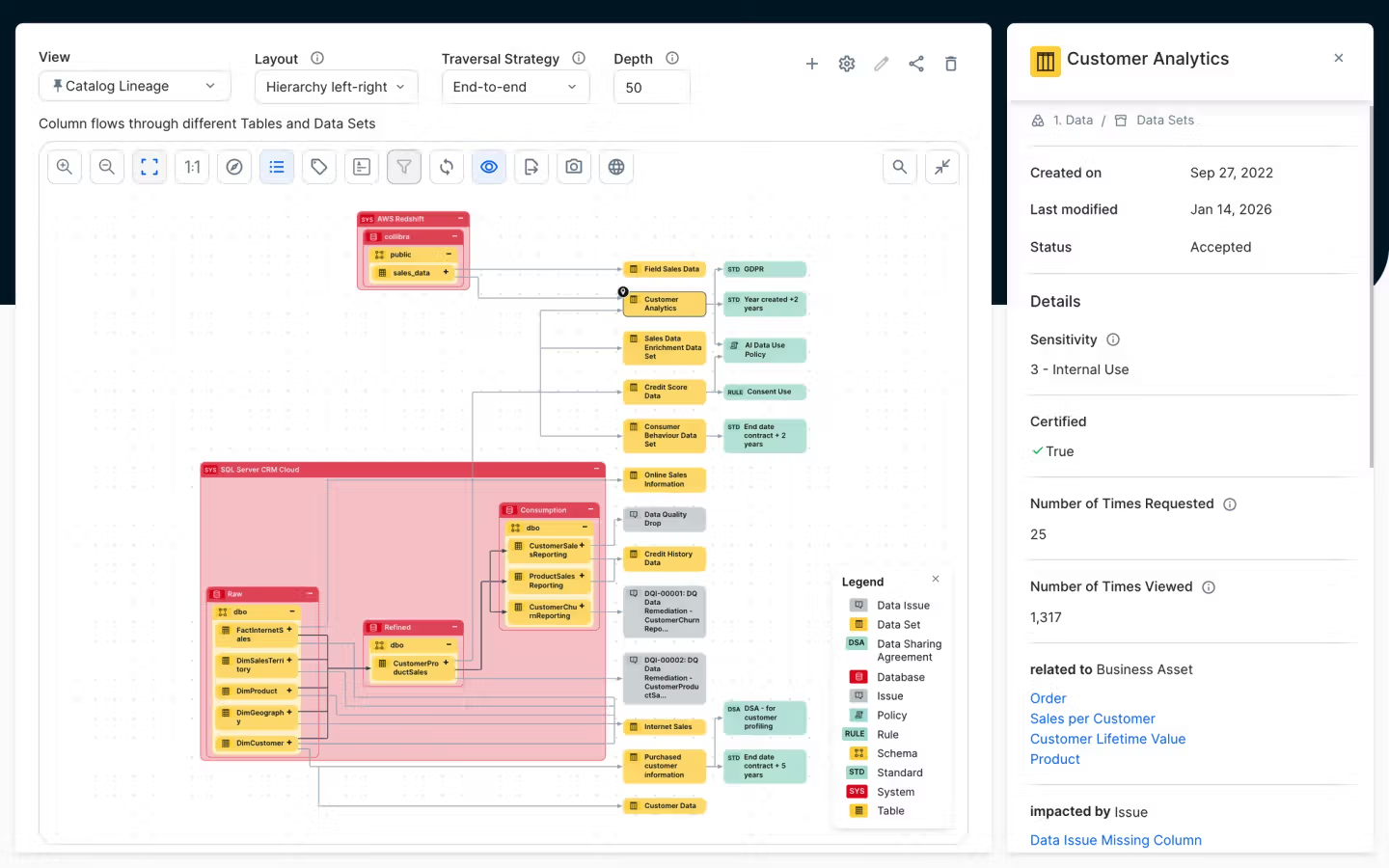
Collibra Data Lineage provides automated visibility into how data moves and transforms across an organization’s data ecosystem. It maps the lifecycle of data by capturing transformations, dependencies, and flows across sources, ETL processes, and BI tools. Using automated extraction and AI techniques, Collibra builds a unified lineage view that helps teams understand data context and trace issues.
General features include:
- End-to-end lineage visualization: Provides a visual map of data flows across systems.
- Automated lineage extraction: Captures lineage from data sources, ETL pipelines, and BI tools.
- AI-powered lineage mapping: Uses AI techniques to accelerate lineage discovery and mapping.
- Broad ecosystem integration: Supports integration with nearly 40 data sources, including SQL databases, ETL tools, and analytics platforms.
- Granular lineage visibility: Allows analysis at table, column, and report levels.
Features related to regulatory reporting include:
- Full data traceability for compliance: Tracks data across systems and processes.
- Visual audit trails for regulators: Provides visual evidence of data lineage, including transformations and access points.
- Verification of data integrity: Helps ensure that data used in regulatory reporting is accurate and consistent.
- Granular lineage for reporting elements: Enables tracing at column and report level.
- Sensitive data identification and tracking: Highlights where sensitive data resides and how it flows.
6. IBM Knowledge Catalog
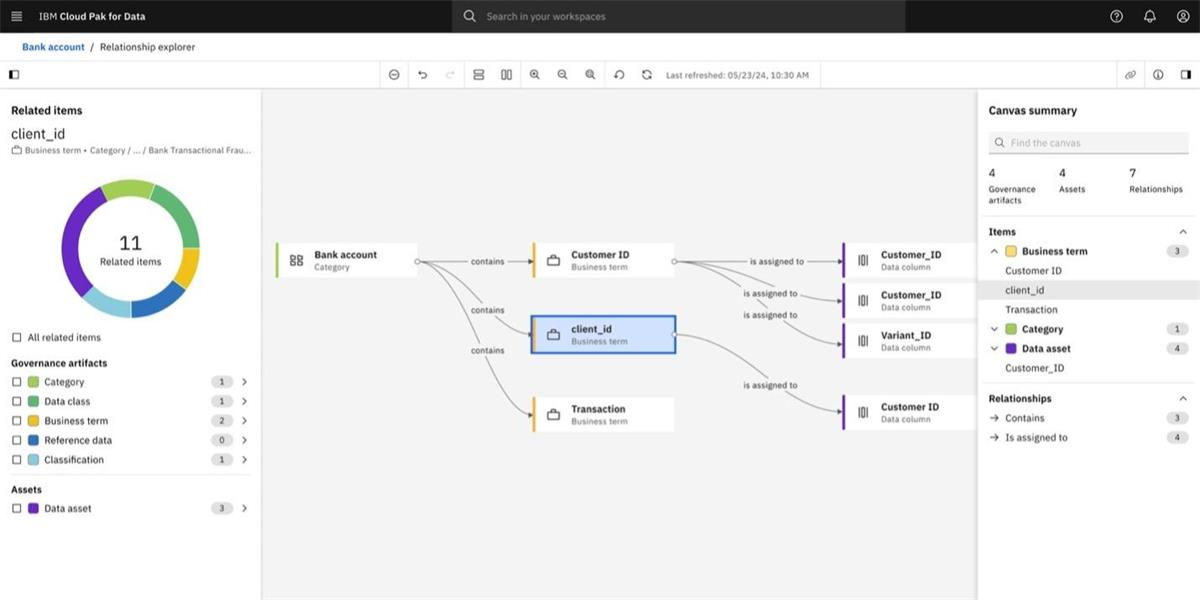
IBM Knowledge Catalog provides a governance-driven platform that connects users to data assets while enforcing policies for data quality, privacy, and compliance. It centralizes metadata, enriches it with business context using AI, and organizes it into governed catalogs that enable secure data access and collaboration.
General features include:
- Centralized data catalog with governance framework: Manages data assets with governance artifacts such as business terms, classifications, and policies.
- AI-augmented metadata enrichment: Uses pretrained and fine-tuned models to generate descriptions and assign business terms.
- Governance artifact management: Supports creation and management of business terms, data classes, and classifications with approval workflows.
- Role-based access and collaboration: Enables controlled access to data assets through catalog roles.
- Integrated data quality management: Defines and enforces data quality rules and SLAs with automated monitoring.
Features related to regulatory reporting include:
- Governed data access for compliance: Ensures that only authorized users can access regulated data through role-based controls.
- Automated data classification and policy alignment: Aligns data with business terms and regulatory classifications.
- Data quality monitoring for reporting accuracy: Monitors data quality using rules and SLAs.
- Audit-ready governance workflows: Maintains approval workflows and governance artifacts.
- Sensitive data protection and masking: Applies masking policies to protect confidential data.
7. Alation Data Lineage

Alation Data Lineage is part of the Alation data intelligence platform, which combines cataloging, governance, and metadata management capabilities. It provides visibility into how data moves across systems by showing relationships, dependencies, and data flows. The platform uses an active metadata graph and integrates with various tools to give users a connected view of data assets.
General features include:
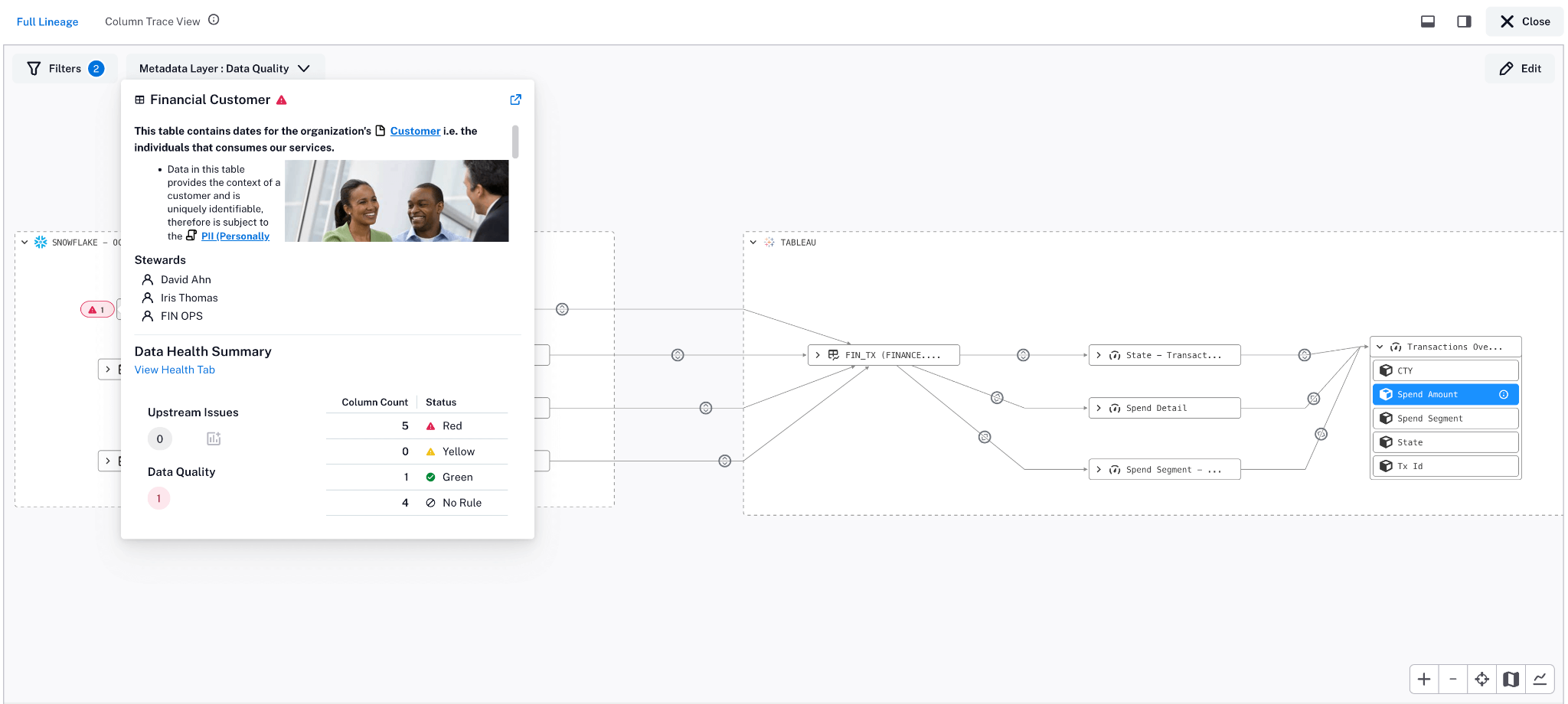
- End-to-end lineage visualization: Displays how data flows across systems, including relationships and dependencies
- Active metadata graph: Connects metadata across tools to provide a unified view of data assets
- Integration with data catalog and governance: Links lineage with cataloged assets, policies, and business context
- Workflow automation support: Enables processes for managing data changes and approvals
- Broad platform capabilities: Includes data catalog, governance, analytics, and APIs within a single environment
Features related to regulatory reporting include:
- Data flow transparency for compliance: Provides visibility into how data moves and is transformed across systems
- Impact analysis across lineage: Helps identify how changes affect downstream reports and datasets
- Data health visibility: Shows the condition and reliability of data within lineage views
- Support for governance and policy enforcement: Connects lineage with governance workflows and controls
- Accessible lineage for business users: Makes it easier for non-technical stakeholders to understand reporting data flows
 ***Related content: Read our guide to [data lineage tools](https://www.getcollate.io/learning-center/data-lineage-tools)***
Conclusion
Data lineage solutions support regulatory reporting by providing clear visibility into how data is sourced, transformed, and used. They reduce manual effort, improve audit readiness, and help organizations respond quickly to compliance requirements. By combining traceability, automation, and governance, these tools enable teams to manage complex data environments with greater confidence.
Fashion Retailer Mango’s Data Journey with Collate
Read the case study
Sign up to receive updates for Collate services, events, and products.
Share this article


Ready for trusted intelligence?
See how Collate helps teams work smarter with trusted data