Microsoft Purview: Pros/Cons, Pricing, and Top 5 Alternatives
What is Microsoft Purview?
Microsoft Purview is a unified data governance, risk, and compliance solution designed to manage and protect data across hybrid and multi-cloud environments. It enables organizations to discover, classify, and secure sensitive information, mitigate insider risks, and ensure regulatory compliance. Key features include a unified data catalog, data lineage, sensitivity labeling, and data loss prevention (DLP).
Core capabilities:
- Data governance: Creates a data map for discovering and classifying data across on-premises, SaaS, and multi-cloud sources.
- Data security: Offers data loss prevention (DLP), information protection, and insider risk management to secure data and mitigate risks.
- Compliance management: Includes compliance manager to track regulatory requirements, audit trails, and data lifecycle management.
- AI and copilot security: Extends security controls to Microsoft 365 Copilot to prevent data oversharing and leaks.
Key features and components:
- Data catalog and map: Provides a visual, searchable inventory of data assets.
- Information protection: Uses sensitivity labels for data classification.
- Data lifecycle management: Manages data retention and deletion.
- eDiscovery and audit: Tools for legal investigations and monitoring.
- Communication compliance: Detects policy violations in communications.
This is part of an extensive series of guides about data security.
Key Features and Components
1. Data Catalog and Map
Microsoft Purview includes a data map and unified data catalog to discover, classify, and manage data across hybrid environments. The data map scans data sources such as databases, storage accounts, and SaaS applications to build an inventory of assets. Metadata is captured and organized to show where data resides, its type, and usage.
With the unified catalog, users can browse and search data assets through a central interface. Integration with classifiers and sensitivity labels ensures that sensitive data is marked and governed according to policy. The catalog supports governance in distributed environments by reducing manual discovery and improving visibility.
2. Information Protection
Microsoft Purview information protection tools safeguard sensitive data using classification, labeling, and policy enforcement. Built-in classifiers detect sensitive content such as personal identifiers, financial information, or health records. Based on these classifications, Purview applies sensitivity labels that remain with the data across Microsoft 365, cloud apps, file shares, and endpoints.
Labels can restrict access, encrypt content, or add visual markings such as watermarks. Policies can block sharing or trigger alerts when sensitive data is at risk of exposure. Information protection integrates with data loss prevention and insider risk management to prevent data leaks and support regulatory requirements.
3. Data Lifecycle Management
Data lifecycle management in Microsoft Purview allows organizations to retain or delete content based on compliance, legal, or operational needs. Admins define retention policies that specify how long data is kept and what actions occur at expiration, such as deletion or archival. These policies apply to email, documents, Teams messages, and other content across Microsoft 365.
Lifecycle policies can be event-based, for example retain for 7 years after employee termination, or time-based, for example delete 5 years after creation. This supports compliance with data retention laws and reduces storage of outdated information. Automation ensures consistent policy application.
4. eDiscovery and Audit
Microsoft Purview includes eDiscovery tools that support legal holds, content search, review workflows, and export. These tools allow legal, compliance, and HR teams to identify relevant content across emails, chats, documents, and other data sources for legal cases or internal investigations. Advanced eDiscovery includes custodian management, review sets, and machine learning to prioritize results.
The audit component provides logging of user and admin activity across Microsoft services. Audit logs help organizations monitor data access, detect suspicious behavior, and provide evidence during investigations.
5. Communication Compliance
Communication compliance in Microsoft Purview monitors and remediates policy violations in corporate communications. Using machine learning and pattern detection, it scans messages in Microsoft Teams, Exchange, Yammer, and third-party platforms to identify content that may indicate risk, such as harassment, threats, or sharing of sensitive data.
Admins define policies that trigger reviews, alerts, or escalations when violations are detected. The system supports role-based workflows for handling flagged content while protecting user privacy.
Core Capabilities of Microsoft Purview
Based on the components above, Purview provides the following data management and security capabilities.
Data governance
Microsoft Purview supports data governance by enabling organizations to catalog and monitor data across on-premises, multi-cloud, and SaaS environments. It uses the data map and unified catalog to automate discovery and classification of data assets, creating a centralized metadata view. It supports a federated governance model where data owners, stewards, and analysts collaborate under consistent policies, with sensitivity labeling and access controls applied to sensitive data.
Data security
Microsoft Purview includes data loss prevention (DLP), information protection, insider risk management, data security investigations, and information barriers to address risks such as accidental sharing and insider threats. It applies automated classification and sensitivity labels to enforce controls based on content. Protections extend across Microsoft 365 apps, cloud services, and endpoints, while data security posture management (DSPM) provides monitoring and risk insights across systems and AI environments.
Compliance management
Microsoft Purview provides capabilities for managing regulatory compliance and reducing compliance risk. It includes data lifecycle management, records management, eDiscovery, audit, and Compliance Manager to enforce policies and retain required data. It supports standards and regulations such as GDPR, HIPAA, and ISO 27001, with templates, assessments, and dashboards that provide visibility into compliance status.
AI and Copilot security
Microsoft Purview secures data used in Copilot and other enterprise AI applications to reduce the risk of exposing sensitive or regulated information in generative AI workflows. It provides visibility into how AI tools access data, applies sensitivity labels to restrict usage, and enables auditing of AI interactions. Data security posture management extends risk insights across AI agents and applications.
Microsoft Purview Pricing Overview
Microsoft Purview uses a pay-as-you-go pricing model based on the services used across data governance, security, and compliance workloads. Pricing is divided into components with meters such as asset counts, request volumes, processing units, storage, or compute time.
Data security and compliance:
- At rest protection is billed at $0.0165 per asset per day (~$0.50/month), based on the number of protected data assets with classification or DLP policies applied.
- In transit protection is billed at $0.50 per 10,000 requests, applying classification and labeling to HTTP data flows.
- Insider risk management uses Data Security Processing Units (DSPUs), billed at $25 per unit, with one unit covering 10,000 user activity logs.
- Data security investigations are billed for compute at $5 per Compute Unit/hour and storage at $5 per GB/month.
- On-demand classification for Microsoft 365 content costs $20 per 10,000 assets scanned and labeled.
- Communication compliance billed per text record analyzed: $0.30 per 1,000 text records for Standard SKU and $0.50 per 1,000 for Premium. Each text record includes up to 1,000 characters.
Audit and lifecycle management:
- Audit logs for non-Microsoft AI apps are billed at $0.015 per 1,000 records ingested.
- Data lifecycle management is priced at $0.0002 per 1,000 text messages stored per day, typically representing AI prompts or responses.
eDiscovery:
- eDiscovery Premium is billed at $20 per GB per month for processed and stored data.
- eDiscovery Graph API includes a 50 GB export allowance; additional exports cost $10 per GB exported.
Data governance:
- Data catalog pricing is $0.0165 per governed asset per day, based on unique data assets linked to governance entities.
- Enterprise data management features are billed by Data Governance Processing Units (DGPUs), starting at $15 (Basic), $60 (Standard), and $240 (Advanced) per DGPU.
Data map and scanning
- Scanning and ingestion of non-Microsoft data sources are billed at $0.63 per vCore hour.
- Advanced resource set processing is billed at $0.21 per vCore hour.
- Insights generation costs $0.82 per vCore hour.
- Data map capacity units are billed at $0.411 per hour, based on metadata storage and request load.
Applications and utilities
- Core applications such as Data Catalog (Classic) and Business Glossaries are included with the Data Map.
- Insights consumption for Data Estate Insights (Classic) is billed at $0.21 per API call (each returns up to 10,000 rows).
- DevOps policies are billed at $0.003 per policy hour; other data policy capabilities are free in preview.
Most charges are usage-based and depend on the volume of assets, activity, or policies managed by Purview.
Key Limitations of Microsoft Purview
While Purview is a robust and widely used solution, there are several limitations to be aware of. The following issues were reported by users on the G2 platform:
- Complex setup and configuration: Initial deployment can be challenging in heterogeneous or hybrid IT environments. Setting up scanning, classification, and integrations across systems requires significant effort.
- Limited integration with non-Microsoft systems: Purview works primarily within the Microsoft ecosystem. Connectivity to legacy, custom-built, or third-party platforms may require workarounds. API support for non-Microsoft sources is limited.
- Performance overhead from continuous scanning: Continuous metadata scanning and classification can introduce performance overhead in large environments.
- High cost and complex pricing: The modular pricing model can lead to high cumulative costs when multiple features are used.
- User interface and navigation challenges: Some users report difficulty navigating the Azure-based interface.
- Data lineage limitations: Capturing data lineage across systems can be difficult, especially when data spans multiple environments.
- Customization constraints: Customization options outside the Microsoft ecosystem are limited.
- Customer support and stability issues: Some users report inconsistent support responsiveness and occasional service instability.
- Limited insight correlation across sources: Some users report difficulty correlating data from multiple sources when structures differ.
Notable Microsoft Purview Alternatives
1. Collate®

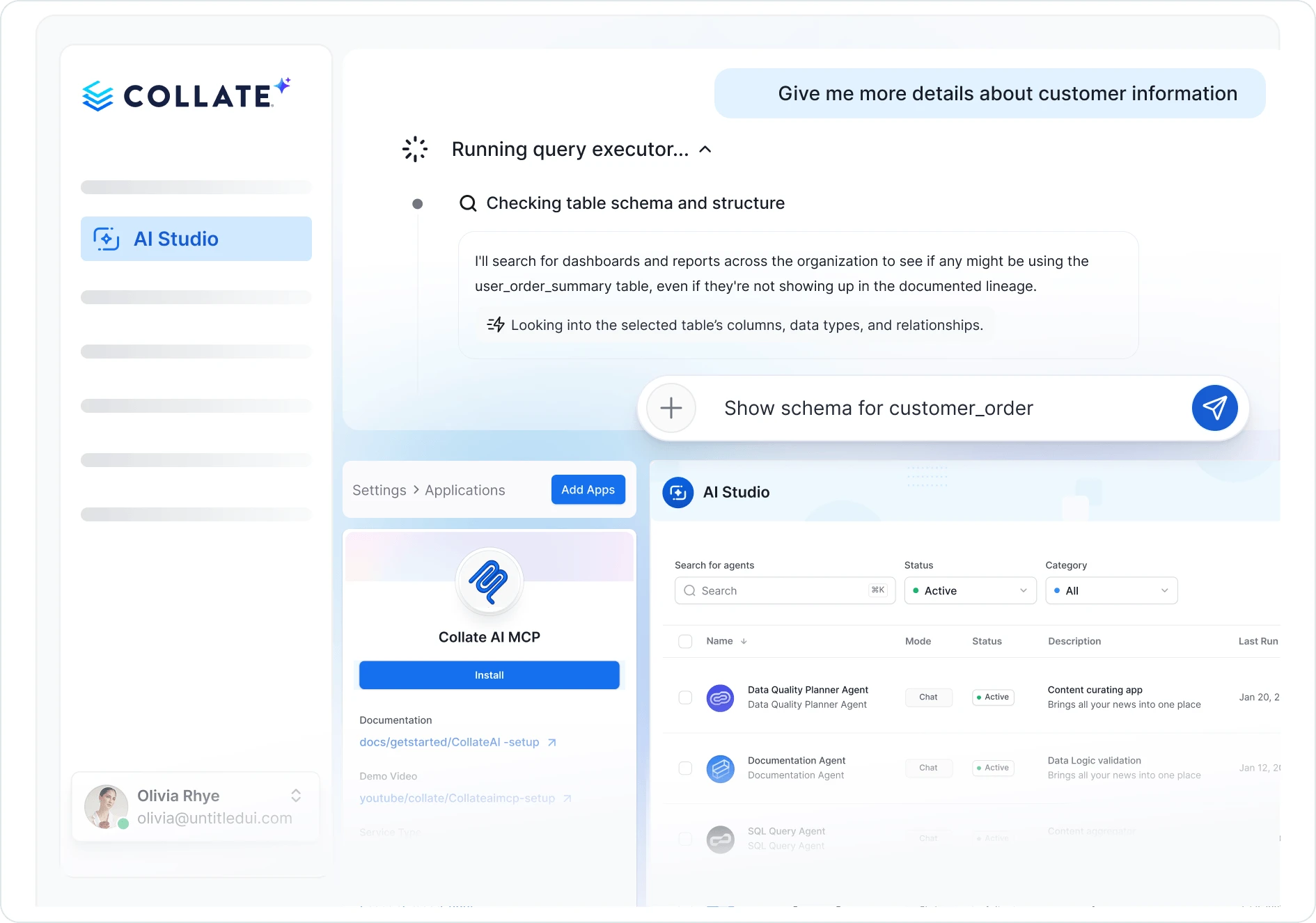
Collate is a semantic intelligence platform built on the open source OpenMetadata project. It combines data discovery, governance, quality, lineage, and observability in a single AI-powered platform. Unlike Purview, Collate is ecosystem-agnostic and works across multi-cloud, on-premises, and hybrid environments.
Key features include:
- Semantic metadata graph: Unifies metadata across business definitions, ontologies, and relationships.
- AI Studio and AskCollate: Conversational AI for instant answers, no-code agents to automate workflows.
- End-to-end data lineage: Column-level lineage with quality test and PII overlays
- No-code data quality: Tests suites with automated incident creation, alerts, and dashboards.
- MCP and SDK integration: LLM and agent access to Collate's semantic metadata.
- Open-source foundation: Built on the OpenMetadata project to remove lock-in risk.
2. Collibra Platform

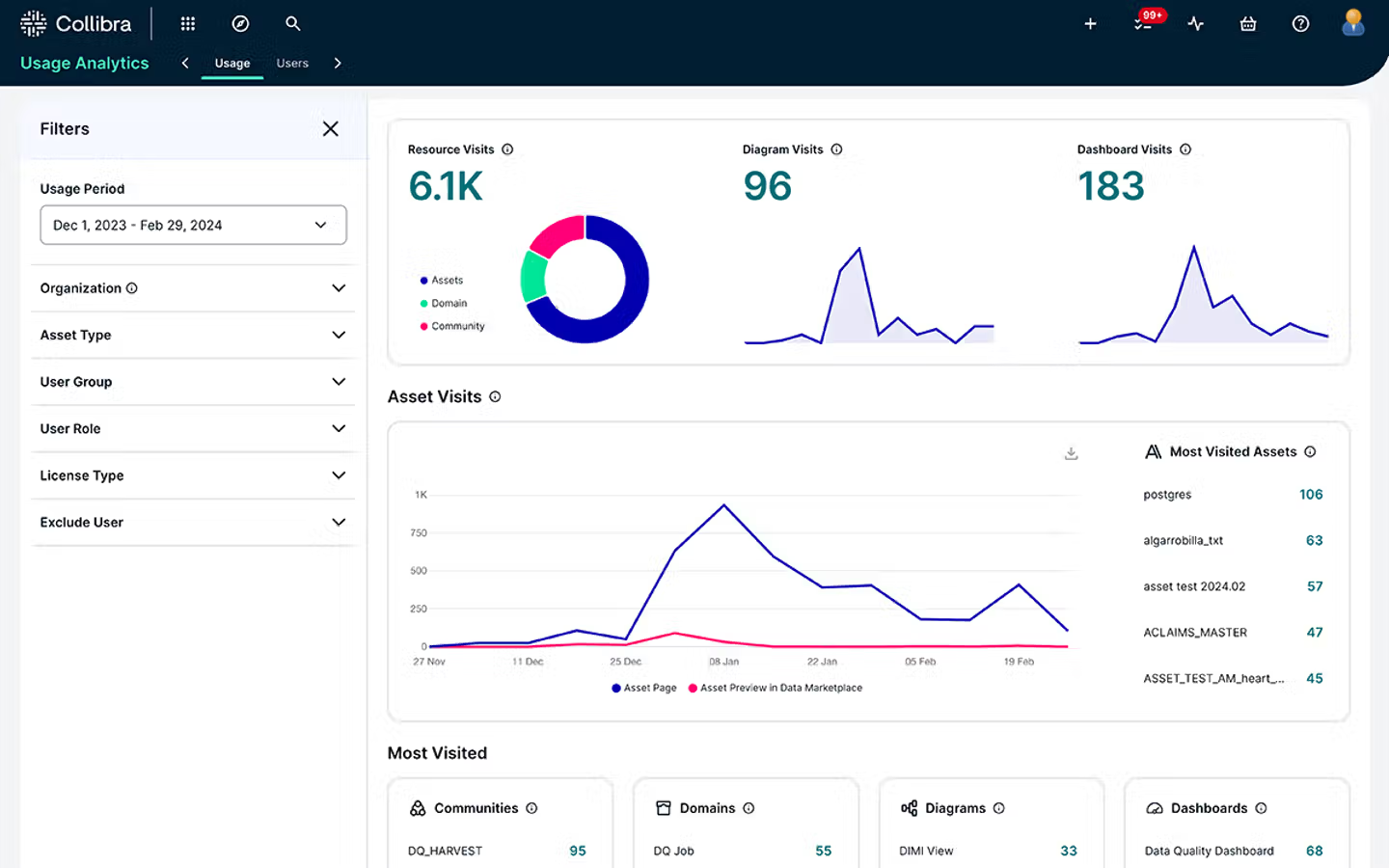
Collibra Platform is a unified data governance solution that connects data producers and consumers across the enterprise. It provides a centralized way to manage structured and unstructured data with business context. Collibra supports use cases such as data privacy and AI governance with tools for semantic mapping, workflows, and governance models.
Key features include:
- Semantic mapping and model generation: Builds a semantic layer linking technical data with business context.
- Federated governance model: Supports organization-specific governance approaches.
- Workflow automation: Tools for building and managing governance workflows.
- Unstructured and AI data governance: Supports governance for unstructured and AI-related data assets.
- Collibra Everywhere extension: Surfaces data context within tools such as Salesforce, Tableau, and Slack.
3. Alation Data Catalog

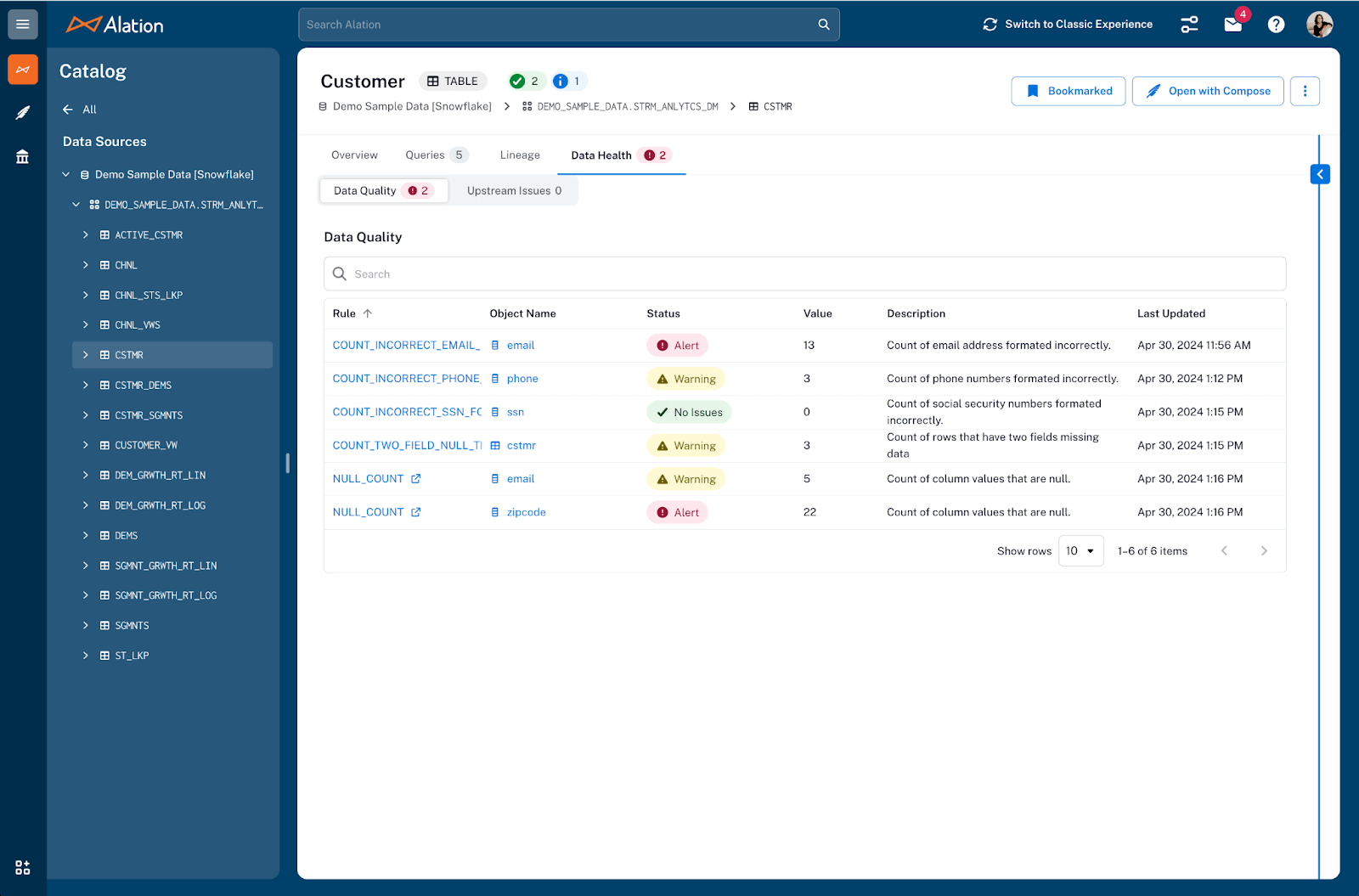
Alation Data Catalog is a data intelligence platform that helps teams find and understand data across the enterprise. It centralizes metadata from multiple data sources, enabling users to search and collaborate on data assets. The platform integrates with over 120 systems.
Key features include:
- Intelligent search and discovery: Uses machine learning to interpret natural language and surface trusted data assets.
- Active metadata management: Extracts and integrates metadata into a unified environment.
- Automated data onboarding: Adds new data assets to the catalog automatically.
- End-to-end data lineage: Visualizes how data moves from source to destination.
- AI-powered curation (ALLIE AI): Recommends metadata descriptions and assists with catalog population.
4. Ataccama Platform
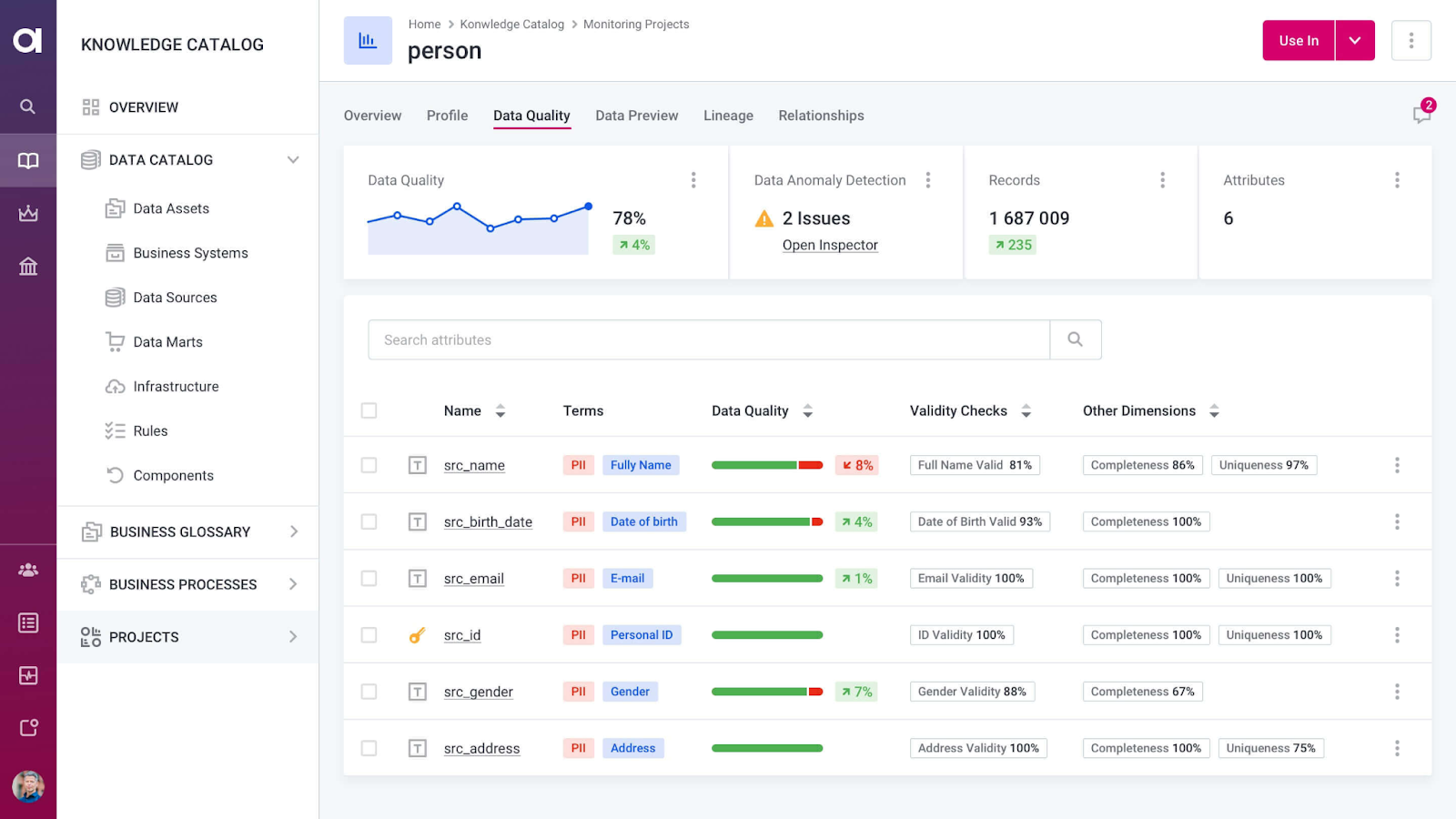
Ataccama ONE is a unified data management platform that combines data quality, cataloging, lineage, observability, reference data, and master data management. It includes AI-driven automation for data tasks.
Key features include:
- Agentic AI capabilities: The ONE AI Agent automates planning, execution, and reasoning across data tasks.
- End-to-end data quality management: Profiles, monitors, and remediates data quality issues across systems.
- Unified platform architecture: Integrates data quality, catalog, lineage, observability, and master and reference data management.
- Embedded automation and intelligence: Generates metadata, quality rules, and test data.
- Trusted data for AI systems: Standardizes and governs data inputs for AI and multi-agent environments.
5. Informatica Axon Data Governance

Informatica Axon Data Governance is a platform for managing enterprise-wide data governance programs. It aligns business and IT users around governed and privacy-compliant data. Axon integrates with the Informatica Intelligent Data Platform, including data quality, cataloging, and privacy tools.
Key features include:
- Integrated governance ecosystem: Connects with Informatica Data Quality, Enterprise Data Catalog, and Data Privacy Management.
- Axon Data Marketplace: Provides access to curated datasets with contextual metadata, ownership, and access rights.
- Contextual data mapping: Documents business definitions, relationships, and usage of data.
- Cross-functional collaboration: Links roles across IT, compliance, and analytics.
- Real-time data quality visibility: Provides business context for data quality metrics.
Conclusion
Microsoft Purview provides a broad set of capabilities for data governance, security, compliance, and AI risk management within the Microsoft ecosystem. It combines cataloging, classification, lifecycle management, insider risk, and eDiscovery into a unified platform. However, complexity, pricing, and ecosystem constraints lead some organizations to evaluate alternatives. The right choice depends on integration needs, governance maturity, regulatory requirements, and whether the organization prioritizes open architecture or deep Microsoft integration.
See Additional Guides on Key Data Security Topics
Together with our content partners, we have authored in-depth guides on several other topics that can also be useful as you explore the world of data security.
Data Catalog
Authored by Collate

Data Mesh
Authored by Collate
PostgreSQL
Authored by Instaclustr
Fashion Retailer Mango’s Data Journey with Collate
Read the case study

Sign up to receive updates for Collate services, events, and products.
Share this article


Ready for trusted intelligence?
See how Collate helps teams work smarter with trusted data