Announcing Collate 1.13


Today we're introducing Collate 1.13, the latest version of our managed OpenMetadata service, with new capabilities that compress the path from question to trusted insight and semantic context that gives every AI agent real business understanding. Highlights include:
-
Collate AI Analytics: Your AI data analyst grounded in your business knowledge. From natural language questions to governed, shareable dashboards in minutes
-
Knowledge Graph: New visualizations of the semantic context connecting your technical and business metadata into an interactive graph
-
Ontology Explorer: Visual map for navigating how business glossary terms relate to each other and to the data assets that implement them
-
Glossary Terms & Relations: Define how business terms relate, with typed relationships that AI agents can reason over
-
Columns as Assets: Columns surface as first-class discoverable assets throughout the platform
We started by standardizing metadata. Now we are standardizing meaning. This semantic context powers AI agents, whether within Collate or deployed by your team, with the necessary context to deliver trusted results.
Collate AI Analytics
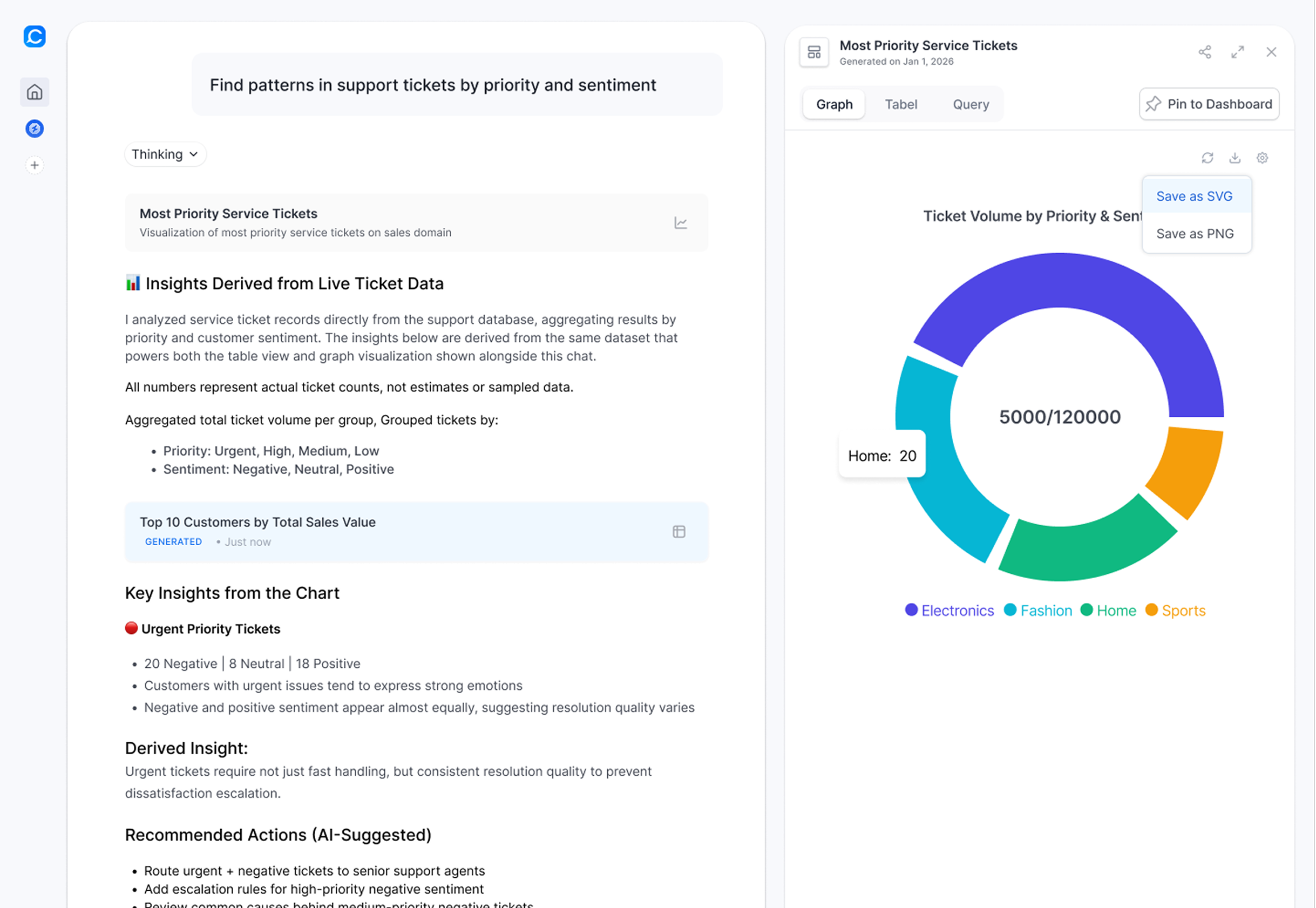
Collate AI Analytics is an AI data analyst native to Collate, built for business users and analysts to get trusted answers faster. Ask a question in plain English, and the AI finds the right data, generates the correct SQL queries, and returns a relevant chart type with a written summary of key findings. Collate's semantic context graph makes results trustworthy. The AI references metric definitions, classifications, and business vocabulary already in Collate to ensure it delivers the right data, queries, and results.
-
Every step is visible: The reasoning trace exposes the AI's thinking process. Tables searched, metric definitions applied, and queries generated are all shown so analysts can verify the path from question to answer.
-
Chart, data, SQL views: Audit the visualization, the underlying data, or the exact SQL behind any answer before sharing it.
-
Custom dashboards: Pin visualizations to shareable, exportable dashboards that can be organized across different teams, tags, and domains.
Why this matters: Getting a dashboard together often means asking around for the right tables, troubleshooting SQL queries, and coordinating with teams that have their own roadmaps, a process that takes too many steps and too much time. Analysts need to do exploratory analysis quickly, while staying within governance controls. Collate AI Analytics compresses that path to minutes, inside the platform where the governed context for your data already lives. Read the Collate AI Analytics product blog post for more details.
Knowledge Graph
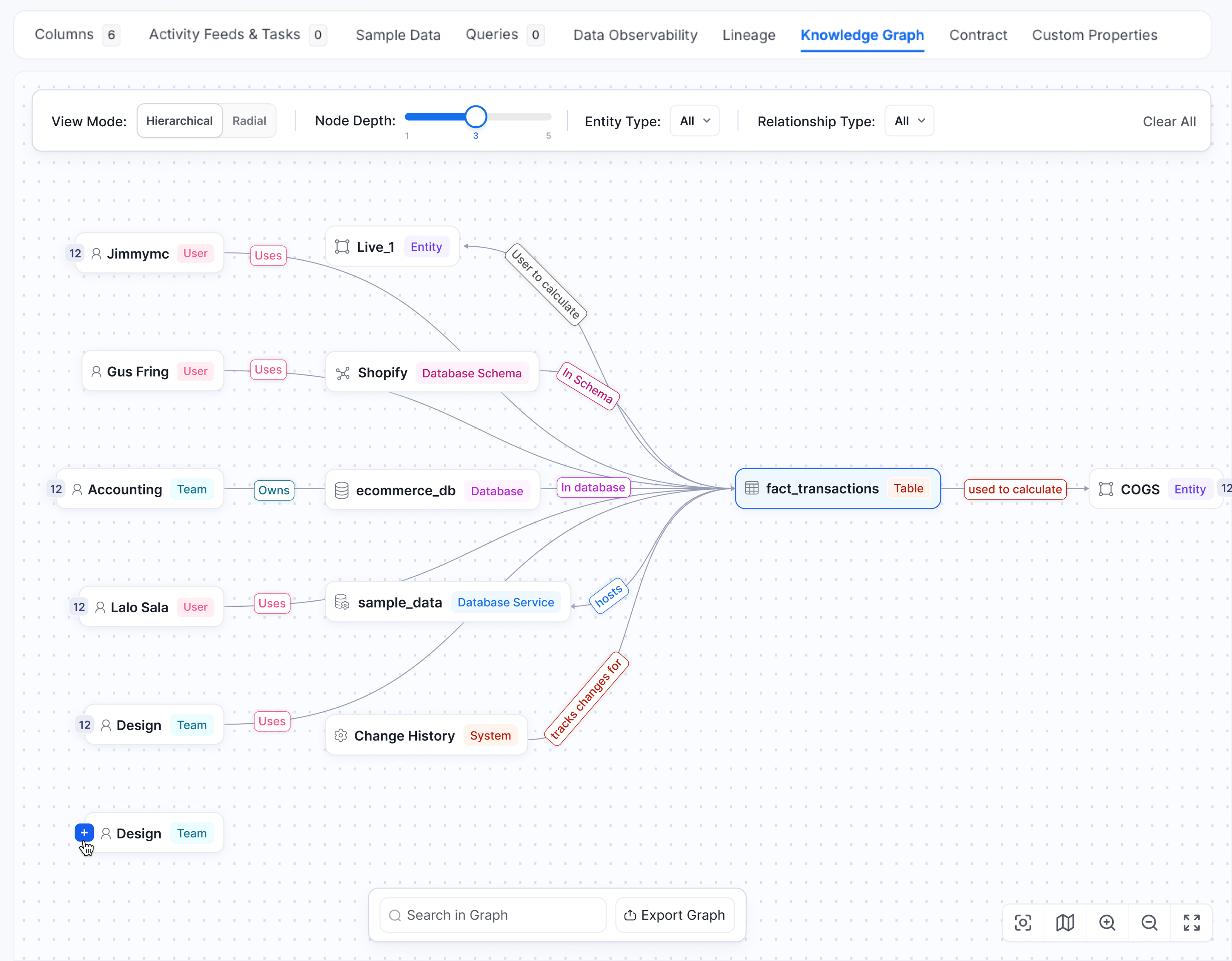
The new Knowledge Graph visualizations show how Collate unifies technical metadata (e.g. schemas, lineage, ownership) with semantic metadata (e.g. glossary terms, classifications) into an interactive graph. Now you can navigate your entire data landscape, from business terms to data assets, in one unified view.
-
Semantic context graph: Every AI agent, including those native to Collate or custom customer agents via MCP, has a deep understanding of what data means and how it interconnects.
-
W3C-compatible: Collate's semantic context graph supports open W3C standards, including RDF, OWL, DCAT, DPROD, SKOS, PROV-O, and Schema.org, to ensure portability and interoperability.
-
Auto-inferred relationships: Knowledge Graph derives ownership chains, reverse relationships, and pipeline associations to surface connections your team never explicitly declared
-
Bidirectional queries: Start from any asset to see everything connected to it, or start from a team, domain, or glossary term to see what it owns or governs.
Why this matters: AI agents and data teams need semantic context to understand your data — schemas alone don't tell you how business terms connect. The Knowledge Graph gives teams visibility into this semantic context, ensuring that the same graph that powers AI reasoning is navigable by every data steward. Read our Knowledge Graph product blog post for more details.
Ontology Explorer
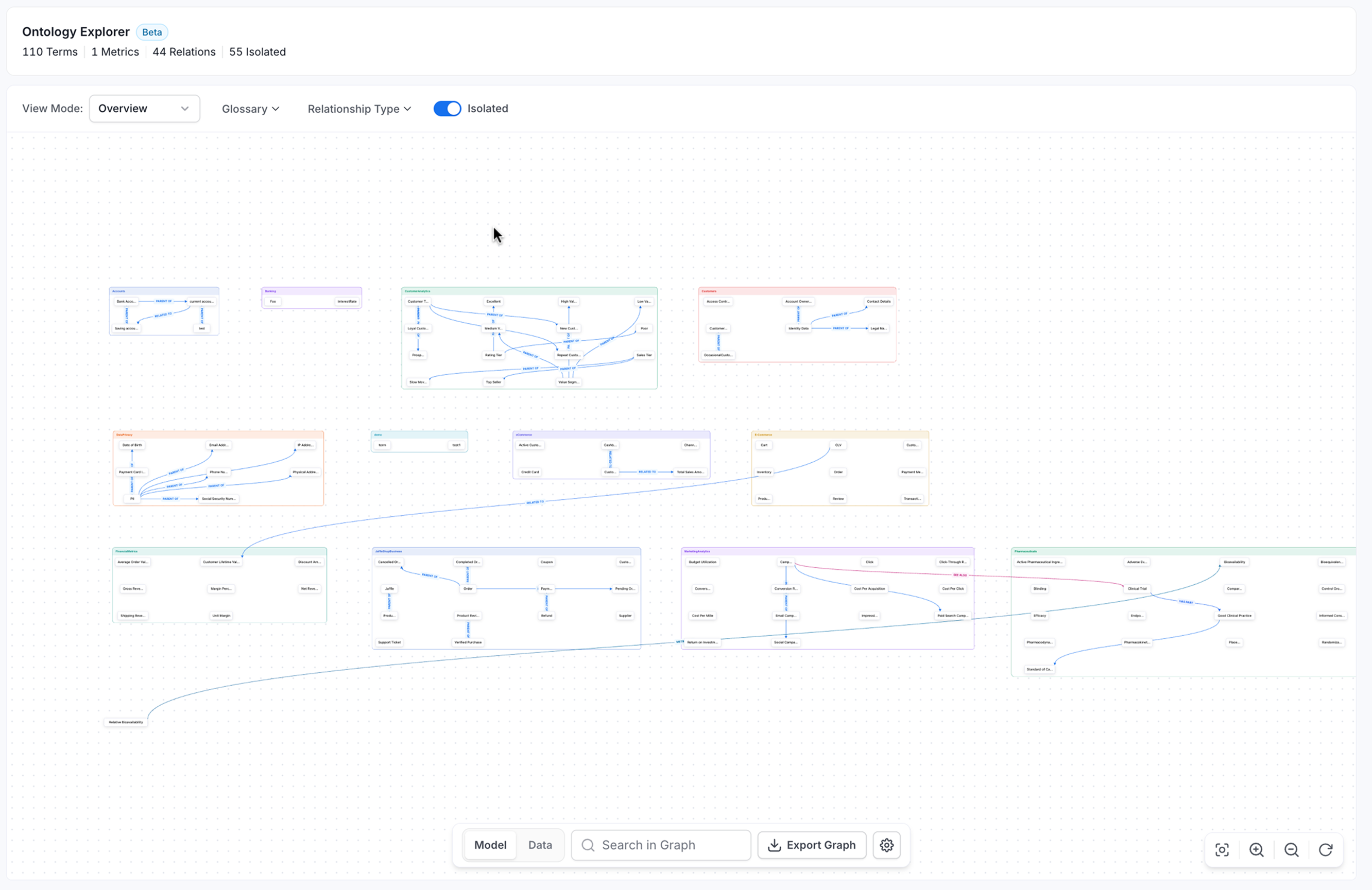
Understand how your business glossary terms connect to each other and to the data that implements them. Ontology Explorer is an interactive map where data teams can build, navigate, and govern their business ontology visually, without writing a single query.
-
View modes: Switch between Overview, Hierarchy, Related, and Cross Glossary perspectives to see how terms relate within a single glossary or across the whole organization.
-
Trace terms to data: In Data Mode, see which tables, dashboards, and pipelines implement each business term, along with their quality scores, lineage, and ownership.
-
Build as you go: Create new term relationships directly on the map, without clicking into individual term pages.
-
Share saved views: Save curated graph perspectives for compliance teams, domain leads, or any stakeholder who needs the same picture you're looking at.
Why this matters: When a CDO asks which Revenue definition is authoritative, a flat glossary list doesn't show what's important. Ontology Explorer makes the relationships between business terms visual and navigable, so governance teams understand what matters and AI agents downstream have the relationship structure they need to produce trustworthy answers. Read our Ontology Explorer product blog post for more details.
Glossary Terms & Relations
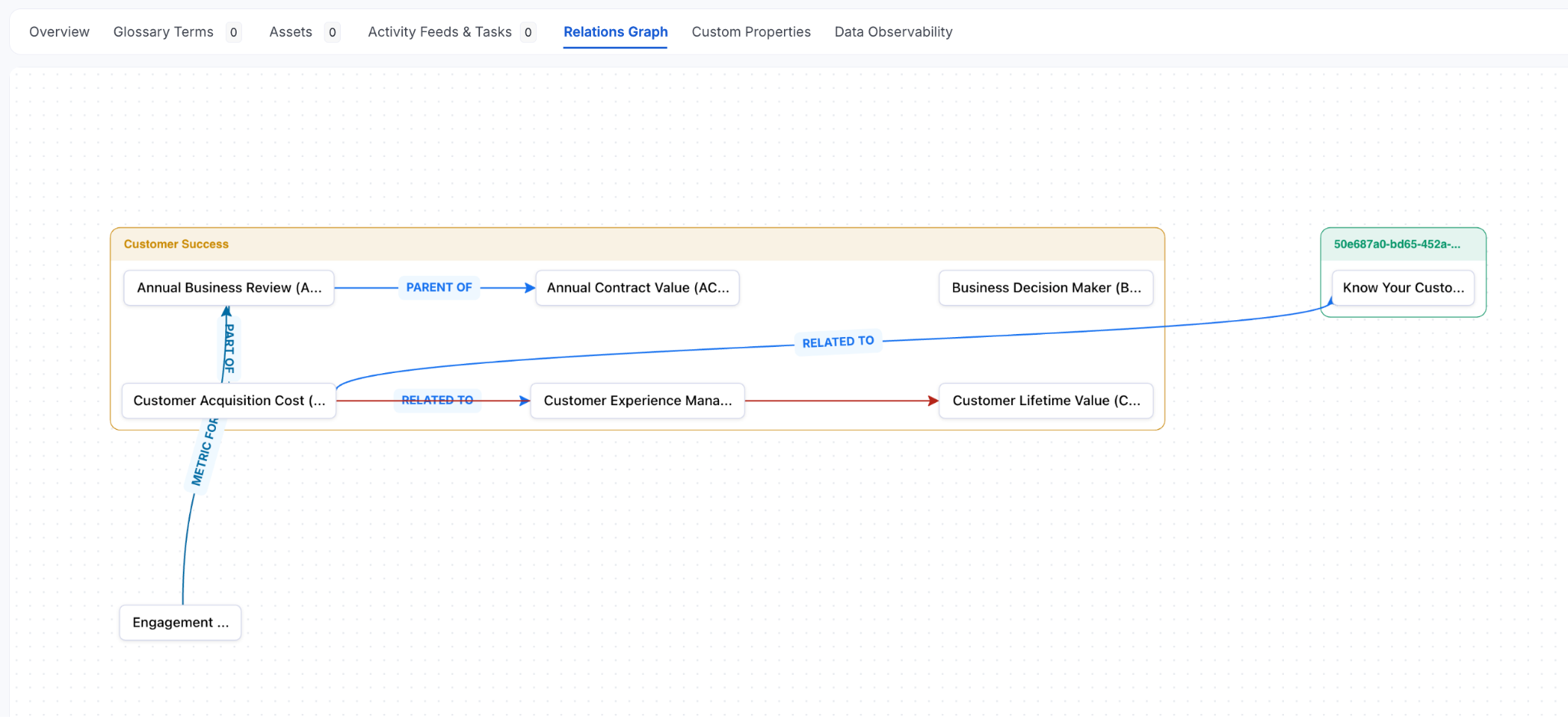
Define how your business terms actually relate to each other, not just that they're related. You can say ARR is calculated from Revenue, or that Customer Tier has a part called Behavioral Segment, or that Churn in Finance is equivalent to Attrition in Product. Glossary Terms & Relations gives admins a configurable schema layer for typed, RDF-compatible relationships between glossary terms.
-
Pick the right relationship type: Define Hierarchical (broader, narrower), Associative (part of, has part, see also), Equivalence (calculated from, synonym, antonym), or other relationship types to match how your organization actually uses terms.
-
Set the rules per type: Configure cardinality, transitivity, inverse relations, cross-glossary flags, and RDF predicates for every relationship type.
-
Track usage counts: Understand which relationship types your teams rely on most to see where semantic coverage is strongest.
Why this matters: AI agents built on schema alone will always guess at the relationships between business terms. Glossary Terms & Relations lets you teach the platform that ARR is calculated from Revenue and that Churn means one thing in Finance and another in Product, so downstream AI reasons from governed context instead of making its own guesses.
New Connectors
Collate 1.13 adds support for multiple new connectors, expanding coverage across databases, reporting, messaging, orchestration, and AI integration sources:
-
BurstIQ: Catalog metadata from the BurstIQ blockchain platform for healthcare and life sciences data.
-
Informix: Native support for IBM Informix databases with full schema, table, and column metadata ingestion.
-
Microsoft Access: Connect to Microsoft Access databases and surface metadata alongside your enterprise sources.
-
SSRS: Ingest metadata and lineage from SQL Server Reporting Services, including reports, data sources, and datasets.
-
Google Pub/Sub: Catalog topics, subscriptions, and schemas from Google Cloud's messaging service.
-
Airflow REST API: Ingest DAG metadata, pipeline schedules, and run history through Airflow's REST API.
-
Matillion Data Cloud: Ingest pipeline metadata and lineage from Matillion's cloud-native ETL platform.
-
Model Context Protocol (Expansion): Our existing MCP support has been expanded to a full service category.
Additional Enhancements
-
Columns as Assets: Columns now surface as first-class assets in Explore, Glossary, and Classification pages, making them discoverable without routing through the parent table.
-
Governance Workflow Improvements: Governance Workflows now trigger on state transitions, not just creation events. If an asset moves from Tier 2 to Tier 1, this reclassification can be routed through human review and approval before it takes effect.
-
Metadata Exporter — Trino Support: Trino joins Snowflake, Databricks, BigQuery, and Redshift as a supported destination for scheduled governance analytics exports. Because Trino operates as a generic query gateway, this extends export compatibility across the range of systems Trino can front.
-
Hybrid Search: Keyword and semantic search are now unified into a single query box, for improved relevance and faster data discovery across your data landscape.
Conclusion
Collate 1.13 gives data teams a governed AI data analyst for faster exploratory analysis, semantic context that makes your data more meaningful to both people and AI, and visibility into how your business glossary terms and data assets connect. Together, these capabilities create a reinforcing loop: the more you define, the more your team can navigate and the smarter every AI agent becomes.
Ready to get started? Sign up for the Collate Free Tier of our managed OpenMetadata service, or contact sales to talk to a product specialist.