What Counts as an Ontology?

AI vendors now ship "ontologies" every month. Most of them are a knowledge graph or a semantic layer with a new label. This guide explains what each term means, then looks at what NVIDIA Auto Ontology and Databricks Genie Ontology contain, and how OpenMetadata compares.
Key takeaways
- An ontology is a formal model of the kinds of things in a domain, how they may relate and the rules that hold between them, written in a standard such as W3C OWL so a machine can check and reason with it.
- A knowledge graph holds the facts, while the ontology is the rulebook those facts follow. Many products sold as ontologies are only the first and lack the features of a true ontology.
- Eight questions separate a real ontology from a relabeled glossary, semantic layer or knowledge graph. The quickest: can you export the .owl file and open it in the open-source ontology tool Protégé?
- By that test, NVIDIA Auto Ontology is a database catalog with LLM-drafted SQL, and Databricks Genie Ontology is a ranked knowledge graph of context.
- OpenMetadata and Collate build every step, from metadata to a governed ontology with a reasoner, on open W3C standards.
Why do AI agents need an ontology?
Even "what was revenue last quarter?" requires an agent to know what revenue means at your company, which tables hold it, how it is calculated, and whether it can trust the answer. Real questions are harder. Try this one:
"Which enterprise customers in EMEA renewed last quarter while they had an open priority-1 support ticket, and how much net revenue do they represent?"
Each phrase needs a piece of meaning that no single table holds.
- "enterprise customer": A defined class: a Customer whose annual contract value is over $100,000. Nobody tags accounts by hand; any customer that meets the rule is one.
- "in EMEA": A hierarchy: Germany is part of DACH, which is part of EMEA. An account in Munich counts without anyone listing it.
- "renewed": A subclass chain: a Subscription Renewal is a kind of Recurring Revenue, which is a kind of Revenue (see the diagram below).
- "open priority-1 ticket": Typed relationships across systems: a Ticket is raised by a Customer, and the Salesforce account and the Zendesk organization are declared to be the same Customer.
- "net revenue": A rule: revenue minus refunds and credits, and an Internal Account is never a Customer, so test accounts drop out.
A glossary can define each phrase on its own, and a semantic layer can store a formula for each. Only an ontology connects them, so an agent can put together an answer to a question nobody wrote SQL for in advance, and show which rule produced each part of it.
In OWL, the W3C standard for ontologies, those pieces are written as classes and relationships:
# Classes and relationships (OWL)
:Customer            a owl:Class ;
                     owl:disjointWith :InternalAccount .

# "enterprise customer": a defined class, membership is computed
:EnterpriseCustomer  owl:equivalentClass [
    owl:intersectionOf ( :Customer
      [ owl:onProperty :annualContractValue ;
        owl:someValuesFrom [ a rdfs:Datatype ;
          owl:onDatatype xsd:decimal ;
          owl:withRestrictions ( [ xsd:minExclusive 100000 ] ) ] ] ) ] .

# "in EMEA": a transitive part-of hierarchy
:partOf   a owl:TransitiveProperty .
:Germany  :partOf :DACH .
:DACH     :partOf :EMEA .

# "renewed": a subclass chain up to Revenue
:SubscriptionRenewal rdfs:subClassOf :RecurringRevenue .
:RecurringRevenue    rdfs:subClassOf :Revenue .

# "open priority-1 ticket": a typed relationship across systems
:raisedBy  a owl:ObjectProperty ;
           rdfs:domain :SupportTicket ;
           rdfs:range  :Customer .
:salesforce_0013x  owl:sameAs  :zendesk_org_4471 .
Here is the "renewed" piece as a picture.
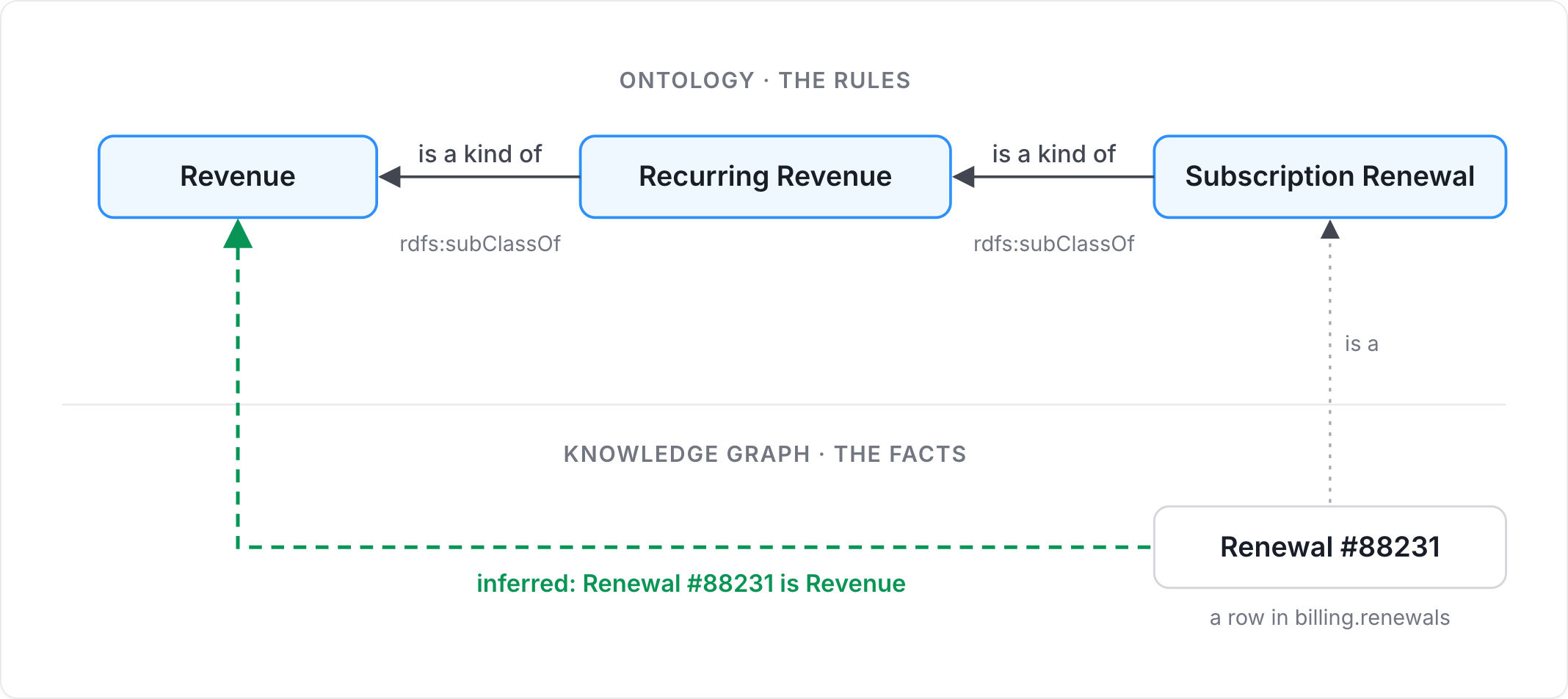
Nobody labeled the renewal as revenue, and nobody added billing.renewals to a revenue query. The ontology says every subscription renewal is a kind of revenue, so a reasoner adds that fact (green), and an agent asked about revenue now includes renewals.
How does an ontology check the data?
An ontology can also say what valid data looks like. Those rules live with the definitions, so every system and every agent that uses the ontology checks the same things. Some examples for the question above:
- Every renewal is paid by exactly one Customer.
- A contract's end date is after its start date.
- Net revenue is never negative.
- An Internal Account is never a Customer.
- Every column tagged as PII has an owner.
The classes above say what things are. Rules that say what valid data must look like are written as SHACL shapes, the W3C standard for validation. The first rule looks like this:
# Validation rule (SHACL)
:RenewalShape a sh:NodeShape ;
  sh:targetClass :SubscriptionRenewal ;
  sh:property [
    sh:path :paidBy ;
    sh:class :Customer ;
    sh:minCount 1 ; sh:maxCount 1
  ] .
Bad data is caught before the answer. A renewal with no customer, or one paid by a test account, fails the check. The agent can flag it or leave it out instead of reporting a wrong number with confidence.
One rule, checked everywhere. The rule is written once, next to the definition it protects. Imports, pipelines, dashboards and agents all apply the same check, so they can't drift apart.
Every failure is explained. A violation names the rule, the record and the value that broke it. Data owners know what to fix, and auditors can see why a figure was excluded.
Agents know when to trust the answer. That was the last thing the agent needed. If the data behind an answer passes the rules, the agent can say so. If it doesn't, the agent can say that too.
A glossary can't do any of this. A definition written in prose has no way to reject a record.
That is why vendors want the word. The trouble is that a list of business terms, a set of SQL snippets, or a graph of search results is not an ontology, however useful it is. Buyers who can't tell the difference end up paying for a glossary and expecting a reasoning engine.
What are the steps from metadata to an ontology?
Information professionals describe a progression from raw metadata to a knowledge graph. Jessica Talisman, an information architect, ontologist, and author of Ontology Pipeline, lays out a version of it: metadata, then taxonomy, then thesaurus, then ontology, then knowledge graph. Each step depends on the one before it, and a skipped step leaves something the next one can't supply.
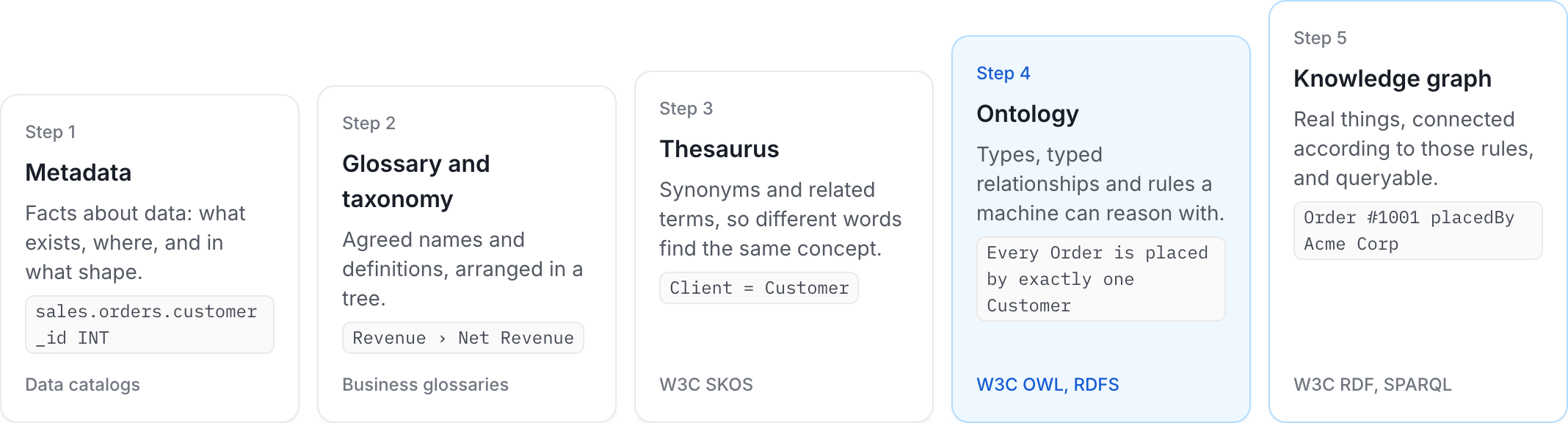
- Metadata. Facts about data: what exists, where, and in what shape. Example:
sales.orders.customer_id INT. Found in data catalogs. - Glossary and taxonomy. Agreed names and definitions, arranged in a tree. Example:
Revenue › Net Revenue. Found in business glossaries. - Thesaurus. Synonyms and related terms, so different words find the same concept. Example:
Client = Customer. Standard: W3C SKOS. - Ontology. Types, typed relationships and rules a machine can reason with. Example:
Every Order is placed by exactly one Customer. Standards: W3C OWL, RDFS. - Knowledge graph. Real things, connected according to those rules, and queryable. Example:
Order #1001 placedBy Acme Corp. Standards: W3C RDF, SPARQL.
A semantic layer (LookML, dbt metrics and similar tools) sits beside step 2: business names mapped to SQL. It is very useful for analytics, but it has no types, rules or inference.
What is the difference between an ontology and a knowledge graph?
Ontology. A formal, explicit specification of a shared conceptualization: the kinds of things in a domain, how they may relate, and the rules that hold between them. Thomas Gruber's 1993 definition is still the standard reference.
Knowledge graph. A network of real entities and the relationships between them, stored so you can query it. A knowledge graph may follow an ontology, or it may not.
Think of a road map. The ontology is the legend: it says what a motorway is, what a junction is, and that a motorway can't cross a river without a bridge. The knowledge graph is the map itself, with real roads and real towns. A map without a legend is still a map. You just can't be sure what anything on it means, and a machine can't check that it is consistent.
Here is a small example. The ontology says orders are placed by customers. The knowledge graph records one order. A reasoner then works out a fact that nobody typed in.
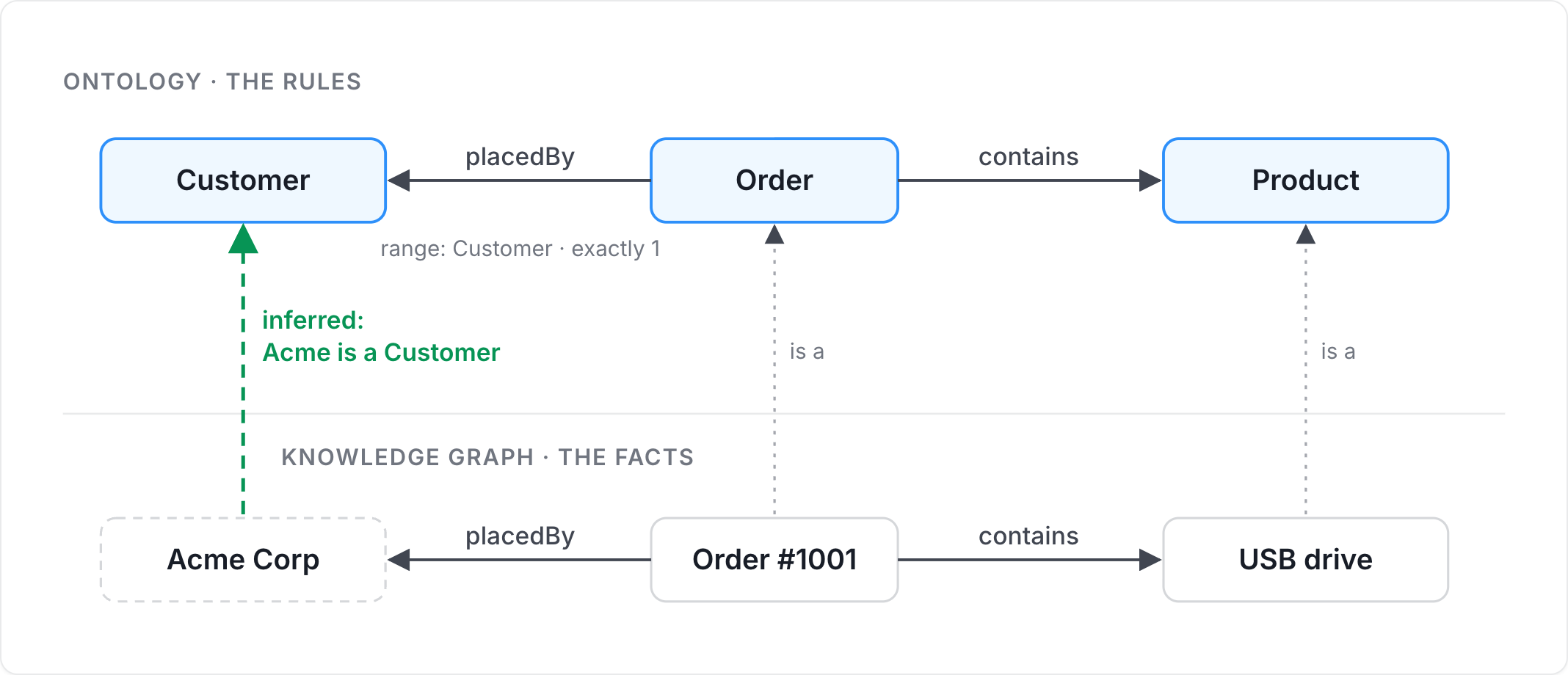
Acme Corp was never labeled a customer. The ontology says anything that places an order is a Customer, so a reasoner adds that fact (green). A knowledge graph without an ontology can store the order, but it can't draw that conclusion or reject an order with two customers.
In the W3C standards this looks like the following. The first block is ontology, the second is knowledge graph, and the last line is what a reasoner adds.
# Ontology (OWL / RDFS)
:Customer  a owl:Class .
:Order     a owl:Class .
:placedBy  a owl:ObjectProperty , owl:FunctionalProperty ;
           rdfs:domain :Order ;
           rdfs:range  :Customer .
:PremiumCustomer rdfs:subClassOf :Customer .

# Knowledge graph (RDF facts)
:order1001 a :Order ;
           :placedBy :acme .

# Inferred by a reasoner, never typed in
:acme a :Customer .
An ontology gives you
- Classes and subclasses with real meaning
- Typed relationships with domain, range and cardinality
- Rules (axioms) a machine can check
- New facts by inference
- Global identifiers (IRIs), so a concept means the same thing everywhere
A knowledge graph gives you
- The real entities: tables, people, orders, metrics
- How they connect: lineage, ownership, usage
- Traversal and search across those connections
- Ranking and recommendations
- Context for an agent's prompt
You want both. The problem is selling the second one under the name of the first.
How can you tell whether a product is an ontology?
You don't need to be an ontologist to check a claim. Ask these questions. If most of the answers are "no", you are looking at a knowledge graph, a glossary or a semantic layer.
- Is it written in a formal language? OWL and RDFS are the W3C standards. A YAML file of names and SQL is not a formal language.
- Can a concept be a kind of another concept? "A Premium Customer is a Customer" has to mean something a machine can use. A folder doesn't.
- Are relationships typed? A relationship should say what it connects (domain and range), how many (cardinality), and what its inverse is. A join path between two tables is not a typed relationship.
- Can you state rules? Axioms such as "an order has exactly one customer" or "a supplier is never a customer".
- Does it infer anything? Logical inference adds facts that follow from the rules. Ranking search results by popularity is not inference.
- Does each concept have a global identifier? IRIs let your "Customer" link to an industry standard such as FIBO or FHIR.
- Can you validate data against it? SHACL checks whether real data follows the model.
- Can you take it with you? Ask for the .owl or Turtle file and open it in Protégé, the free ontology editor from Stanford. If you can't, the "ontology" only exists inside one product.
How do OpenMetadata, NVIDIA Auto Ontology and Databricks Genie Ontology compare?
Each answer comes from the product's own code or public documentation, checked on November 23, 2026. For Databricks, which is closed source, "not mentioned" means their public documentation doesn't describe the capability.
| Question | OpenMetadata + Collate | NVIDIA Auto Ontology | Databricks Genie Ontology |
|---|---|---|---|
| What it is | Open Context Platform: unified metadata, knowledge graph and formal ontology workbench, with text-to-SQL for agents through MCP | Database catalog with LLM-drafted SQL metrics, for text-to-SQL | Context layer: curated definitions plus ranked snippets learned from usage |
| Ontology | |||
| Formal language (OWL / RDFS) | Yes: OWL ontology of all platform metadata, plus native OWL authoring | No: rows in Postgres tables | Not mentioned |
| Class hierarchy (subclass with meaning) | Yes: superclasses, subclasses, SKOS broader and narrower | No: one term per table, flat namespace | No: domains and subdomains group assets |
| Typed relationships (domain, range, cardinality, inverse) | Yes: governed relationship types, property chains | No: relationships are SQL join paths | Not mentioned: "relationships between concepts, metrics, tables, and teams", untyped |
| Rules and axioms | Yes: typed OWL axioms, restrictions, disjointness | No | Not mentioned |
| Logical inference | Yes: rules run inside the RDF store; every derived fact is explained | No | No: OntoRank ranks snippets; it does not infer facts |
| Global identifiers (IRIs) | Yes: governed base IRIs, prefixes, minting patterns | No: internal UUIDs | Not mentioned |
| Validation (SHACL) | Yes: off, report or enforce on import | No | Not mentioned |
| Portable file (opens in Protégé) | Yes: Turtle, RDF/XML, N-Triples, JSON-LD | No: Apache Ossie YAML only | Not mentioned: pages sync through an API |
| Knowledge graph and context | |||
| Graph of real assets | Yes: all platform metadata in RDF: lineage, owners, quality, usage | Partial: tables, columns, terms and joins as edge tables | Yes: "a living graph of how a company works" |
| Graph query language | Yes: SPARQL, scoped to what the caller may see | No: SQL over its own tables | Not mentioned |
| Brings in existing metrics (from warehouses, dbt and BI tools) | Yes: Snowflake, Databricks, dbt, Power BI, Tableau, Looker and more | No: a model drafts metrics from query history; the only import is Ossie YAML | Partial: metric views inside Databricks |
| Text-to-SQL for agents (grounded in real schemas and terms) | Yes: MCP server grounds any agent in schemas, profiles, lineage, metrics, glossary and ontology from 150+ connectors; AskCollate in Collate | Yes: its core purpose, built on its own schema crawl | Yes: Genie, for data inside Databricks |
| Learns from usage | Partial: query-log joins and usage; AI drafts are reviewable suggestions | Yes: LLM pipeline over profiles and query history | Yes: snippets from dashboards, queries and metric views |
| Governance and openness | |||
| Versioned releases and review | Yes: change sets, approval, sealed releases with digests | No: created and modified timestamps only | Partial: certification and deprecation; no releases described |
| Open source | Yes: Apache 2.0 since August 2021 | Yes: Apache 2.0 since April 2026 | No: proprietary, part of the Databricks platform |
Yes = supported. Partial = some of it. No = absent from code or docs. Not mentioned = closed source; public docs don't say.
Is NVIDIA Auto Ontology an ontology?
No. It is a database catalog with LLM-drafted SQL, sold under an ontology label. NVIDIA released Auto Ontology as open source in April 2026. It connects to a database, reads its schema, profiles the data, and uses language models to name business "terms", map them to columns, infer joins and write SQL metrics. An agent then uses that layer to answer questions in SQL. Because the code is public, we can see exactly what it stores.
- Where it lives. About 30 ordinary Postgres tables. Concepts are rows in
term, column mappings are rows incolumn_attribute, metrics are SQL text insql_attribute, and links are join tables such astable__term. Embeddings sit in pgvector. Code comments show the project moved there from Neo4j. - Sources. Ten database engines, among them Postgres, Snowflake, Databricks and DuckDB. No BI tools, no dbt, no pipelines.
- Metrics. Metrics are "SQL attributes" that a model suggests from query history, which people can then edit and certify. Nothing brings in the metrics a company has already defined in dbt, Looker, Power BI, Tableau, Snowflake or Databricks. The only import is an Apache Ossie YAML file.
- Relationships. There is no relationship type. Two terms count as related when a join path connects their tables. The graph view labels each edge with the join that produced it.
- Standards. None. No OWL, RDF, SKOS, SHACL or SPARQL appears in the code or the dependencies, and there are no IRIs. Export is Apache Ossie YAML, so no .owl file ever comes out.
- Change history. Each row records when it was created and last edited. There are no versions, drafts, reviews or releases. Recompiling replaces derived data, and their docs note that switching off a join doesn't survive the next compile.
- Security. Their README says the backend trusts a user ID forwarded in a request header, and that the ingestion service's endpoints (ingest, delete, reset, compile) have no authentication. Both must sit on a private network.
Look at what goes in: tables, columns, keys, views, query history, column profiles, sample values, PII tags and joins mined from queries. That is a metadata catalog. OpenMetadata has ingested every one of those inputs, through 150+ connectors, for years. Auto Ontology adds LLM-written names and SQL drafted from query logs on top. That isn't even a full semantic layer, because the governed metric definitions a business already relies on never come in. It is a database catalog with generated SQL, and calling it an ontology skips steps 3 and 4 of the ladder.
Text-to-SQL itself is not what sets it apart either. OpenMetadata already gives agents what they need to write correct SQL through its MCP server: schemas, profiles, sample values, lineage, join usage, metrics, glossary terms and now ontology concepts, drawn from every one of those 150+ connectors and scoped to what the caller may see. The metrics are the ones your teams already defined and trust, brought in from Snowflake, Databricks, dbt, Power BI, Tableau, Looker and more, not new SQL that a model guessed from query logs. The agent gets the same governed metadata your data team already curates, instead of a second copy rebuilt by crawling each database again.
Credit where due. The engineering is careful. A join that an LLM proposes is kept only when the two columns join in the data. The agent checks whether a question is answerable before it writes SQL. Those are good ideas for any semantic layer. Note that the project's benchmark results (BEAVER, BIRD-Interact) measure how well the agent writes SQL. They don't measure anything an ontology is for.
Is Databricks Genie Ontology an ontology?
No. It is a ranked knowledge graph of context, inside Unity Catalog. Databricks announced Genie Ontology in June 2026 and made it generally available in November 2026. Their documentation defines it this way:
"Genie Ontology is the unified context layer that gives AI agents a business-aware map of your organization." (Databricks documentation, Genie Ontology)
Their launch post calls it "a living graph of how a company works". That description is accurate, and it describes a knowledge graph.
- Modeled knowledge. Metric views, domains and subdomains, Unity Catalog Pages (governed definitions of terms and acronyms) and certification. People define these, and they win when sources conflict.
- Learned knowledge. "Snippets" that Genie extracts from dashboards, SQL queries, metric views and agents. Each gets an authority score from its source, usage and freshness. A ranking algorithm called OntoRank, which Databricks compares to PageRank, orders them. You can't edit a snippet directly; you change its source.
- Standards. None of the four public pages we reviewed mentions OWL, RDF, SKOS, SHACL, SPARQL, IRIs, class hierarchies, axioms, logical inference or exporting an ontology file.
- Governance notes. Snippets follow Unity Catalog permissions. The documentation also states that snippets from external knowledge sources are available to every user in the account, and that ontology snippets don't support customer-managed keys.
- Portability. Agents elsewhere can reach it through Databricks' MCP server, but the knowledge stays inside the platform. There is no standard file to take away.
Ranking popular, authoritative snippets is a sound way to give an agent context. It is retrieval, though, not reasoning. Nothing in the documentation lets you state that a concept is a kind of another concept, constrain a relationship, or derive a fact. By the standard definition, Genie Ontology is a knowledge graph and context store.
Credit where due. Learning definitions from how people query data, and weighing them by authority and freshness, solves a real cold-start problem. Separating human-modeled knowledge from machine-learned knowledge, and letting the modeled side win, is the right design.
How do OpenMetadata and Collate cover every step?
OpenMetadata did not start as an ontology product. It started in August 2021 as an open metadata standard: every asset type defined by an open JSON Schema. Each later layer was built on the one beneath it, in the same order as the ladder above. Today it is an Open Context Platform: one governed place where metadata, a knowledge graph and an ontology give people and agents the same context.
Metadata foundation (since August 2021, 1.0 in April 2023)
The inputs that NVIDIA and Databricks now collect, gathered in one governed place for years, through 150+ connectors.
- Tables, dashboards, pipelines, ML models, APIs and more, all defined by open JSON Schemas
- Lineage down to the column, OpenLineage support, query-log usage and joins
- Metrics brought in from where teams already define them: Snowflake, Databricks, dbt, Power BI, Tableau, Looker and more
- Profiles, sample data, data quality tests and data contracts
- Glossaries (since 2022), classifications, domains, data products, owners and policies
Knowledge graph (since 1.10, October 2025)
All of that metadata projected into RDF, using OpenMetadata's own published OWL ontology.
- 90 classes, 124 object properties and 53 datatype properties, built on W3C DCAT, PROV and SKOS
- JSON-LD contexts, SHACL shapes and SPARQL querying
- Graph insights: lineage paths, centrality and communities
Ontology Studio (new in 2.1, November 2026)
A governed workbench for building your business ontology on top of that metadata. See Ontology Studio.
- Concepts, properties and typed OWL axioms; governed relationship types with domain, range, cardinality, inverses and chains
- IRIs and prefixes; ontologies split into foundation, domain and application layers that import each other
- Drafts as change sets, review, sealed releases with content digests, and a full version history
- A reasoner that runs inside the RDF store and explains every fact it derives (see below)
- OWL 2 DL profile checks while you author; SHACL validation that can report or block imports
- Import and export in Turtle, RDF/XML, N-Triples and JSON-LD, without losing statements it doesn't model
- Starter packs for industry standards such as FIBO (finance) and FHIR (healthcare)
- Concepts bound to the real tables and columns the platform already knows
Agents and text-to-SQL (OpenMetadata MCP, Collate AI)
Text-to-SQL comes with the platform. It doesn't need a separate product.
- OpenMetadata's MCP server gives any agent governed access to the platform's metadata, knowledge graph and ontology, so the SQL it writes rests on real schemas, profiles, lineage, metrics and business terms from 150+ connectors
- AskCollate (Collate) answers questions in SQL, using schemas, profiles and sampled values, and fixes its own failed queries
- AI automations (Collate) draft descriptions, tags, glossary terms and ontology changes as suggestions for a person to approve
Two design choices matter. First, the relational database is the source of truth and the RDF store is a projection, so authoring, review, import and export keep working even when the graph store is off. Second, AI never writes directly. It proposes, and a person approves through the same review workflow as every other change.
What does an ontology reasoner do?
An ontology earns its name when a machine can draw conclusions from it. In OpenMetadata 2.1 that job belongs to a reasoner built on the RDF store. You write a rule once, and the store applies it to the whole knowledge graph and keeps the results.

The reasoner never loads the graph into the application. Every rule runs inside the store, and each rule's conclusions go to their own named graph.
Which rules does it ship with?
OpenMetadata 2.1 includes four starter rules. Each one answers a question that people otherwise answer by hand, or not at all.
- Lineage closure. Follows lineage through every hop, so "all upstream tables of this dashboard" is a single lookup.
- PII propagation. If a column is tagged as PII and another column receives its data through column-level lineage, the downstream column inherits the tag.
- Tag inheritance. A tag on a schema reaches every table in it, and a tag on a table reaches every column.
- Domain membership. When a table belongs to a domain, so does every column in it.
Administrators can add their own rules for their ontology, such as "anything that places an order is a Customer" from the example above.
Why build it on the RDF store
It scales with the graph. Reasoning runs where the data already is. Nothing is copied into application memory, so a large metadata estate doesn't turn into a large server.
It speaks the standard. Derived facts are ordinary RDF. Any SPARQL client, notebook or agent can query them, with or without inferences.
It keeps truth separate. Asserted facts and inferred facts live in different graphs. You can always tell what someone stated from what the machine concluded, and inferred facts are read-only.
It explains itself. Ask why a column carries a PII tag, and the reasoner returns the rule and the facts that produced it. Auditors and agents both need that answer.
The reasoner is also built to be safe to run. It accepts only rules that add facts and can't loop forever, so every run finishes. Editing a rule marks the derived results as stale and they are recomputed. Queries see only what the caller is allowed to see.
Why it matters
Take the question "does this dashboard show personal data?" Nobody tagged the dashboard. The answer lives in a chain of facts: a source column tagged as PII, three lineage hops, and a chart built on the result. Without a reasoner, every agent and every report has to rebuild that chain, and each one does it a little differently. With a reasoner, the rule is defined once, governed, computed for the whole graph and explained on demand. Agents get the same answer as the compliance team.
Neither product we reviewed has an equivalent. NVIDIA Auto Ontology has no inference step at all. Databricks Genie Ontology ranks snippets by authority and freshness, which helps an agent pick context but cannot derive a fact. Ranking finds what is popular. Reasoning works out what is true.
Why choose OpenMetadata for an ontology?
Maturity
5+ years in open source. 200+ GitHub releases.
OpenMetadata has been developed in the open since August 2021, with 1.0 in April 2023 and 2.1 in November 2026. The ontology layers sit on a platform that has run in production for years. NVIDIA's project appeared in April 2026. Genie Ontology became generally available in November 2026.
Security
Access control is enforced on the server, not delegated to the network.
- SSO, role- and policy-based permissions, and scoped bot tokens
- Graph queries run only over what the caller is allowed to see; updates and unsafe federation are rejected
- Imports are size-limited, and remote JSON-LD contexts and XML DOCTYPEs are refused
- Edit leases stop two people overwriting each other's work
- A published threat model and security policy in the repository
Adoption
15.8k GitHub stars. 2.5k forks. 500+ contributors.
A broad community has contributed over five years. NVIDIA's repository has drawn a lot of attention quickly, with 14.6k stars, but 19 contributors and seven months of history. Attention is not a track record.
Open standards
Your model is never locked inside one product.
- Metadata defined in open JSON Schema
- W3C OWL, RDF, RDFS, SKOS, SHACL, SPARQL, JSON-LD, DCAT and PROV
- OpenLineage for lineage exchange
- Apache 2.0 license
Export your ontology, open it in Protégé, load it into any triple store, and link it to FIBO or FHIR.
Text-to-SQL is already included
150+ connectors feeding agents.
You don't need a separate text-to-SQL product. OpenMetadata's MCP server hands any agent the schemas, profiles, sample values, lineage, metrics, glossary and ontology it needs to write correct SQL, from every source you have connected and within each user's permissions. Because it reads the same governed metadata your team already maintains, a definition fixed once is fixed for every agent.
The short version
NVIDIA built a database catalog with LLM-drafted SQL for text-to-SQL. Databricks built a ranked knowledge graph of context inside its platform. Neither is an ontology by the definition the field has used for thirty years. OpenMetadata is an Open Context Platform: it gives you unified metadata, the knowledge graph, a real ontology and text-to-SQL for agents through MCP across 150+ connectors, in the open, on standards you can take anywhere. Before you buy anything called an ontology, ask for the .owl file.
FAQs
What is an ontology in data management?
It's a formal model of a business domain: its concepts, the relationships allowed between them, and the rules they must follow. Because it's written in a W3C standard such as OWL, a machine can validate data against it and infer facts not explicitly added.
What is the difference between an ontology and a knowledge graph?
A knowledge graph stores entities, such as tables, customers and orders, and how they connect. The ontology adds the classes, typed relationships and axioms that let a machine check those facts and draw conclusions from them.
Is a semantic layer an ontology?
No. A semantic layer such as LookML or dbt metrics maps business names to SQL. It is very useful for analytics, but it has no types, rules or inference. See can an ontology replace a semantic layer? for how the two fit together.
Which standards are used to build an ontology?
W3C OWL and RDFS define classes, relationships and rules. SKOS covers taxonomies and synonyms, SHACL validates data against the model, RDF stores the facts and SPARQL queries them. An ontology built on these standards can be exported as a Turtle or .owl file and opened in any compliant tool.
How can I tell whether a vendor's "ontology" is real?
Ask for the .owl or Turtle file and open it in Protégé, the free ontology editor from Stanford. Then check for a class hierarchy, typed relationships, rules a machine can check and logical inference. If most answers are no, you are looking at a knowledge graph, a glossary or a semantic layer.
Sources
- Jessica Talisman, "What is an Ontology?", LinkedIn.
- Jessica Talisman, "Ontology, Part I: The Architecture of Meaning", Intentional Arrangement, 2026.
- Syed Humair, "Why Your AI Agents Get It Wrong: Ontology Explained (Full Guide)", CodeUCraftAI, YouTube.
- Thomas R. Gruber, "A Translation Approach to Portable Ontology Specifications", Knowledge Acquisition 5(2), 1993.
- W3C, OWL 2 Web Ontology Language Overview; RDF 1.1 Concepts; SKOS Reference; SHACL; SPARQL 1.1 Query Language.
- NVIDIA, auto-ontology repository: README, docs/architecture.md, auto_ontology/dal/schema.py, auto_ontology/server/model_interchange/service.py.
- Databricks, Genie Ontology documentation (updated November 16, 2026).
- Databricks, "Announcing GA of Genie Ontology", November 11, 2026.
- Databricks, "Introducing Genie One, Genie Agents, and Genie Ontology", June 16, 2026.
- OpenMetadata, repository, release 2.1.0, including openmetadata-spec/src/main/resources/rdf/ontology/openmetadata.ttl.
Facts checked on November 23, 2026 against the NVIDIA auto-ontology main branch, Databricks' public documentation, and the OpenMetadata 2.1.0 release. GitHub figures are from the same date.