Data Marketplace: Components, Use Cases & 15 Notable Solutions
What Is a Data Marketplace? Internal vs. External
There are two main types of data marketplaces: internal data marketplaces and external data marketplaces.
An internal data marketplace is an employee-facing platform for discovering and accessing internal data products. It is designed for governed self-service inside an organization. For example, a marketing analyst might use an internal data marketplace to find a certified customer segmentation dataset, review its lineage and quality score, and request access through an automated approval workflow.
An internal marketplace is similar to a data catalog, which helps organizations inventory and understand data assets. But unlike data catalogs, data marketplaces help teams actually consume governed data at scale.
An external data marketplace is a commercial exchange where organizations buy, sell, or share third-party datasets. Examples include marketplaces such as Snowflake Marketplace, AWS Data Exchange, and data collaboration platforms like LiveRamp. These platforms are often used to source external data for analytics, advertising, benchmarking, enrichment, or machine learning.
Many large enterprises use both. They may purchase third-party datasets from external marketplaces while also operating an internal marketplace for governed access to first-party data.
This is part of a series of articles about data catalog.
Why Internal Data Marketplaces Matter Now
Many organizations have reached the limits of traditional data discovery and access models. Despite years of investment in data infrastructure, business users still face a familiar set of unanswered questions whenever they need data:
Questions data consumers ask every day:
- Where is the right dataset?
- Can I trust it?
- Who owns it?
- Is it approved for my use case?
- How do I get access?
- What does this field mean?
This creates a persistent gap between data availability and data usability. The organization may have plenty of data, but consumers still cannot easily find, trust, or access the right data when they need it.
Data Democratization Has Stalled
The promise of data democratization was that more employees would use data independently. In practice, dependency on specialists remains the norm. Analysts and data scientists spend too much time searching for data and too little time analyzing it.
- Business users submit tickets instead of self-serving
- Data engineers answer repetitive access requests
- Governance teams struggle to enforce policy without slowing work
An internal data marketplace addresses this directly by giving consumers a self-service path to governed data without requiring specialists to act as intermediaries at every step.
AI Needs Governed, Curated Data
The rise of generative AI and AI agents has made trusted data access even more urgent. AI systems are only as useful as the context they can safely reach. If an AI agent pulls from poorly documented, low-quality, or unauthorized datasets, the results can be inaccurate, noncompliant, or misleading.
An internal data marketplace gives AI systems a governed way to discover and use certified data products. Instead of connecting agents to raw, ambiguous assets, organizations can expose curated, approved, AI-ready products with clear ownership, provenance, and access controls built in.
Ticket Queues Are Becoming a Bottleneck
Without a marketplace, data access often becomes a manual workflow. A user asks for a dataset. Someone verifies the request. Someone else approves it. A data engineer grants access. Another team updates documentation. Governance checks happen inconsistently, if at all. This does not scale.
An internal data marketplace turns this process into a governed workflow. Consumers can request access from the marketplace interface, policies can determine whether approval is needed, and provisioning can happen automatically when conditions are met.
Data Products Need a Consumer-Facing Layer
Many organizations are shifting toward data products and data mesh operating models. In these models, domain teams own and publish reusable data assets for others to consume.
But data products only work if consumers can find and understand them.
An internal data marketplace provides the consumer-facing layer for data products. It allows domain teams to publish trusted datasets, metrics, features, APIs, reports, or models as reusable products with documentation, ownership, quality expectations, access rules, and support channels.
How an Internal Data Marketplace Works
An internal data marketplace works by connecting data producers, data consumers, and governance workflows in one platform. The exact implementation varies by organization, but most internal data marketplaces follow a similar flow.
1. Publishing Data Products
The process begins when a data product owner publishes a data product to the marketplace.
A data product could be a curated dataset, a table, a dashboard, a metric, a machine learning feature set, a data API, or another reusable data asset. The owner adds business context, technical metadata, definitions, quality expectations, access requirements, and usage guidance.
A strong marketplace listing typically includes:
- Product name and description
- Business domain
- Owner and steward
- Schema and field definitions
- Lineage
- Data quality score
- Certification status
- Sensitivity classification
- Permitted use cases
- Access requirements
- Example queries or usage instructions
- Support contact or channel
The goal is to make the data product understandable to consumers without requiring them to contact the data team for every basic question.
2. Discovery and Search
Once published, the data product becomes discoverable through search, browsing, recommendations, or domain-based navigation. A data consumer might search for “customer churn,” filter by certified datasets, browse the sales domain, or ask an AI assistant to find approved customer data for a specific use case.
Modern internal data marketplaces increasingly support semantic and AI-powered search. This allows consumers to search using business language, not just exact table names or technical terms.
3. Request and Approval
When a consumer finds a relevant data product, they can evaluate whether it fits their needs and request access. The marketplace routes the request through a governance workflow. Depending on the sensitivity of the data and the consumer’s role, access may be approved automatically or sent to the appropriate owner, steward, or compliance reviewer.
For example, access to a public sales performance dataset may be granted instantly. Access to personally identifiable customer data may require manager approval, data owner approval, and confirmation of an approved business purpose.
4. Automated Provisioning and Enforcement
After approval, the marketplace can trigger provisioning automatically. This may involve granting permissions in a warehouse, adding a user to a group, creating a policy-based access rule, opening a Jira or ServiceNow workflow, or calling an identity and access management system.
Policy enforcement is critical. The marketplace should not simply advertise datasets; it should connect discovery to secure, governed access.
5. Audit and Ongoing Governance
An internal data marketplace also supports auditability and ongoing governance. Organizations need to know who requested access, who approved it, when access was granted, what policy was applied, and whether the data is still being used appropriately.
Marketplace activity can feed governance reporting, compliance reviews, usage analytics, data product performance metrics, and access recertification processes.
Key Capabilities of an Internal Data Marketplace
A successful internal data marketplace is more than a searchable list of datasets. It combines metadata, governance, workflow automation, and a consumer-grade user experience.
Data Product Publishing
Data producers need a structured way to publish data products into the marketplace. This includes defining product metadata, ownership, service-level expectations, documentation, access rules, and lifecycle status.
The marketplace should make publishing easy enough for domain teams while still enforcing governance standards. Strong publishing workflows help ensure that marketplace listings are complete, accurate, and useful.
Discovery and Search
Discovery is one of the core functions of a data marketplace. Users should be able to search by business term, domain, owner, data type, classification, certification status, quality score, popularity, and more.
AI-powered and semantic search can help users find relevant data even when they do not know the exact name of a dataset. Faceted search is especially useful in large enterprises because it allows consumers to narrow results quickly.
Trust Signals
A data marketplace should help consumers decide whether a data product is trustworthy. Common trust signals include:
- Quality scores
- Certification badges
- Owner and steward information
- Lineage
- Freshness
- Usage statistics
- Ratings and reviews
- Data sensitivity labels
- Policy status
- Known issues
These signals reduce uncertainty. They help users choose the right data product and avoid outdated, duplicated, or unapproved assets.
Shopping-Like Self-Service UX
The best internal data marketplaces borrow patterns from eCommerce and app stores. A consumer can search, compare, read descriptions, review trust indicators, see usage examples, request access, and track the request status.
Some platforms use “add to cart” patterns where users can request multiple data products in one workflow. This shopping-like experience matters because data consumers are often not data engineers. They need a clear, intuitive path from discovery to access.
Workflow Automation with Policy-Driven Access
Internal data marketplaces should integrate with governance and IT service workflows. This may include tools such as ServiceNow, Jira, identity providers, data warehouses, access management systems, and policy engines. The marketplace should be able to route requests, apply approval rules, trigger automated grants, and record audit evidence.
For example, a request for non-sensitive financial reporting data might result in an automated warehouse GRANT. A request for restricted employee data might require multi-step approval and time-limited access.
Domain-Based Ownership and Stewardship
In data mesh and data product operating models, ownership sits with domains. A data marketplace should make ownership visible. Consumers should know which team owns the data product, who maintains it, who approves access, and where to ask questions.
This accountability improves trust and helps prevent the internal marketplace from becoming another unmanaged inventory of assets.
AI and Agent Integration
As AI adoption grows, marketplaces need to support programmatic access. This can include APIs, metadata endpoints, integration with AI agents, and emerging standards such as Model Context Protocol, or MCP.
The goal is to let AI systems discover approved data products, understand their meaning, check access permissions, and retrieve governed context safely. An internal marketplace built only for human browsing may not be enough. Increasingly, the marketplace must serve both human consumers and machine consumers.
Internal Data Marketplaces for AI
AI is one of the strongest reasons organizations are rethinking data marketplaces. Traditional data catalogs were built mainly for humans searching for datasets. AI agents introduce a new type of consumer: software that can reason, retrieve, summarize, and act on behalf of users. These agents need more than raw metadata. They need governed, trusted, well-described data products that can be accessed programmatically.
Why AI Agents Need a Marketplace, Not Just a Catalog
A data catalog helps identify what data exists. But an AI agent needs to know more than that. It needs to know which data is approved for use, what it means, whether it is certified, how fresh it is, what policies apply, and how to access it safely.
An internal data marketplace adds this consumer-facing and governance-aware layer. It helps AI agents choose the right data product instead of simply retrieving any matching asset.
Certified, AI-Ready Data Products
For AI use cases, organizations can publish certified, AI-ready data products in the marketplace. These products may include curated datasets, approved metrics, vector indexes, feature sets, knowledge bases, governed APIs, or semantic models.
Each product should include clear definitions, lineage, data quality indicators, usage restrictions, and ownership. This gives AI systems reliable context and reduces the risk of hallucinations, policy violations, or inconsistent answers.
Programmatic Access Through APIs and MCP
AI agents need machine-readable ways to interact with the marketplace. APIs can allow agents to search for data products, inspect metadata, check permissions, request access, and retrieve approved data.
MCP can provide a standardized way for AI applications to connect with enterprise data tools and governed context sources. This turns the internal marketplace into a control plane for AI data access.
Trust and Provenance for AI Accuracy and Compliance
AI outputs are easier to trust when the underlying data has clear provenance. A data marketplace can expose lineage, certification status, quality metrics, ownership, and policy information to both users and AI systems. This helps organizations explain where AI-generated answers came from and whether the underlying data was appropriate for the use case.
For regulated industries, this is especially important. AI systems must not only produce useful answers; they must do so using compliant, approved, and auditable data.
Use Cases for Internal Data Marketplaces
Data marketplaces support a range of enterprise data initiatives.
Self-Service Analytics
Business analysts can use the internal marketplace to find certified datasets, dashboards, and metrics without relying on tribal knowledge or repeated requests to the data team. For example, instead of asking which revenue table is correct, an analyst can search for “recurring revenue,” find the certified revenue data product, review its definitions, and request access directly.
AI and Machine Learning Model Development
Data scientists and ML engineers need reliable training, validation, and feature data. An internal marketplace can help them find approved datasets, understand data quality, review lineage, and confirm whether a dataset is permitted for model development. It can also help avoid duplicated feature engineering work by exposing reusable feature sets as data products.
AI Agents and Automated Workflows
AI agents can use the marketplace to discover governed context and take action safely. For example, an internal sales assistant could retrieve certified account, opportunity, and customer health data from approved marketplace products instead of querying raw warehouse tables directly. This improves accuracy, governance, and auditability.
Cross-Team Data Sharing
Large organizations often struggle with data silos. One team may produce valuable data that another team does not know exists. An internal data marketplace makes cross-team sharing easier by giving teams a standard way to publish, describe, and govern their data products. This is especially valuable for shared domains such as customer, product, finance, risk, and operations.
Governance and Compliance
Internal data marketplaces help governance teams enforce policies without blocking productivity. By embedding access rules, classifications, approvals, and audit trails into the marketplace workflow, organizations can make governed access the default. This is particularly useful in regulated industries such as financial services, healthcare, insurance, telecommunications, and the public sector.
Data Mesh Implementation
Data mesh depends on domain-owned data products. But without an internal marketplace, those data products can be hard to find and consume. A data marketplace provides the discovery and access layer for data mesh. Domain teams publish products. Consumers find and request them. Governance policies are applied consistently across domains.
How External Data Marketplaces Work: Key Aspects
Intermediary Role
An external data marketplace operates as an intermediary that connects data providers with potential data consumers. This intermediary function includes not only hosting datasets but also handling transactions, enforcing data licensing agreements, and providing technical interfaces for data access. The marketplace intermediates trust, acting as a neutral party that defines processes for onboarding providers, standardizing metadata, and enforcing data usage policies.
Through this role, the external marketplace reduces legal, technical, and operational barriers for both parties. Rather than negotiating custom data-sharing agreements with each counterparty, participants rely on predefined contracts and processes established by the marketplace. This speeds up data transactions, helps manage compliance, and supports scalable growth of the data ecosystem.
Seamless Experience for Data Consumers
External data marketplaces emphasize user experience to ensure adoption and value for both providers and consumers. They deliver intuitive search and filtering tools, allowing users to discover data products using semantic categories, business terms, or technical attributes. Previews, sample data, and clear documentation support evaluation before purchase or subscription.
Once a dataset is selected, seamless onboarding, instant provisioning, and self-service access lower the friction further. Some marketplaces integrate with enterprise identity management, support API integrations, and provide automated billing or usage tracking, creating a familiar experience similar to buying apps from a software app store.
Data Discovery
Effective data discovery is a core component of an external data marketplace. Discovery tools index catalogs with rich metadata, trust indicators, and quality scores, enabling users to assess relevance and suitability quickly. Tags, business glossary terms, and contextual information help bridge the gap between technical and non-technical stakeholders.
Advanced search features, including natural language queries and recommender systems, are becoming standard to support users who might not know exactly what data they need. By making it easy to surface unexpected or high-value datasets, discovery features drive usage and increase return on investment for both data providers and consumers.
Secure Environment
Trust and security are essential when exchanging data via an external marketplace. Leading platforms employ encryption in transit and at rest, role-based access controls, and rigorous provider vetting. These features help ensure sensitive data is protected against unauthorized access, misuse, and leakage.
Many external data marketplaces also support auditing, compliance reporting, and enforce data usage restrictions embedded within data products. Providers can specify how their data may be used, by whom, and under what conditions, while the platform programmatically enforces these rules. This layer of governance is essential for regulated industries and for data with privacy or intellectual property constraints.
Common Use Cases for External Data Marketplace Platforms
Enterprise Analytics and Decision Intelligence
One of the primary use cases for external data marketplaces is to fuel enterprise analytics and decision intelligence initiatives. Companies rely on timely access to diverse data sources to inform business strategy, create forecasts, and analyze market opportunities. Marketplaces make it easy for analysts and data scientists to augment internal datasets with third-party data, reducing the time it takes to find and onboard relevant information.
By democratizing data access and reducing friction, external data marketplaces help organizations stay competitive in dynamic markets. They also allow decentralized teams to make data-driven decisions without relying on a centralized data engineering function. This results in faster innovation cycles, improved forecasting, and broader adoption of advanced analytics capabilities.
AI/ML Model Training and Validation Datasets
External data marketplaces are valuable for AI and ML teams seeking quality training or validation data. Developing machine learning models requires large, representative datasets that may not always exist within an organization. External marketplaces offer access to curated, privacy-compliant datasets tailored for AI training, covering domains such as image, text, audio, or behavior data.
By sourcing data through these marketplaces, organizations ensure data variety, avoid bias, and accelerate experimentation. Seductive features include labeling services, licensing that supports model commercialization, and documentation of data provenance or consent. This is particularly useful when targeting regulated markets, ensuring that models are trained and validated on compliant, trustworthy data.
Marketing and Customer Intelligence Applications
Marketers and customer intelligence teams use external data marketplaces to enrich their understanding of target audiences, market segments, and consumer trends. Purchasing demographic, psychographic, location, or behavioral datasets allows for deeper segmentation, campaign personalization, and advanced analytics without months of primary research.
Prolific data partnerships through marketplaces help companies identify new leads, track shifts in consumer behavior, and optimize advertising spend. Integrated analytics, visualization tools, and simple acquisition processes mean that marketing teams can quickly launch more effective, evidence-based campaigns, fully leveraging the breadth of available external data.
Regulated-Industry Data Collaboration Scenarios
For industries under strict regulatory oversight (such as healthcare, finance, or energy) external data marketplaces enable controlled data sharing between organizations. These platforms enable secure, governed collaboration while maintaining compliance with regulations like GDPR, HIPAA, or sector-specific standards. Participants can share or access sensitive datasets without breaching privacy or intellectual property agreements.
External data marketplaces intended for regulated industries offer consent management, data anonymization, audit trails, and access controls. This creates safe environments for data-driven research, benchmarking, and innovation partnerships, especially where legal and reputational risks would otherwise hinder collaboration across organizational boundaries.
Data Marketplace Solutions and Services
Internal Data Marketplace Solutions
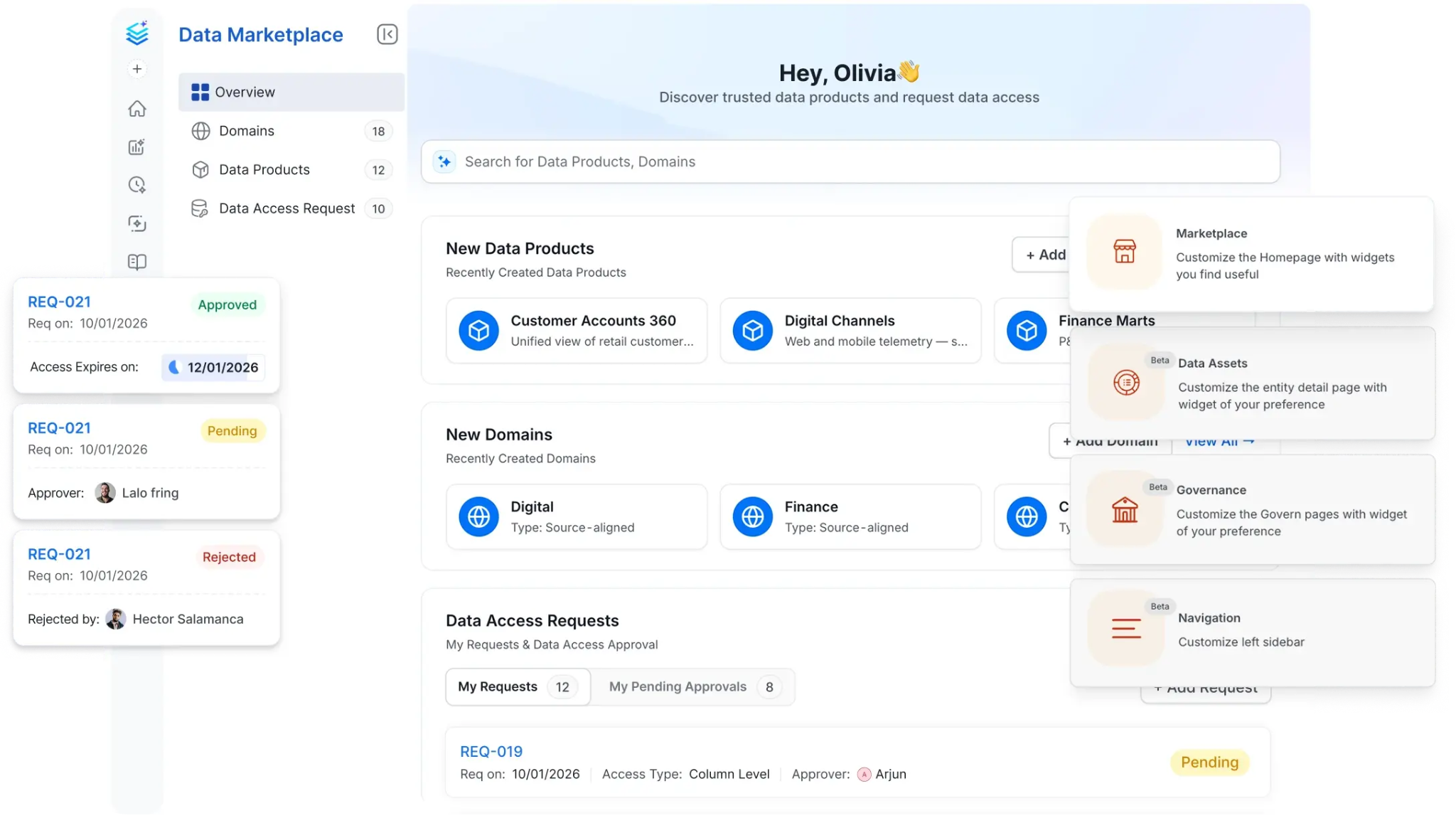
1. Collate Data Marketplace

Collate Data Marketplace is the consumer-facing layer of the Collate platform, where teams discover trusted data products and request access with integrated approval workflows. Built on OpenMetadata, the open context layer, it unifies discovery, governance, lineage, and quality in one marketplace. Business users, stewards, and engineers can self-service governed data products by domain, without waiting on the data team.
Key features include:
- Discover trusted data products: Cross-attribute search by name, domain, or business term across data products, datasets, and assets
- Browse by domain: Navigate hierarchical domains organized as aggregate, consumer-aligned, or source-aligned per the data mesh pattern
- Persona-aware self-service: A marketplace homepage shaped to each role, with the widgets that match business users, stewards, and engineers
- Governed access in place: Request a dataset or a formally defined data product, with column-level, time-bound access approved before it is granted
- Trust signals built in: Ownership, glossary terms, lineage, quality scores, and certification on every listing
- AI- and agent-ready: MCP and APIs let AI agents discover and retrieve governed, certified data products safely
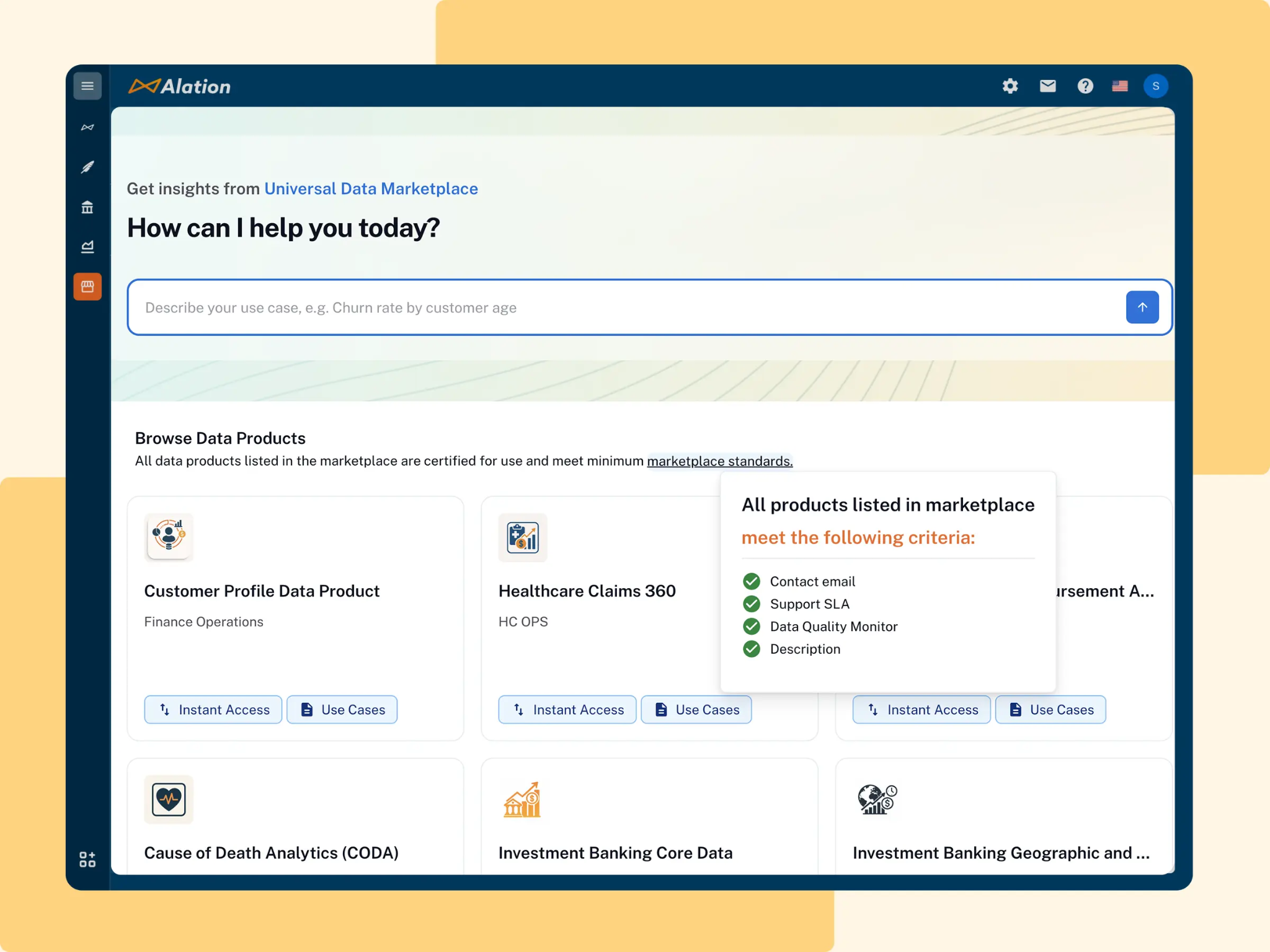
2. Alation Data Products Marketplace

Alation Data Products Marketplace focuses on creating and distributing governed data products that are ready for analytics and AI use. It enables teams to transform raw data into reusable assets, enforce quality and compliance standards, and interact with data using natural language. The platform combines data product creation, governance, and discovery in a single environment to support consistent and scalable data usage.
Key features include:
- No-code data product creation: Allows teams to build governed and reusable data products quickly without writing code.
- Built-in governance and certification: Ensures all published data products meet organizational standards for quality, ownership, and compliance.
- Natural language data interaction: Enables users to query data products using plain language with transparent results and context.
- Centralized data marketplace: Provides a single location to discover, access, and reuse curated data products.
- Managed access workflows: Supports controlled access requests to ensure secure and compliant data usage.
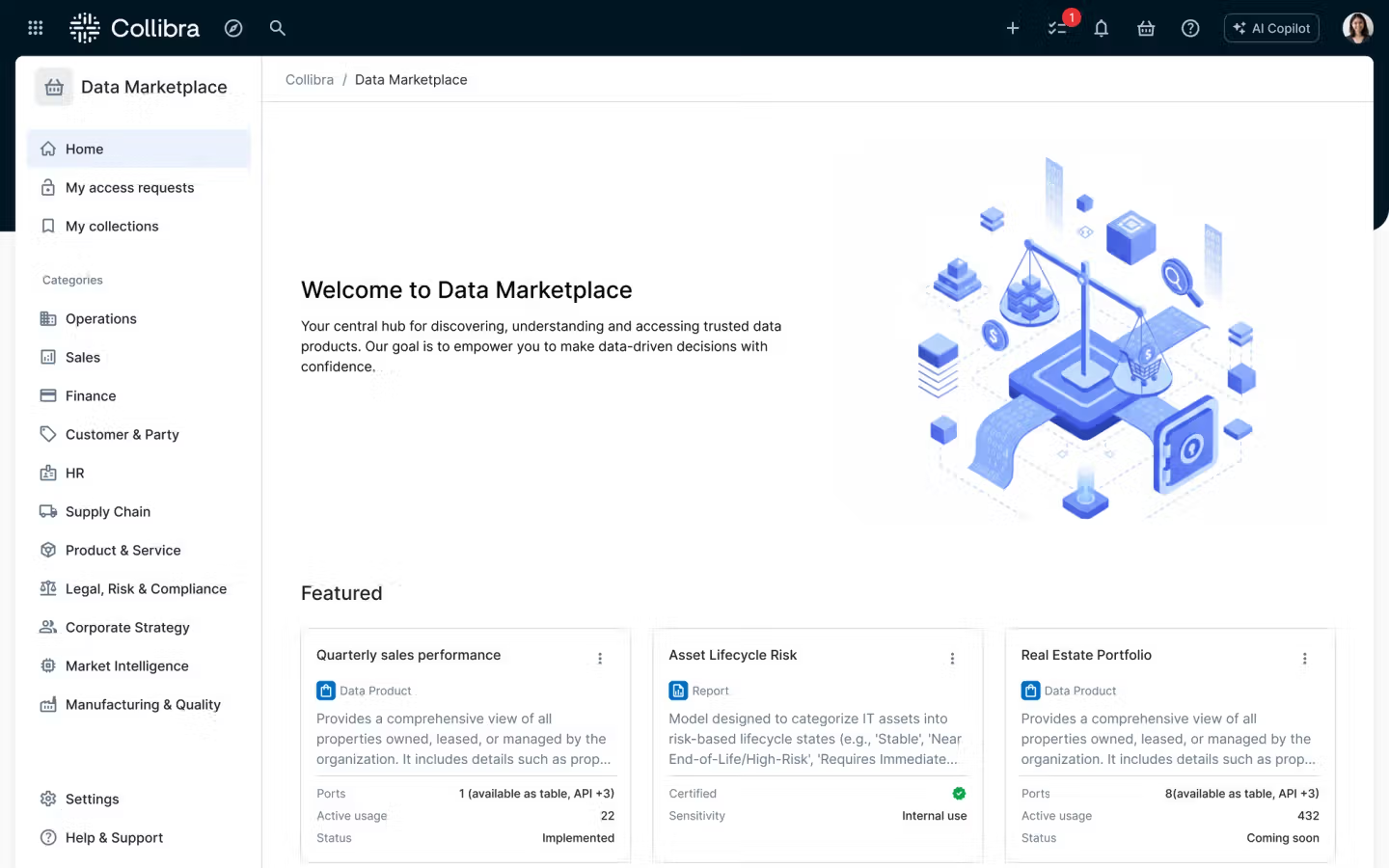
3. Collibra Data Marketplace
Collibra Data Marketplace provides a centralized, self-service platform for discovering, understanding, and accessing trusted data products. It emphasizes ease of use through a shopping-like experience, helping both technical and business users quickly find relevant data assets. The platform also integrates governance, context, and collaboration features to improve data trust and reuse across the organization.
Key features include:
- Search and discovery: Uses filters, AI recommendations, and personalization to help users quickly find relevant data products.
- Business context and data understanding: Provides descriptions, glossary terms, and lineage to help users interpret data correctly.
- Data trust indicators: Displays quality scores, certifications, and lineage to assess reliability at a glance.
- Self-service data access: מאפשר users to request and obtain access through automated workflows.
- Collaboration features: Supports ratings, reviews, comments, and shared collections to promote knowledge sharing.
- Access tracking and auditability: Maintains detailed records of access requests to support compliance and reporting.
4. Informatica Cloud Data Marketplace
Informatica Cloud Data Marketplace enables organizations to share and consume trusted data products through a governed, self-service experience. It supports data democratization by allowing users to discover, request, and use data assets while ensuring compliance with governance policies. The platform integrates with broader data management services to support the full lifecycle of data products.
Key features include:
- Data product publishing: Allows teams to package and share datasets, pipelines, and AI/ML models as reusable data products.
- Automated data provisioning: Simplifies the process from request to delivery, improving operational efficiency.
- Self-service data access: Enables users to locate, evaluate, and request relevant data independently.
- Context and guidance: Provides insights, reviews, and recommendations to improve data literacy and usage.
- Collaboration capabilities: Includes chat, ratings, and alerts to connect teams and share insights.
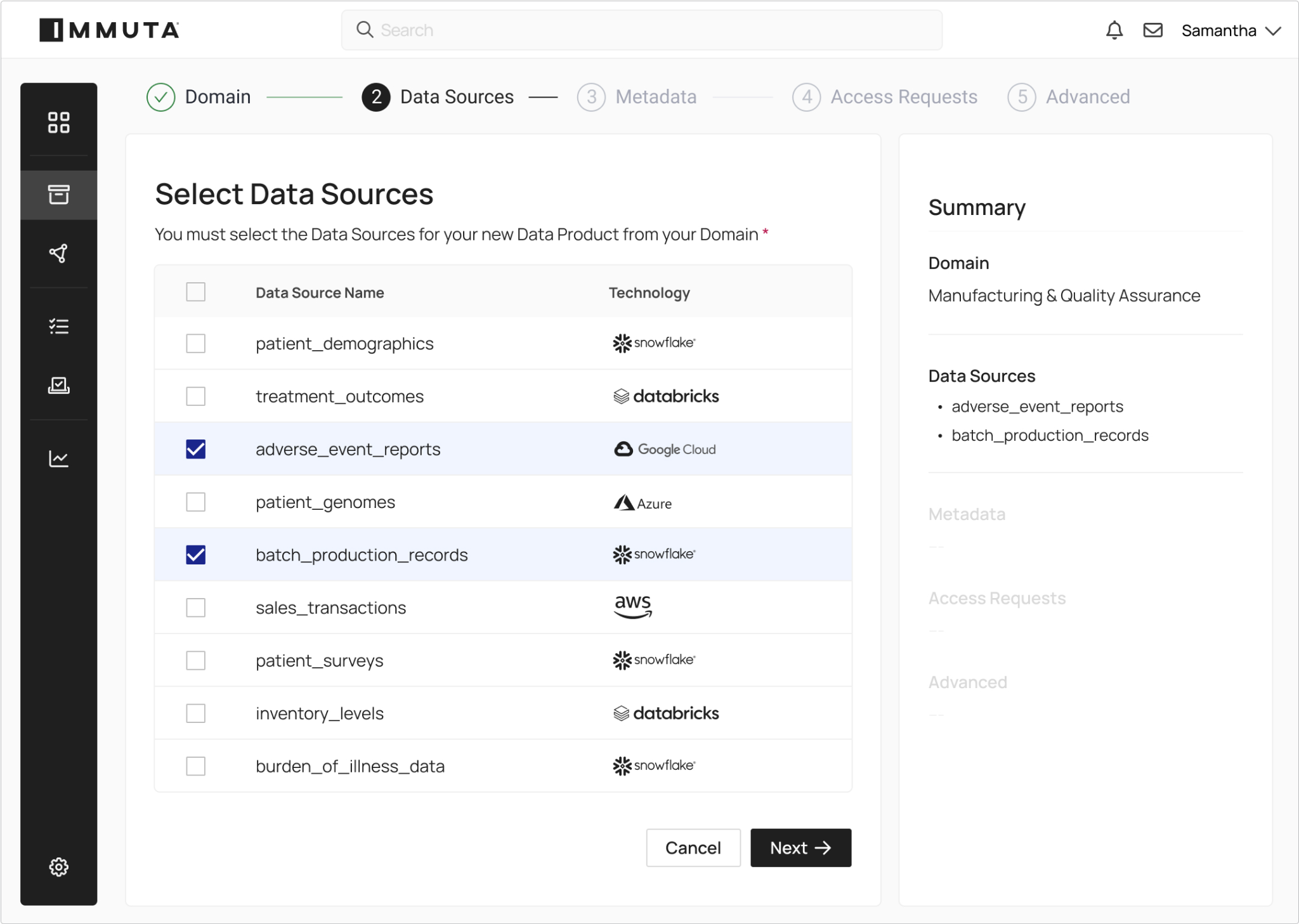
5. Immuta Data Marketplace

Immuta Data Marketplace focuses on secure and automated data access through policy-driven workflows. It acts as a centralized platform where data products are published, discovered, and accessed with built-in governance controls. The platform emphasizes simplifying data provisioning while maintaining strict control over sensitive data and compliance requirements.
Key features include:
- Centralized data discovery: Provides a single interface to publish, find, and manage data products across environments.
- Policy-driven access control: Uses governance policies to automatically grant or restrict access based on approvals and agreements.
- Automated provisioning workflows: Simplifies access requests and approvals to reduce delays and manual effort.
- Data classification and metadata management: Supports tagging, describing, and organizing data products for better visibility.
- Role-based collaboration: Defines roles such as data owners and stewards to manage approvals and workflows.
- Secure data sharing: Ensures sensitive data is protected while enabling controlled access across platforms.
### External Data Marketplace Services
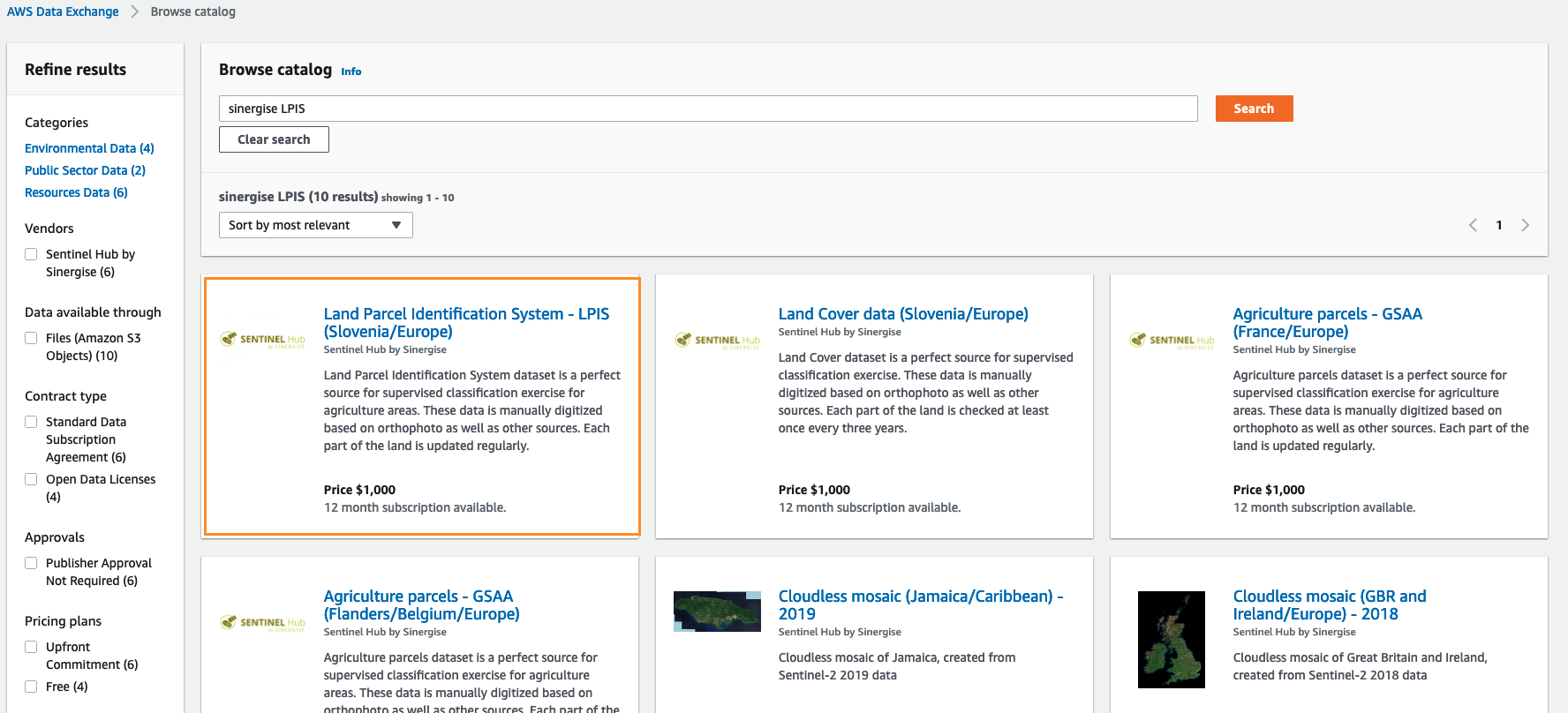
6. Snowflake Data Marketplace

Snowflake Data Marketplace is a platform that allows users to discover, access, and integrate live, AI-ready data, apps, and SaaS products within their Snowflake environment. It connects consumers with data providers, offering more than 3,400 data assets and solutions.
Key features include:
- AI-ready integrations: Direct access to structured and unstructured third-party data, ready for use in AI agents and machine learning workflows
- Broad provider network: Connects users with over 820 data and solution providers across industries
- App and SaaS ecosystem: Includes Snowflake Native Apps and integrated SaaS tools, usable without moving data out of the platform
- Internal and external marketplace options: Supports both public and internal marketplace deployments for external and in-house collaboration
- Flexible procurement: Allows purchases using Snowflake credits via the Marketplace Capacity Drawdown Program
7. AWS Data Exchange
AWS Data Exchange is a cloud-based service that enables customers to find, subscribe to, and use third-party data from a network of qualified providers. The platform simplifies the process of accessing data files, APIs, and data tables by centralizing them into a searchable catalog with consistent pricing and delivery formats.
Key features include:
- Dataset catalog: Access over 3,500 third-party datasets, including APIs, files, and database tables, across diverse industries
- AWS integration: Use subscribed data with AWS services like S3, Redshift, Athena, and SageMaker
- Simplified subscription model: Consistent subscription terms and pricing options reduce friction in data acquisition
- For data providers: Eliminate the need to build delivery or billing infrastructure; AWS handles entitlements and secure distribution
- Discovery and search: Find relevant datasets using the AWS data catalog or Discovery API for custom integrations
8. Datarade
Datarade is a global B2B data marketplace that helps businesses find, compare, and connect with over 2,000 data providers offering products across more than 560 categories. It simplifies third-party data sourcing by allowing users to preview data samples, view transparent pricing, and receive free sourcing advice from specialists.
Key features include:
- Data catalog: Access thousands of data products across over 560 categories, from geospatial to financial, healthcare, and AI training data
- Provider comparison: Benchmark datasets with side-by-side comparisons, including pricing, coverage, and delivery options
- Free sample previews: Preview data samples and metadata to assess product quality before purchase
- Sourcing support: Complimentary guidance from Datarade’s team of data acquisition experts to help match business needs with relevant data
- No buyer fees: The platform is free for data buyers; revenue comes from providers when a transaction occurs
9. Bright Data
Bright Data is a platform for accessing and extracting structured public web data at scale. It enables businesses to gather real-time or historical information from websites using a suite of APIs, scraping tools, and a proxy network. With over 150M ethically-sourced IPs across 195 countries, it offers infrastructure for data pipelines, AI training, and business intelligence.
Key features include:
- Dataset marketplace: Access pre-collected datasets across more than 120 domains, continuously refreshed and validated
- Scraper APIs: Use pre-built or custom scraping endpoints to extract real-time data from a public web source
- Web archive: Tap into a petabyte-scale archive of historical web data, suitable for time-series analysis and trend monitoring
- Web access APIs: Includes SERP, Unlocker, Crawl, and Browser APIs to automate and scale scraping tasks
- Proxy network: Use over 150M residential, datacenter, ISP, and mobile IPs with high availability and geographic targeting
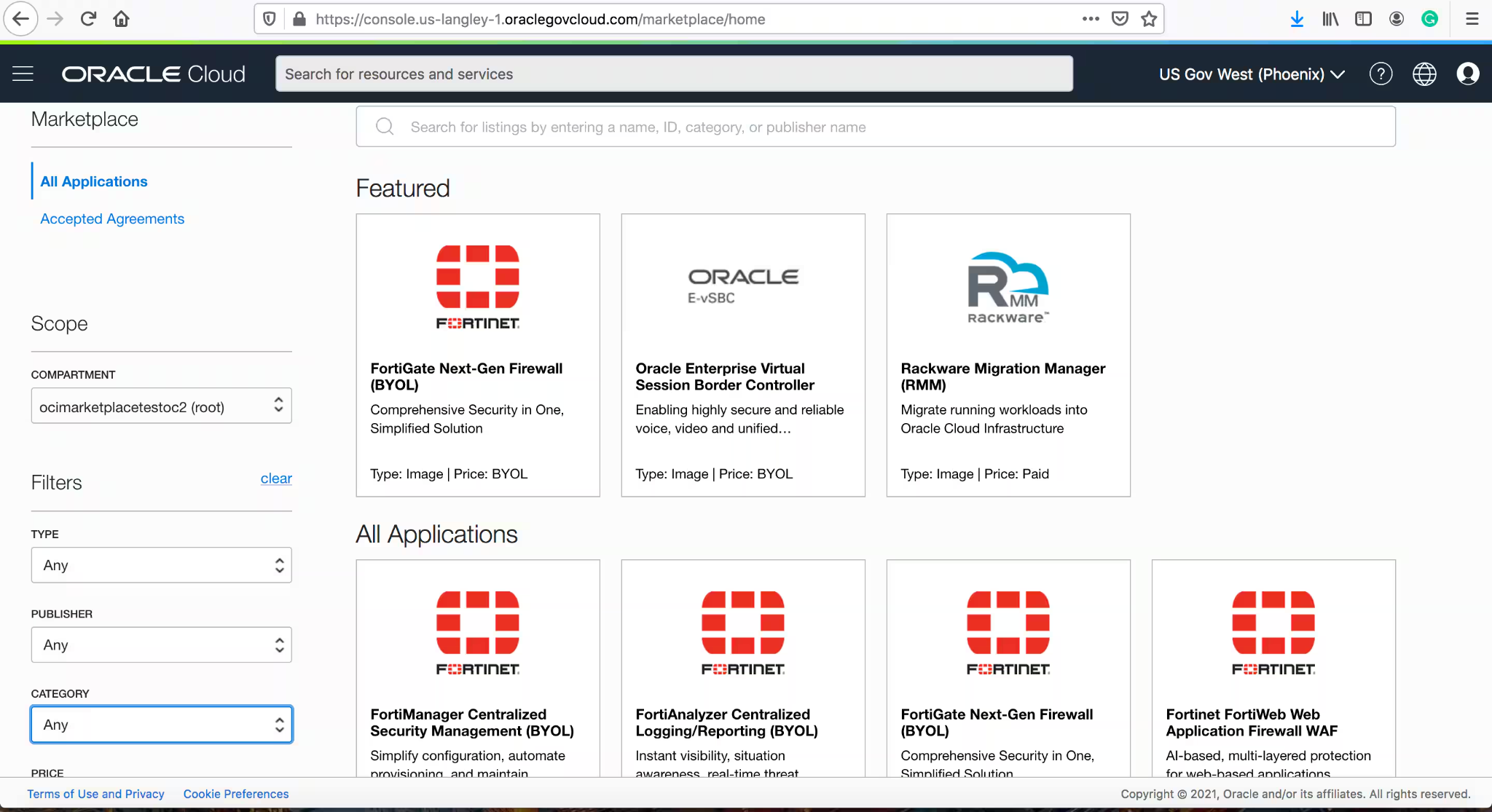
10. Oracle Cloud Marketplace

Oracle Cloud Marketplace is a curated catalog of third-party software solutions to extend Oracle Cloud Infrastructure (OCI) environments. It enables users to quickly deploy a range of applications, including both Oracle and independent software vendor (ISV) offerings, using prebuilt images, containers, and Terraform stacks.
Key features include:
- Click-to-deploy stacks: Prebuilt Terraform templates enable automated, end-to-end deployment of third-party software on OCI
- Oracle application support: Simplified deployment of Oracle apps like E-Business Suite, JD Edwards, PeopleSoft, Siebel, and WebLogic
- Flexible deployment options: Supports compute images, Terraform stacks, and containerized apps for varied infrastructure needs
- Consumption models: Choose between free, BYOL (Bring Your Own License), or hourly paid software
- OCI integration: Integrates with Oracle Identity and Access Management (IAM) for secure, role-based access control
11. AvocaData Marketplace

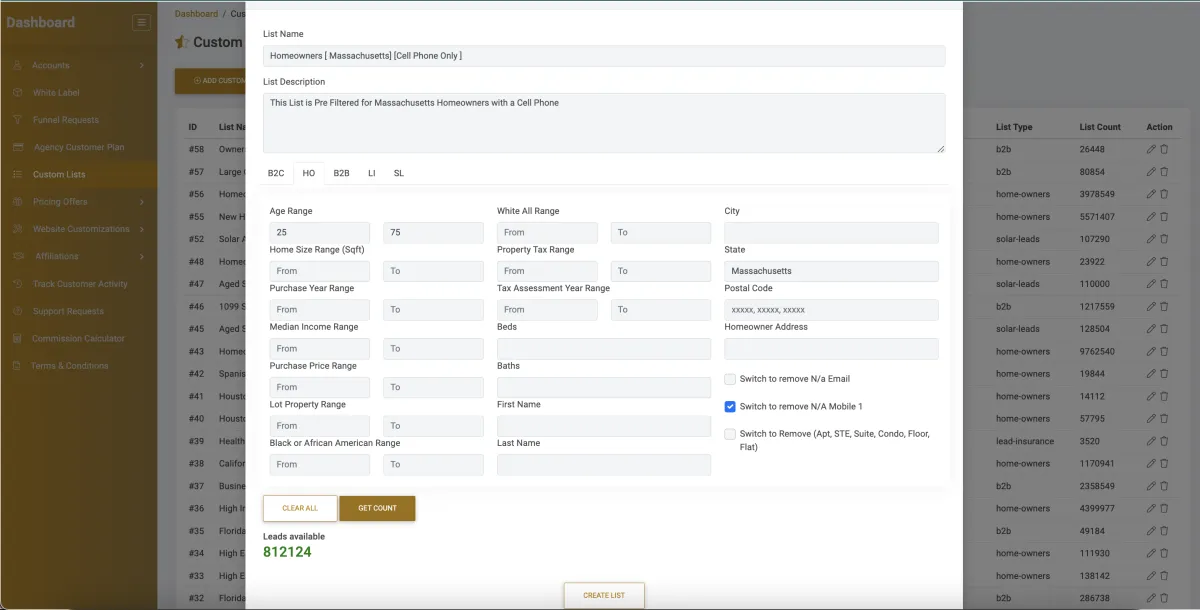
AvocaData is a data-as-a-service (DaaS) marketplace that brings together over 250 data providers in a platform for buying, selling, and monetizing data, leads, and appointments. Unlike traditional platforms, AvocaData offers free, customizable data stores for sellers and unlimited access to lead downloads for buyers.
Key features include:
- Unified marketplace: Access a growing network of over 1,000 data providers and connect with both buyers and sellers in one platform
- Unlimited lead downloads: Paid users can download lead lists without restrictions (up to 5,000 per list)
- White-label data stores: Create branded stores to sell data under a unique label, with control over pricing and presentation
- Data enrichment tools: Improve the accuracy and value of data using enrichment capabilities
- Flexible participation: Choose to only buy data, or easily start selling with access to backend tools
12. SAP Datasphere

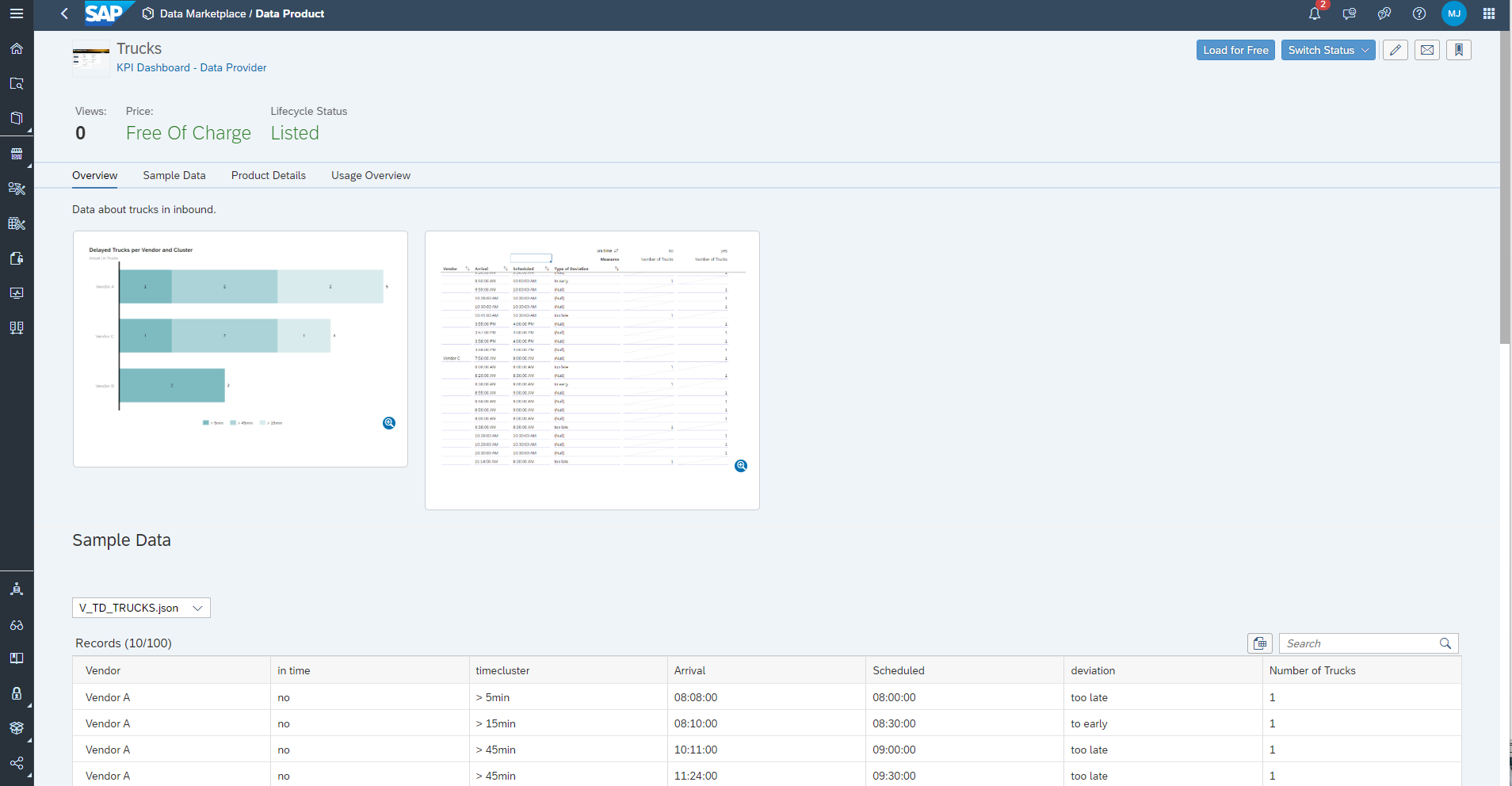
SAP Datasphere is the data component of SAP Business Data Cloud, giving data professionals real-time, governed access to both SAP and non-SAP data across hybrid and multi-cloud environments. It enables organizations to unify their data landscape without duplication, while preserving business logic and context.
Key features include:
- Business data fabric foundation: Serves as the core layer of a business data fabric, enabling integrated data access across systems
- Cross-platform data access: Connects SAP and non-SAP data from multiple sources without moving or duplicating data
- Semantic integration: Automatically reuses business logic and semantic models from SAP applications to preserve context and accelerate time to insight
- Unified data modeling: Harmonizes structured and unstructured data across landscapes into a consistent business semantic layer
- Modern SAP BW evolution: Offers a path to modernize SAP Business Warehouse environments using cloud-native capabilities
13. Databricks Marketplace

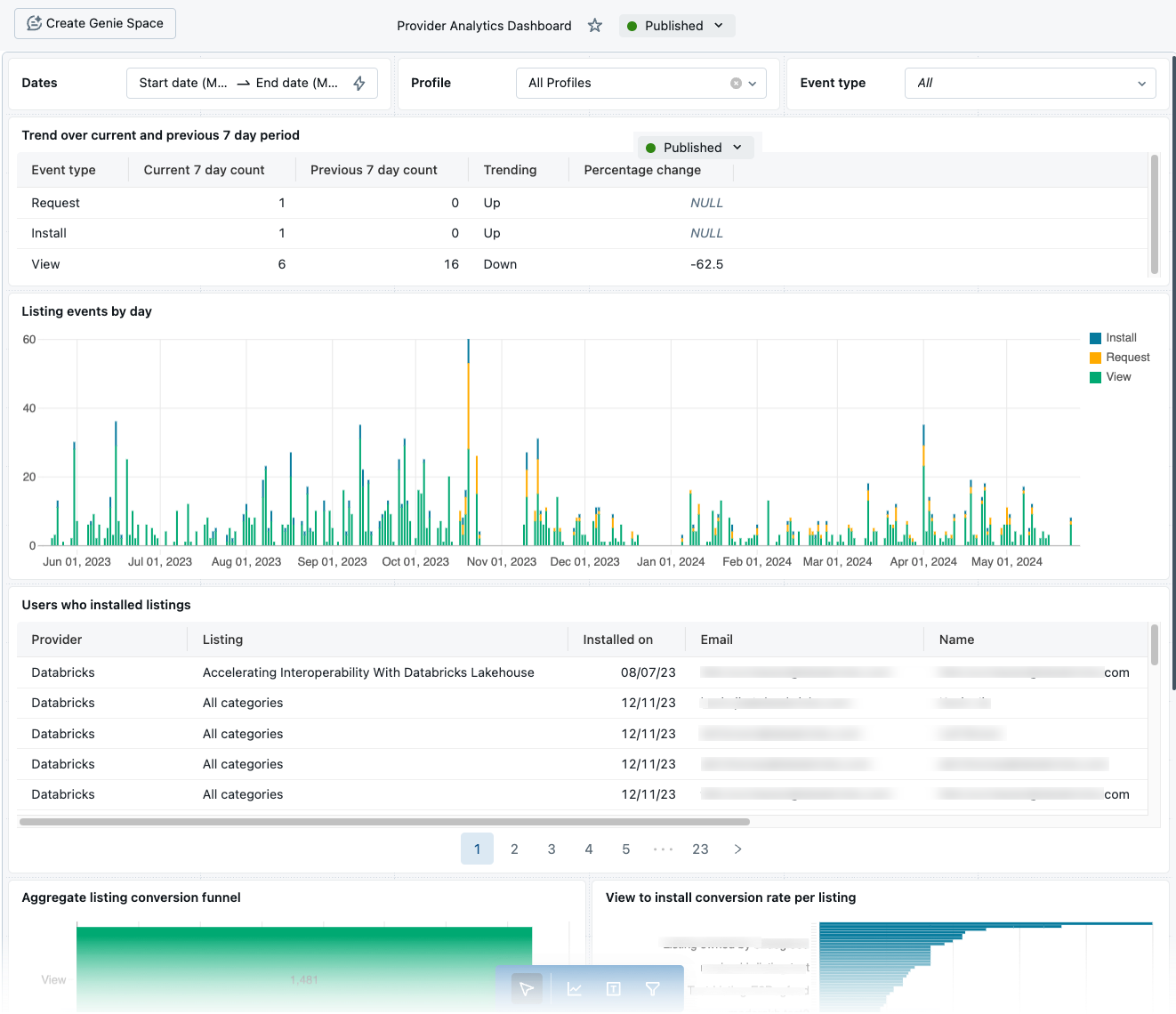
Databricks Marketplace is an open, cloud-agnostic platform for discovering and exchanging data, AI models, notebooks, and analytics assets. Built on the open source Delta Sharing standard, it enables collaboration between data providers and consumers without proprietary dependencies, complex ETL processes, or unnecessary data duplication.
Key features include:
- Open sharing standard: Built on Delta Sharing to enable secure, real-time data access across platforms or cloud environments
- Beyond datasets: Access ML models, notebooks, applications, and dashboards (not just data) within a unified marketplace
- No vendor lock-in: Integrates with existing tools and workflows without proprietary dependencies or infrastructure limitations
- Fast evaluation: Prebuilt notebooks and sample data enable quick assessment of datasets for AI, ML, and analytics use cases
- Cloud-native architecture: Enables collaboration and sharing across clouds, regions, and organizational boundaries
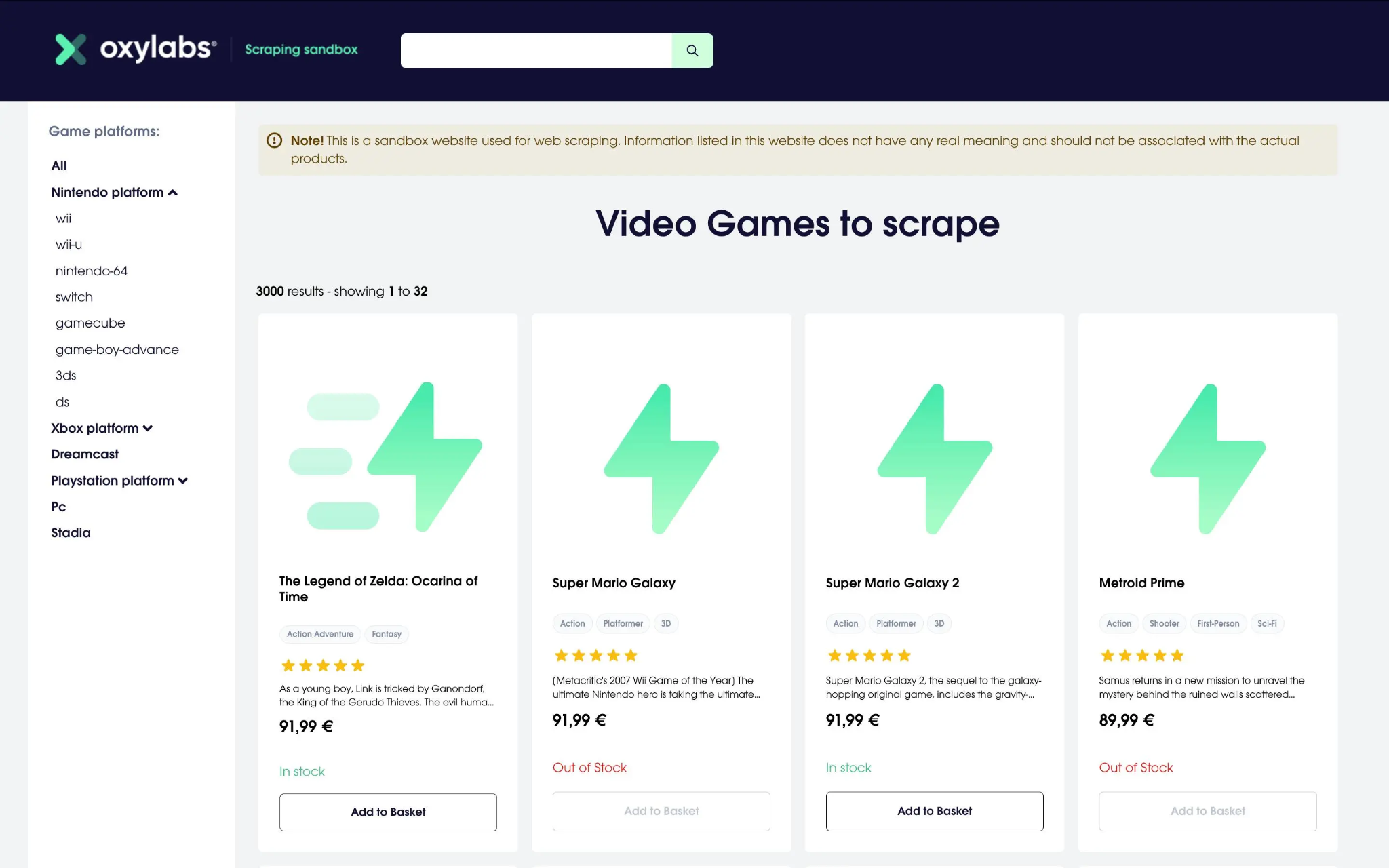
14. Oxylabs

Oxylabs is a web data access platform offering a large ethical proxy network and a suite of scraping tools for scalability, automation, and AI integration. With over 177 million IPs spanning 195 countries, Oxylabs supports tasks from real-time public data collection to complex, AI-ready workflows.
Key features include:
- Proxy network: Access over 177M IPs across residential, ISP, mobile, and datacenter proxy types with coverage in 195 countries
- AI studio: Natural language-driven scraping tool that automates data extraction by mimicking human browsing behavior, suitable for LLM pipelines
- Web unblocker: AI-powered tool that bypasses blocks and CAPTCHAs automatically for smooth, uninterrupted scraping
- Prebuilt scraping APIs: APIs for SERP, eCommerce, travel, and other verticals, delivering structured, ready-to-use data
- Dev integration: Supports major languages (Python, Node.js, Java, PHP, etc.) with documentation and code examples
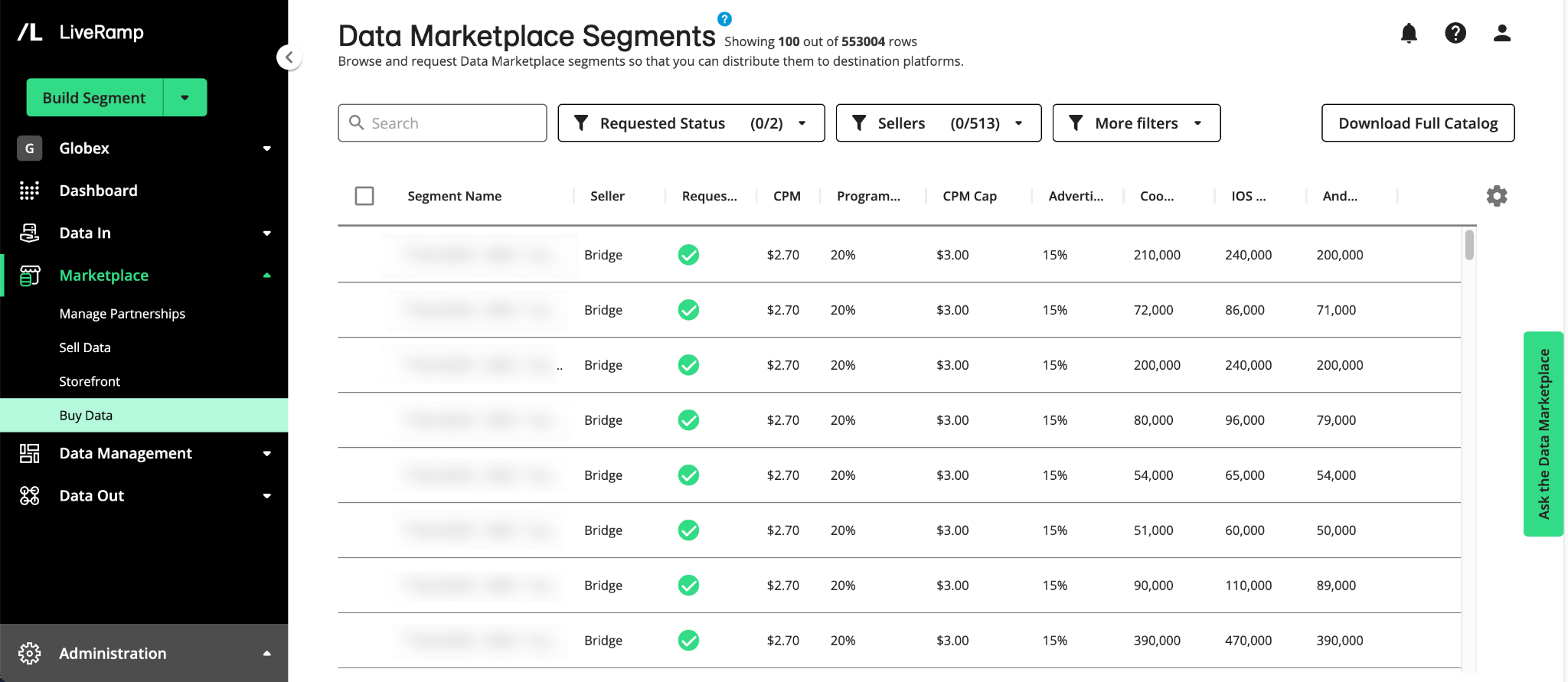
15. LiveRamp Data Marketplace

LiveRamp Data Marketplace is a centralized platform that gives organizations access to third-party data segments to support more effective targeting, measurement, and customer engagement. It enables marketers, analysts, and data teams to refine audience segmentation, enhance campaign performance, and expand customer reach.
Key features include:
- Data catalog: Access thousands of third-party audience segments across industries and use cases
- Custom and syndicated segments: Choose from prebuilt segments or build tailored audiences based on the data strategy
- Seamless activation: Deliver data directly to hundreds of destinations including DSPs, CDPs, social platforms, and measurement tools
- Data collaboration: Tap into LiveRamp’s broader data collaboration ecosystem via Live/Access for second- and third-party partnerships
- Performance-driven: Improve marketing outcomes by using curated data to improve targeting, personalization, and ROI