Atlan Data Catalog: Pros, Cons, and Top 6 Alternatives in 2026
What Is Atlan?
Atlan is a modern data catalog and collaboration platform designed to help organizations manage and understand their data assets. It centralizes metadata from across the data stack, making it easier for teams to discover, document, and govern data at scale. Data discovery is a core use case Atlan addresses through natural language search and active metadata enrichment.
The platform is built around the concept of active metadata, where metadata is continuously updated and enriched with signals like usage, lineage, and quality. This allows users to not only find data but also assess its reliability and understand how it flows through the organization.
Atlan serves as a single source of reference for data knowledge, reducing duplicated work and minimizing the risks of using incorrect or outdated datasets. Organizations also use it alongside a data dictionary to standardize definitions and improve data understanding. Teams evaluating options can also review what features to look for in a data catalog before committing to a platform. Its combination of automation, AI assistance, and broad integrations makes it particularly suited for teams working in fast-moving, cloud-based data environments.
Key Takeaways
- Atlan centers its catalog on active metadata: usage, lineage, and quality signals sit on the asset so you can judge reliability before you query it.
- G2 reviewers in this article flag a steep learning curve, a UI that can feel technical for business users, confusing Personas and Purposes permissions, and little native usage reporting.
- Connector and seat pricing can be a barrier for smaller teams.
- Collate is the first alternative here because it keeps discovery, column-level lineage, quality, governance, and agents on OpenMetadata instead of bolting those on as modules.
- When you evaluate any catalog, weigh integration breadth, governance you can enforce, and whether both engineers and business users can actually find data.
Key Features of Atlan Data Catalog
Atlan offers a range of features that go beyond traditional data cataloging. Built for modern data teams, it focuses on simplifying data discovery, enhancing trust, and improving collaboration through active metadata and AI-driven tools. Below are some of the key capabilities that set Atlan apart.
- Natural language search: Atlan offers a Google-like search experience where users can type in natural language queries to find relevant data assets. It recognizes synonyms and contextual relevance, allowing both technical and non-technical users to discover data without needing to know specific table names or column structures.
- Business context integration: Users can search through business logic by finding assets linked to KPIs, metrics, and operational definitions. This enables business teams to locate the exact data they need within their own contextual frameworks.
- SQL syntax support: For engineers and technical users, Atlan supports SQL-based queries, such as db.schema, making it easier to navigate large and complex data environments using familiar syntax.
- Asset coverage: The catalog spans a wide array of asset types, including dashboards, tables, columns, schemas, calculated fields, connections, and more. This comprehensive scope ensures that teams have visibility into everything from upstream data sources to downstream analytics tools.
- Trust signals and metadata insights: Atlan's Companion Sidebar provides critical trust signals, such as usage activity, downstream dependencies, and verification status, so users can evaluate the reliability and impact of a data asset before using it.
- Personalized browsing: The platform allows users to filter data assets using any metadata property. This creates a tailored "shopping" experience that matches individual roles, such as analysts, data engineers, or architects.
- AI-driven data exploration: Atlan AI acts as a co-pilot, enabling users to discover data via chat, auto-generate SQL, and explore suggested questions based on what others in the organization are asking. It also creates first-draft documentation for assets, easing the burden of manual updates.
- Seamless integration: Atlan connects with a wide range of modern tools including Snowflake, dbt Labs, Redshift, Looker, Sisense, Tableau, and Slack. This ensures it fits naturally into existing data ecosystems without requiring major workflow changes.
Limitations of Atlan Data Catalog
While Atlan offers a modern approach to data cataloging, it does come with a set of limitations that teams should be aware of, especially when planning large-scale rollouts or business adoption. These limitations were reported by users on the G2 platform:
- Steep learning curve: The interface and feature set can be overwhelming for new users, especially when transitioning from basic usage to more advanced tasks like mass-tagging or documentation. This requires extra training and time investment.
- Complex UI and navigation: The user interface is often perceived as too technical and not intuitive for business users. Some screens are difficult to navigate or would benefit from a more table-like layout for clarity.
- Bugs and reliability issues: Despite frequent feature updates, users report intermittent bugs that require engineering support. Fixes are usually prompt, but the issues can disrupt workflows.
- Search usability issues: The search functionality can be less effective for users who aren't sure what they're looking for. General search terms often yield overwhelming or unclear results.
- Permission management complexity: The Personas and Purposes model for access control is powerful but confusing. Users often find it difficult to understand what they can access without toggling between different configurations.
- Lack of native usage reporting: Usage analytics aren't built into the product. Organizations must rely on third-party tools to track adoption and value, which may require additional approvals and integration work.
- Limited automation flexibility: The Playbooks feature is useful but could benefit from more automation options like event-based triggers, outbound API calls, and advanced approval workflows.
- Pricing concerns: Connector and member license costs are relatively high unless discounted. This can be a barrier for smaller teams or those with limited budgets.
- No built-in lineage editing UI: There is currently no interface for manually building or editing lineage within the tool, limiting flexibility when automated lineage capture is incomplete.
- Integration instability: Some users have experienced unexpected issues with third-party integrations like Tableau and Matillion, which took time to resolve and slowed down implementation.
Notable Atlan Data Catalog Alternatives
1. Collate
Collate is an AI-powered metadata platform that unifies data discovery, observability, and governance beyond traditional data catalogs. Built on OpenMetadata, the fastest-growing open source metadata platform, Collate was developed by the founders of Apache Hadoop, Apache Atlas, and Uber Databook, and hardened by a community of hundreds of open committers. The platform centralizes metadata across the entire data estate and makes it easily accessible through a collaborative interface customizable for both technical and business users. Key features include:
- Unified Metadata Graph: Organizes all metadata across the data landscape into a central source of truth, eliminating the need to switch between catalog, quality, or governance tools.
- Extensive connectivity: Includes 130+ turnkey integrations for databases, data warehouses, BI platforms, streaming services, and ML models, with easy setup and bi-directional synchronization. Collate's Snowflake integration goes beyond basic cataloging to surface lineage and quality signals directly in the warehouse.
- AI-powered capabilities: Features conversational AI for data management and analytics, AI Agents for intelligent automation, enterprise-grade Model Context Protocol support.
- Advanced lineage and impact analysis: Automated column-level lineage capture with cross-platform tracing across services, products, and domains. Upstream and downstream impact analysis for accelerated troubleshooting.
- Data products and contracts: Organizes assets into business domains and consumable products with ownership, certifications, and documentation. Machine-readable contracts enforce schemas, quality, and SLAs between data teams.
2. Collibra Data Catalog
Collibra Data Catalog is an enterprise data intelligence platform designed to unify, enrich, and simplify access to data across complex ecosystems. It helps organizations break down silos and create a single, trusted view of their data assets through more than 100 native integrations. By combining automation, AI, and governance, Collibra enables teams to discover, understand, and collaborate around data with speed and confidence. Key features include:
- Unified view of data assets: Integrates with 100+ data sources, including unstructured data, to automatically discover and centralize metadata across the organization.
- Automated stewardship: Reduces manual curation with AI-driven classification, profiling, and automated generation of data descriptions.
- Business context enrichment: Links data to glossary terms, quality metrics, stakeholders, and policies, helping both business and technical users understand meaning and use.
- Collaborative data products: Supports reusable data products and workflows, allowing teams to define service-level objectives and data contracts for consistent, reliable access.
- Trusted data marketplace: Provides a self-service portal where users can easily browse, request, and access curated, certified data assets.
3. Alation Data Catalog
Alation Data Catalog is a data intelligence platform built to simplify data discovery, governance, and collaboration across organizations. For a detailed look at Alation's governance capabilities and limitations, see the Alation data governance comparison. It unifies data assets from diverse environments into a single searchable catalog, allowing both technical and business teams to quickly find, understand, and trust the data they need. Key features include:
- Search engine: Uses machine learning and natural language to surface the most relevant data assets, even without technical keywords.
- Collaboration tools: Breaks down silos by showing what data exists, where it resides, how it can be used, and how trustworthy it is.
- Extensive integrations: Supports 120+ connectors across databases, BI systems, AI models, and applications, with an Open Connector Framework for other sources.
- Automation with active metadata: Auto-extracts and integrates metadata, generates pipeline code, and keeps catalogs up to date without manual stitching.
- End-to-end lineage: Provides visibility into data's full journey from source to destination for better trust and compliance.
4. Purview Unified Catalog
Microsoft Purview Unified Catalog is a comprehensive data governance and discovery platform designed to unify data visibility, compliance, and value creation across the enterprise. It extends beyond traditional governance tools by not only securing and managing data but also enabling organizations to turn their data estate into a business asset. The unified catalog is delivered as an integrated SaaS solution. Key features include:
- Federated data governance: Balances central oversight with distributed accountability. Enables consistent policies and standards while empowering teams with self-service.
- Governance domains: Organizes data assets by business function, such as Finance or Marketing, to improve accessibility and clarify ownership.
- Unified access policies: Supports self-service access requests while ensuring compliance and right-use standards are enforced across the data estate.
- Data products: Groups related data assets, like tables, files, and reports, into reusable packages that provide business context and enable discovery.
- AI-powered discovery: Offers search through an AI copilot that helps users find relevant data by governance domain, keyword, or product.
5. DataHub
DataHub is a metadata platform built to handle the scale and complexity of AI and data in production. Unlike traditional catalogs that focus mainly on dataset discovery, DataHub unifies discovery, observability, and governance in a single platform. It is designed to support both human and machine use cases, ensuring that AI models, data pipelines, and business users operate with trusted, reliable, and well-governed data. It is delivered as a fully managed cloud service. Key features include:
- Unified discovery: Personalized search and discovery for analysts, developers, and scientists, with Chrome extensions to bring data context directly into BI tools.
- Metadata graph: Scalable graph-based architecture that keeps up with large volumes and high velocity of data and AI assets
- Lineage visibility: Detailed table, column, and job-level lineage graphs to understand data provenance and downstream impact.
- AI-driven context enrichment: Automated metadata enrichment, AI-generated documentation, and smart propagation to reduce manual effort.
- Subscriptions and notifications: Stay updated on changes and activity with personalized alerts in tools like Slack and email.
6. Secoda Data Catalog
Secoda is an AI-powered enterprise data catalog designed to scale with modern organizations. It centralizes metadata into a single view of the entire data ecosystem, making discovery as simple as a web search. By combining intelligent search, automated documentation, lineage, and governance workflows, Secoda reduces duplicate work, builds confidence in data assets, and helps teams make faster, more reliable decisions. Key features include:
- AI-powered search: Instantly find relevant datasets, owners, and usage details with a search experience similar to the web.
- Business glossary: Define and standardize key terms to bridge technical and business teams with a shared vocabulary.
- Centralized requests: Collect, organize, and manage data questions and requests in one location, reducing repeated effort.
- Automated lineage: Visualize column- and table-level lineage with automatic updates, enriched further through the Secoda API.
- Certified assets: Mark and share trusted datasets and sensitive resources to promote safe, consistent data usage.
FAQs
What is Atlan used for?
Atlan is a data catalog and collaboration platform that centralizes metadata so teams can find assets, see lineage and usage signals, and decide whether a dataset is trustworthy before they use it.
What limitations do reviewers report?
G2 reviews cited in this article mention a steep learning curve, a UI that can feel technical for business users, confusing Personas and Purposes permissions, limited native usage reporting, and relatively high connector and seat pricing.
How does Collate compare as an Atlan alternative?
Collate is built on OpenMetadata. It keeps discovery, column-level lineage, quality, governance, and AI agents on one metadata graph instead of treating those as separate modules. You can export metadata in open formats rather than a proprietary catalog schema.
Which other alternatives should I evaluate?
Besides Collate, this page covers Collibra, Alation, Microsoft Purview, DataHub, and Secoda. Match the shortlist to whether you need a governance suite, a Microsoft-native catalog, or an open metadata platform.
Where should I go next if I am choosing a catalog?
Start with what a data catalog actually covers, then use a buying checklist. Collate also publishes a direct Collate vs Atlan comparison if you are already looking at both.
Related Reading
Conclusion
Atlan is a capable metadata platform, with AI-driven features that make it suitable for modern data ecosystems. However, organizations should evaluate its learning curve, pricing, and integration stability when comparing it with alternatives like Collate, Collibra, Alation, ensuring the chosen solution aligns with their governance maturity and operational needs. For a broader view of the market, see the comparison of top data governance platforms.
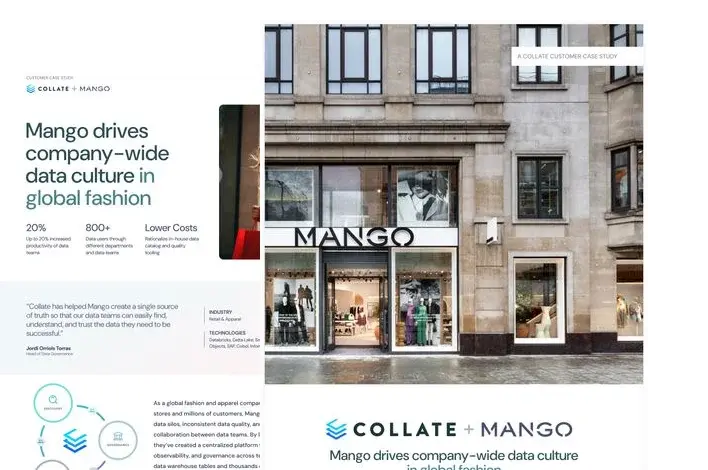
Fashion Retailer Mango’s Data Journey with Collate
Read the case study
Sign up to receive updates for Collate services, events, and products.
Share this article


Ready for trusted intelligence?
See how Collate helps teams work smarter with trusted data