Why We Built a Native Agentic Harness for Data on Top of Collate's Context Platform


Claude Code and Codex are usually described as coding agents. That description is accurate, but it leaves out a large part of why they are useful.
A strong model is clearly important, but the model is only one component of the product. Around it sits an agentic harness that manages context, decides which tools are available, controls permissions, executes commands, observes the results, validates the work, and gives the model another opportunity to correct itself.
Anthropic describes its Agent SDK as providing the same tools, agent loop, and context management that power Claude Code. OpenAI explicitly calls the core Codex loop a harness that coordinates the user, the model, and the tools needed to perform software work. The Codex loop plans, edits code, runs tests or other tools, observes the result, repairs failures, and repeats.
There has also been a useful discussion in the Claude Code community about the “harness problem.” Some of the specific performance claims in that discussion are anecdotal and were rightly challenged for lacking reproducible evidence. But the broader observation is important: model quality and agent quality are not the same thing. The same model can feel very different depending on how context is managed, how tools are exposed, how much system overhead is introduced, and whether the execution loop gives the model useful feedback.
This distinction matters for data even more than it does for code.
Enterprise Data and Agentic Analytics Needs a Harness, Not a Single Data Agent
Code already lives inside a designed system.
A repository has files, types, interfaces, dependencies, tests, build scripts, version history, and conventions. Claude Code or Codex can inspect that environment, make a change, run the test suite, observe a failure, and try again.
Enterprise data does not live in anything resembling a single repository.
It is distributed across Snowflake, Databricks, operational databases, Kafka topics, Protobuf schemas, S3 buckets, orchestration systems, dbt projects, Power BI, Tableau, Looker, APIs, ML platforms, documents, and years of SQL written across different tools.
The meaning of that data is even more fragmented.
A table called orders does not tell you whether it represents orders placed, fulfilled, invoiced, or paid. A column called customer_id does not tell you whether Customer means a person, an account, a household, a merchant, or a legal entity. A metric called Revenue does not tell you whether Finance means booked revenue, recognized revenue, gross revenue, net revenue, or the version approved for the board.
An LLM can produce SQL that compiles and still return the wrong business answer.
This is why I do not think the right architecture is an LLM connected directly to a warehouse. A successful enterprise data experience needs an agentic harness for data.
That harness has to interpret the business question, resolve the concepts and metrics involved, find the authoritative data across systems, apply the requesting user’s permissions, plan the analysis, execute the queries, observe the results, validate them against quality and semantic rules, repair the plan when necessary, explain the assumptions, and preserve what the organization learns.
Text-to-SQL is one tool inside that harness. It is not the harness itself.
What is An Agentic Data Harness?
The word “harness” should not be interpreted as adding as many tools, instructions, and pieces of context as possible.
That usually creates the opposite problem.
A model can be overwhelmed by an oversized system prompt, hundreds of tool definitions, conflicting instructions, and large amounts of irrelevant context. Anthropic has written about this problem directly: loading tool definitions and routing intermediate results through the model’s context window can slow an agent down and increase cost as the number of connected tools grows.
A good agentic harness is selective.
It gives the model the context needed for the current task, exposes the tools that are relevant, defines clear permission boundaries, and provides a useful feedback loop. It also knows when to summarize, when to retrieve more detail, and when the available evidence is not enough to answer the question.
This became an important design principle for us in Collate.
We did not want to collect an entire enterprise data estate and then dump all of it into every prompt, since there is no model context window big enough to fit this. We wanted one governed source of context, transformed into the right view for the person, question, and task.
Enterprise Data and Agentic Analytics Depend on A Context Platform
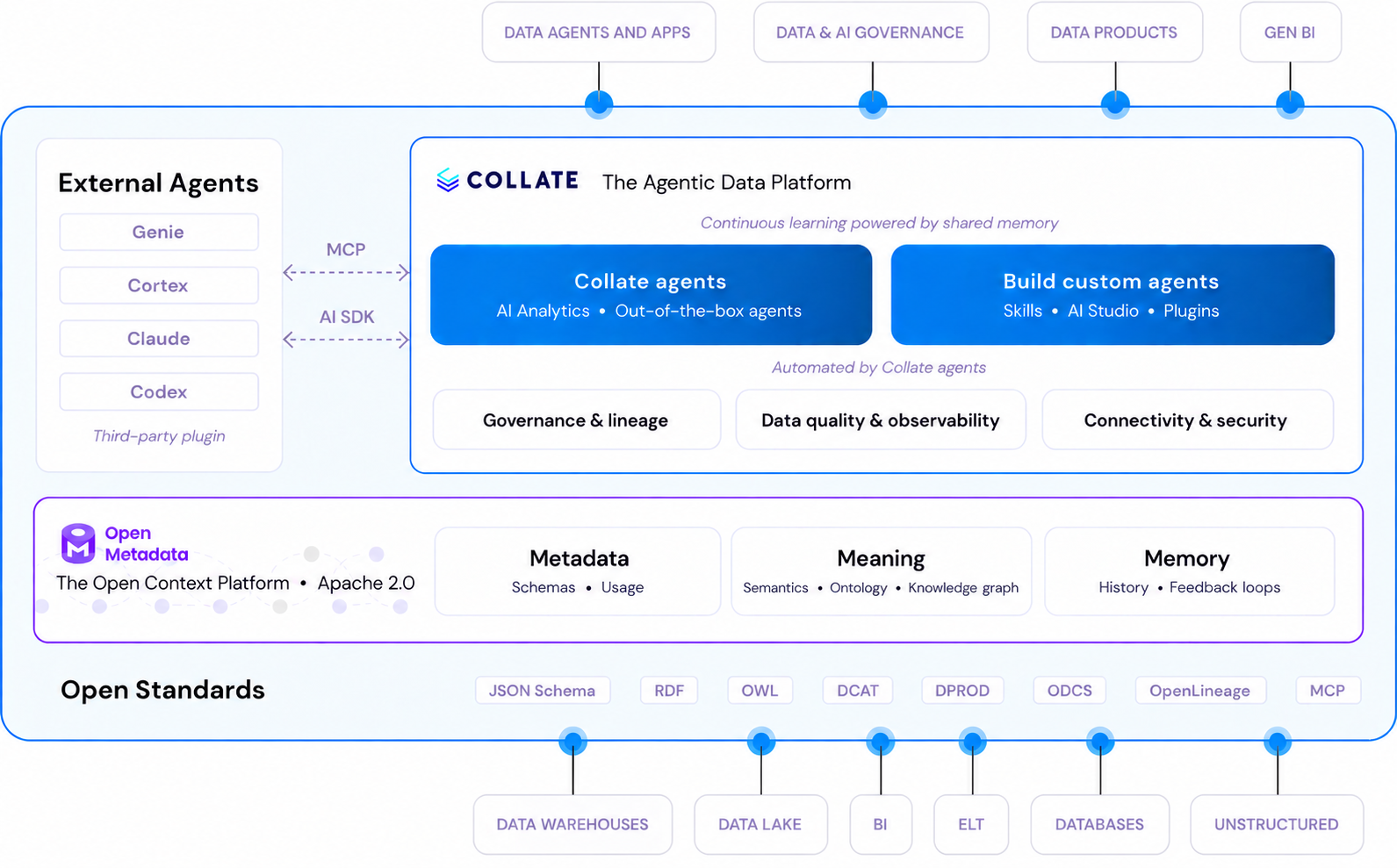
A context platform provides metadata + meaning + memory
Before an agentic harness can answer a serious business question, the organization needs a reliable model of its data.
That is the foundation we have spent the past five years building in OpenMetadata and Collate.
OpenMetadata is the Open Context Platform for AI. It gives agents three things together:
-
Metadata - the technical schemas, lineage, quality, ownership, and usage that describe what data exists
-
Meaning - the glossaries, classifications, metrics, business concepts, and semantics that describe what the data means
-
Memory - the conversations and corrections across your organizations captured once so they don't have to be re-explained.
More than 130 connectors bring that context from databases, warehouses, lakehouses, dashboards, pipelines, messaging systems, object stores, ML systems, and other parts of the enterprise estate.
This is not only an inventory of tables and columns.
For an individual asset, the Open Context Platform can assemble this into LLM-ready context containing the schema, foreign-key graph, frequently observed joins, glossary terms, applied metrics, Context Center articles, organizational memories, lineage, profile signals, and current data-quality standing. The same context is available through MCP, REST, and SDKs rather than being rebuilt independently inside every application.
That gives the agentic harness we built in Collate, something a database connection alone cannot provide: a connected view of how the asset is structured, how it is used, whether it can be trusted, and how it relates to the rest of the organization.
Collate is the agentic platform built on top of OpenMetadata which includes out-of-the-box agents and a no-code agent builder to make it easier to build and govern context for people and agents in your organization.
Collate’s Agents Keep Context Current
An enterprise context platform cannot depend on every asset being documented and governed manually before it becomes useful.
The Collate Agentic Data Platform uses a harness to orchestrate specialized AI agents and automations to improve the context foundation continuously. A Documentation Agent drafts missing descriptions. A Tier Agent uses lineage and usage to identify important assets. A Data Quality Agent recommends tests based on constraints and patterns. Classification agents identify sensitive information and link business terms to the relevant tables and columns.
These agents are not separate applications operating over disconnected copies of metadata. They update the same context graph used by people, Collate AI Analytics, external agents, and governance workflows.
That is important because the quality of the agentic harness depends on the quality of the environment it operates inside. If the metadata is incomplete, the definitions are inconsistent, or the quality signals are missing, the harness cannot compensate simply by making more model calls.
Defining Explicit Business Meaning Through Ontologies
Technical metadata can tell the harness that customer_id is a string. It cannot tell the harness what concepts like “Customer” means to the business.
That is the role of ontologies.
OpenMetadata allows organizations to define business concepts, the properties those concepts carry, and the relationships between them. Those concepts can then be mapped to the physical tables, columns, metrics, dashboards, policies, and data products that implement them.
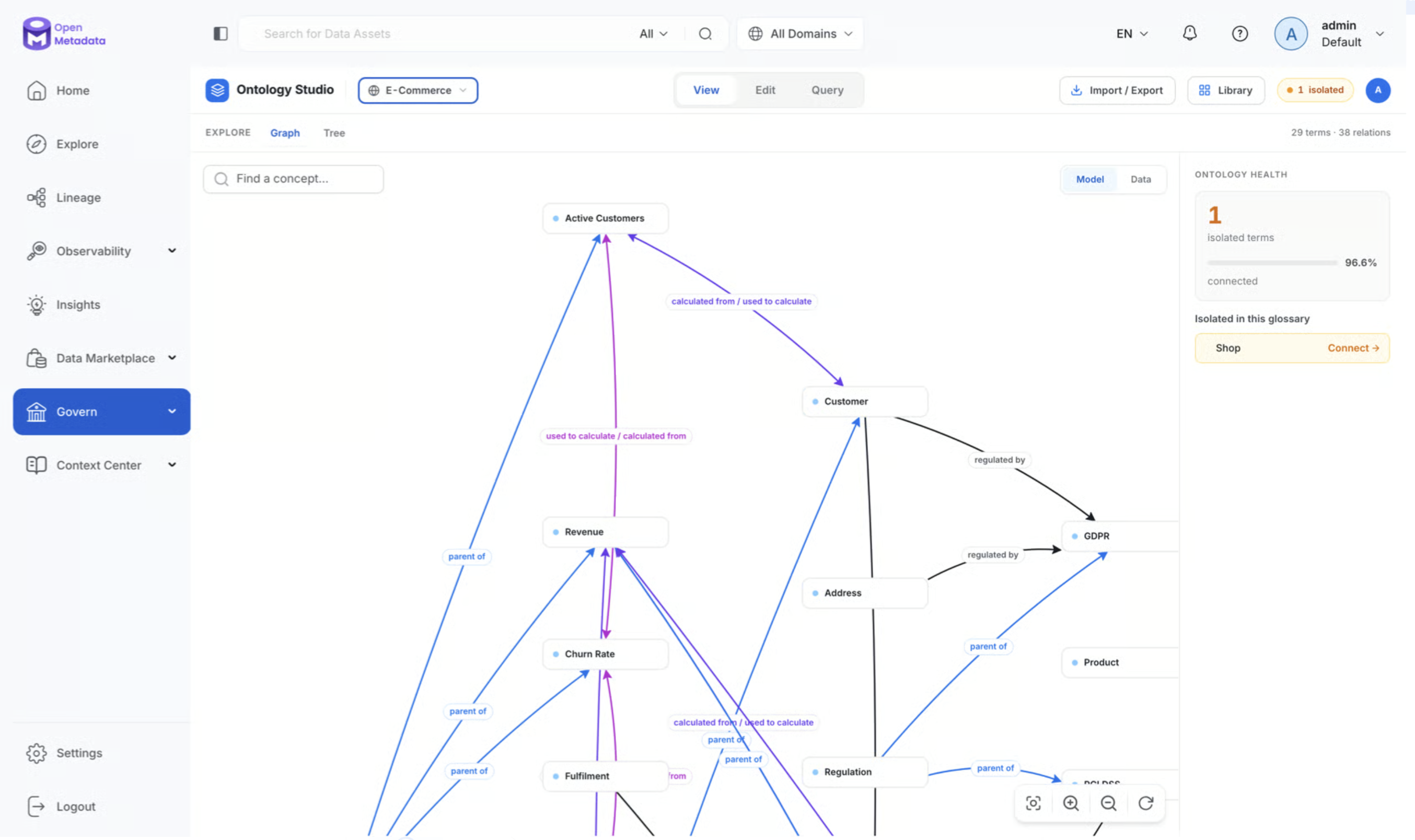
Ontology Studio: business concepts as a graph
An ontology can define Customer, Account, Order, Product, Subscription, Region, Revenue, and Churn as separate concepts. It can describe how they relate and map properties such as customer identifier, segment, account status, region, and churn probability to the actual data where those values live.
The word Customer is no longer left for an LLM to reinterpret in every conversation. It becomes a governed business concept connected to the data that represents it.
The Ontology Explorer and Knowledge Graph provide both directions of this relationship. Starting from a table or dashboard, a user or agent can move upward into business meaning. Starting from a concept such as Revenue, they can move downward into the tables, columns, metrics, dashboards, quality tests, owners, and policies that make the concept operational.
A Knowledge Graph Beats Vector Search for Certified Metrics
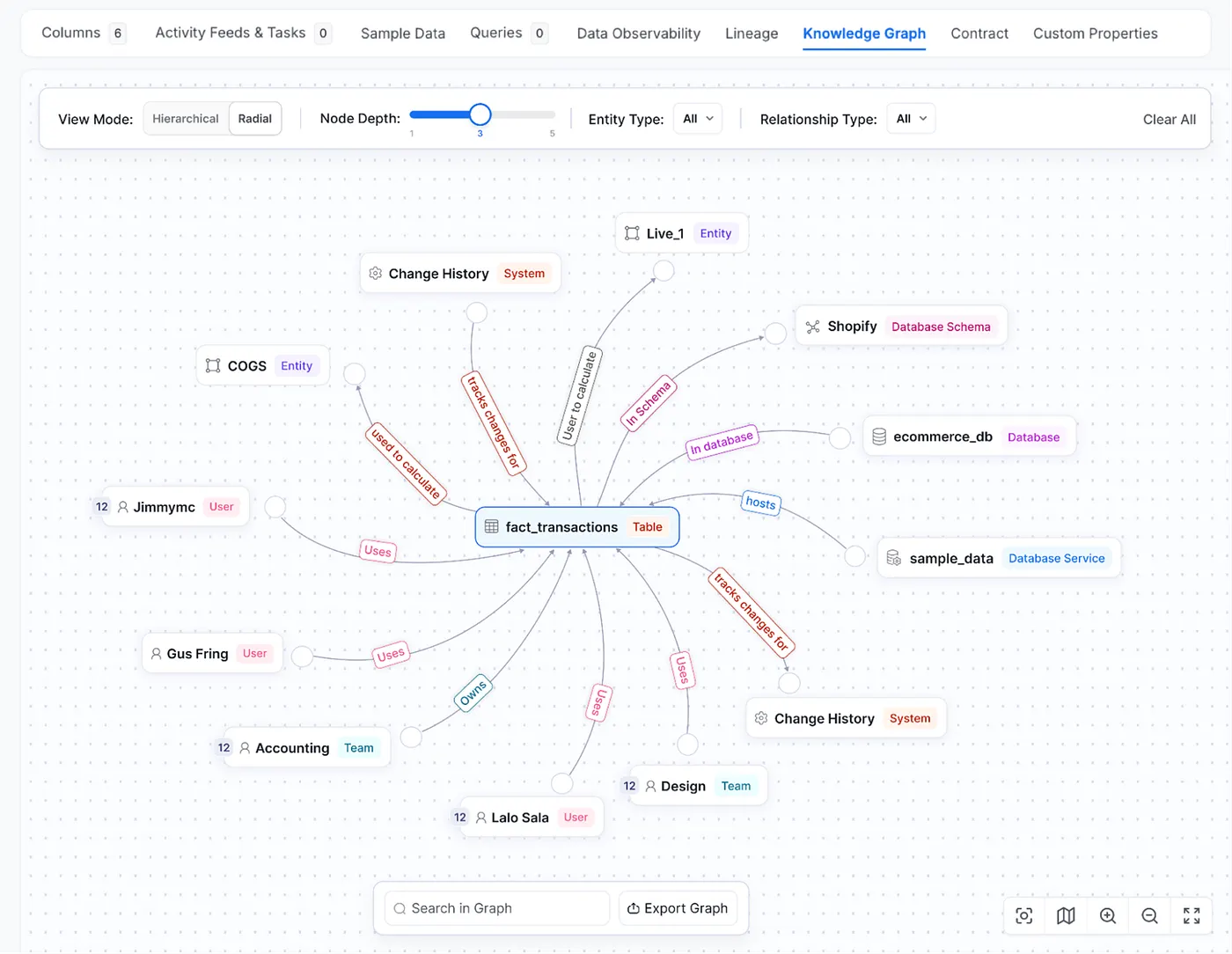
Knowledge Graph view: certified metric + relationships
Ontologies become more useful when they are connected to the operational metadata graph.
A concept such as Net Revenue can be linked to its canonical metric, the source tables used to calculate it, the pipelines that produce those tables, the dashboards that display it, the tests that validate the inputs, the policies that govern it, and the team responsible for it.
OpenMetadata’s schema-first entity model remains the operational source of truth. RDF and OWL provide a standards-based semantic representation of the graph. JSON-LD connects the entity model to linked data, SHACL supports validation, SPARQL supports multi-hop traversal, and RDFS and OWL allow the graph to infer relationships from the facts already represented.
This is different from vector retrieval alone.
Vector search is useful for finding descriptions, articles, and assets that appear semantically related to a question. The knowledge graph establishes identity, authority, and explicit relationships.
A vector search may find several pieces of content containing the phrase “Revenue.” The graph can tell the harness which Revenue metric is certified, which business concept it implements, which source tables feed it, which dashboards depend on it, and which policies apply.
The agentic harness should use both. Retrieval locates potentially useful context, while the graph explains how that context is connected and which paths are authoritative.
A Context Platform Reuses Snowflake, dbt and Looker Semantics
Most enterprises have already defined parts of their business logic in the tools they use today.
Snowflake Semantic Views define logical entities, metrics, dimensions, facts, relationships, verified queries, and instructions for Cortex Analyst. Databricks metric views centralize measures and dimensions within Unity Catalog. Power BI, Tableau, Looker, and dbt also contain measures, models, relationships, dashboards, and semantic definitions that people already rely on.
Those definitions should not be recreated from scratch for every new AI application.
Collate brings the metadata and semantics available from those systems into the broader OpenMetadata context graph. Snowflake Semantic Views, dbt metrics, Databricks and Unity Catalog assets, Power BI measures and data models, and the models and lineage available from Tableau and Looker can be connected to the organization’s ontology, source assets, policies, quality signals, ownership, and downstream usage.
The goal is not to replace the semantic work already completed in those platforms. It is to make that work available as part of an enterprise-wide understanding rather than leaving every definition inside the boundary of one warehouse or BI tool.
Context Center Adds the Knowledge That Is Not in the Schema
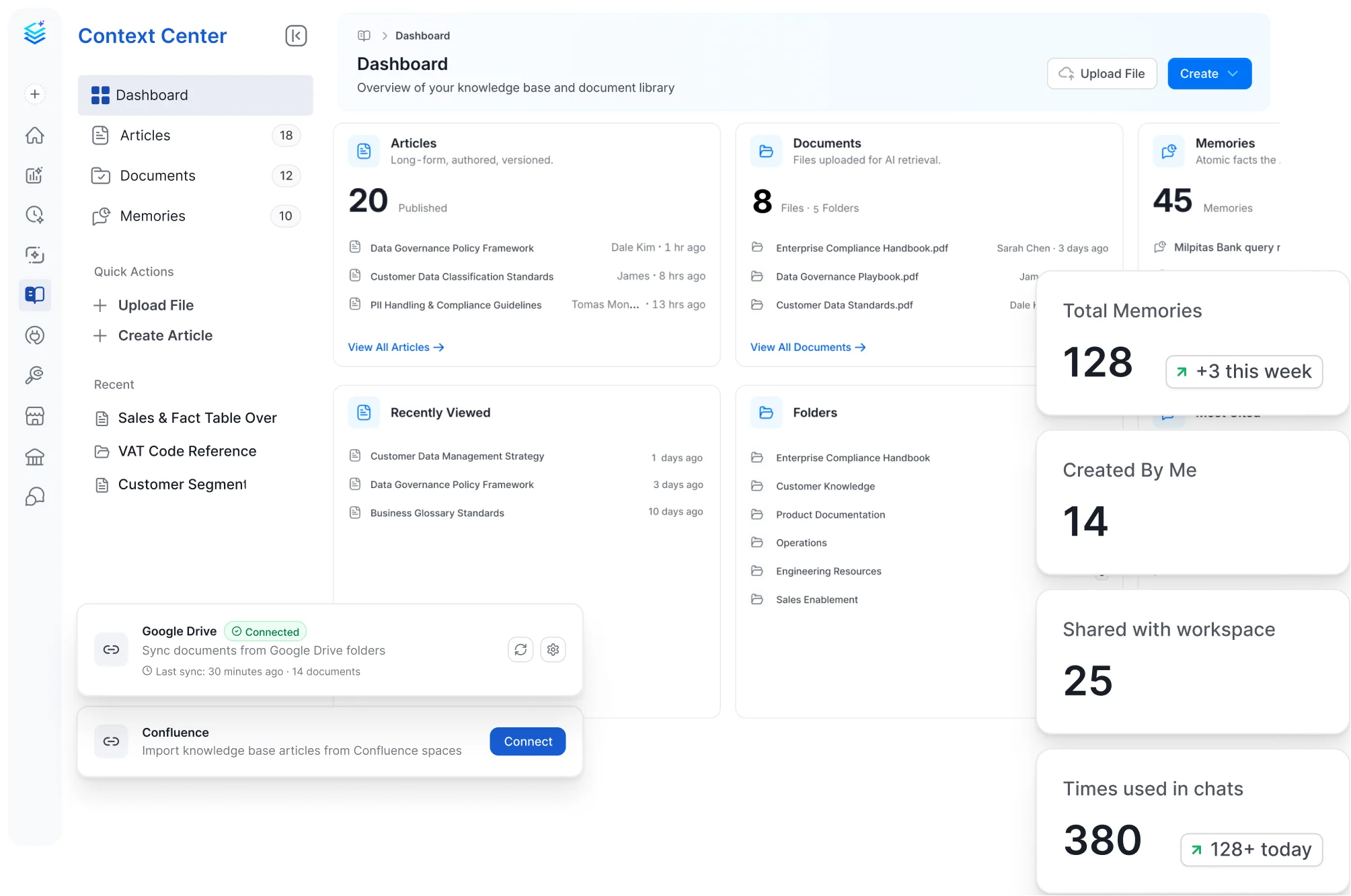
Context Center pulling from Confluence, Slack, Drive, GitHub
A lot of important enterprise knowledge does not live in structured metadata.
Business rules may be documented in Confluence or Notion. Implementation details may live in GitHub. Decisions and exceptions may appear in Slack. A policy may sit in Google Drive. A useful correction may have been made once during an analyst’s conversation with an AI system.
Context Center brings articles, documents, external knowledge, and memory into the same graph as the assets and concepts they describe. Collate also provides plugins for systems such as GitHub, Slack, Confluence, and Notion, allowing the agentic harness to use relevant knowledge and tools without manually copying every source into one prompt.
Memory is particularly important.
Suppose an analyst explains that cancelled orders must be excluded from Revenue, or that a historical report must use the territory mapping that was active during that quarter. That correction should not disappear when the conversation ends.
In Collate, the memory can be attached to the metric, table, dashboard, domain, data product, or ontology concept it describes. It retains its author, access controls, source, and audit history, and it is returned only when the user represented by the agent is permitted to see it.
Session memory helps an agent continue a conversation. Organizational memory allows future authorized users and agents to start from what the enterprise has already learned.
For the agentic harness, this closes an important part of the loop. It can understand, act, observe a correction, and preserve that learning for the next relevant task.
Persona-based Context Is Part of the Harness
One shared context graph does not mean every person should receive the same context.
A business user asking, “What was revenue by region last quarter?” may need the certified metric, business definition, approved planning context, trusted data product, and final visualization.
An analyst may need those same governed facts, but also the schemas, join paths, column profiles, SQL, lineage, and query history.
A data engineer investigating why Protobuf events stopped landing in S3 needs a different view: topics, schema versions, pipelines, owners, observability signals, and downstream impact.
The facts should remain consistent, but the context required for the task changes with the user.
OpenMetadata supports configurable persona context so organizations can define which assets and which sections of context are relevant to a persona. The rules are evaluated by priority, overlapping assets are deduplicated, context budgets are enforced, and the final context can be rendered in full, compact, or manifest form for consumption through MCP.
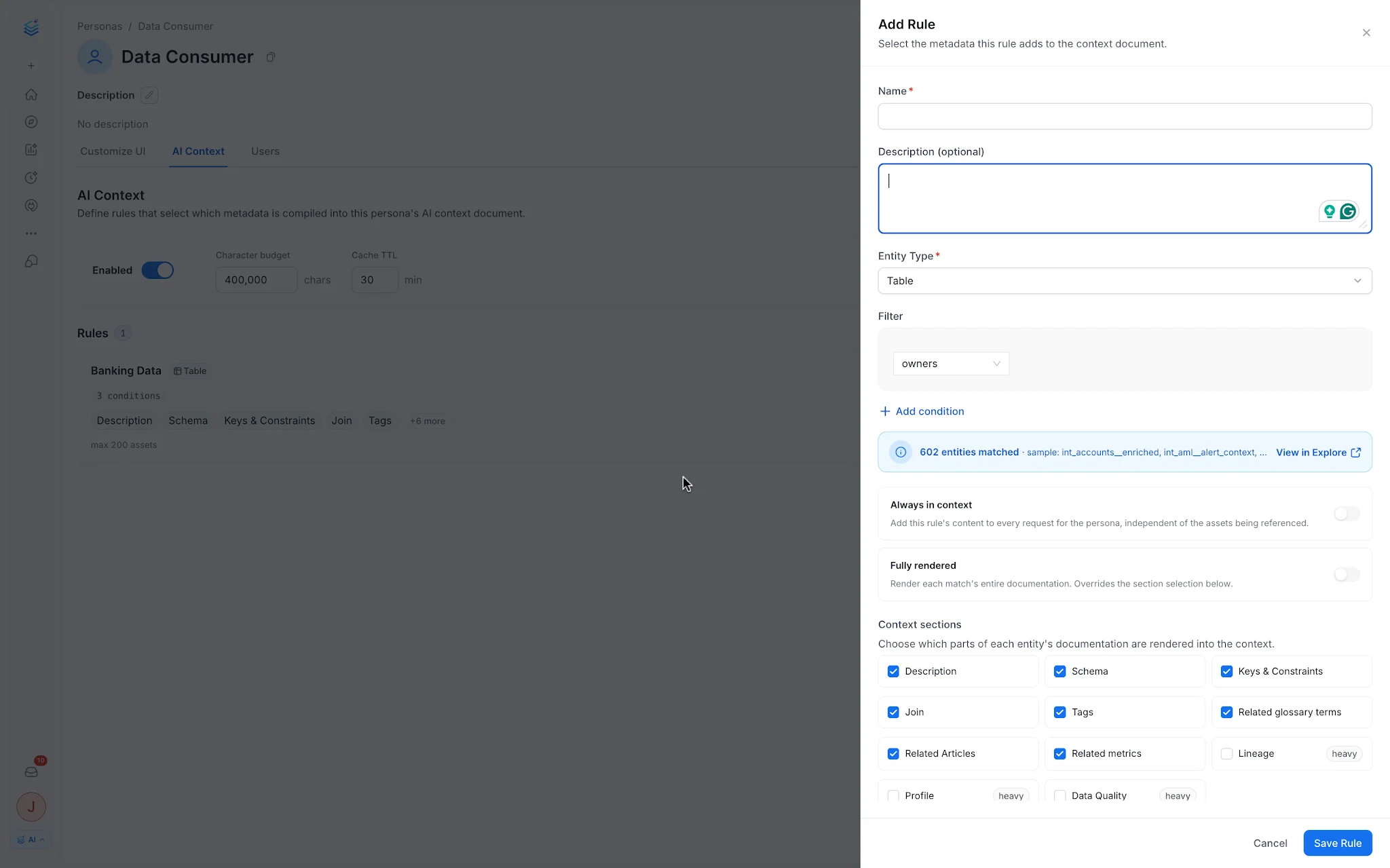
Persona-Based Context Curation
This is the same harness-design principle that matters in coding agents.
The best harness does not expose every tool and every file on every turn. It gives the model the relevant environment for the task.
For data, that means the right business concepts, metrics, assets, knowledge, quality signals, permissions, and memories for the person asking the question.
What the Collate Agentic Harness Does
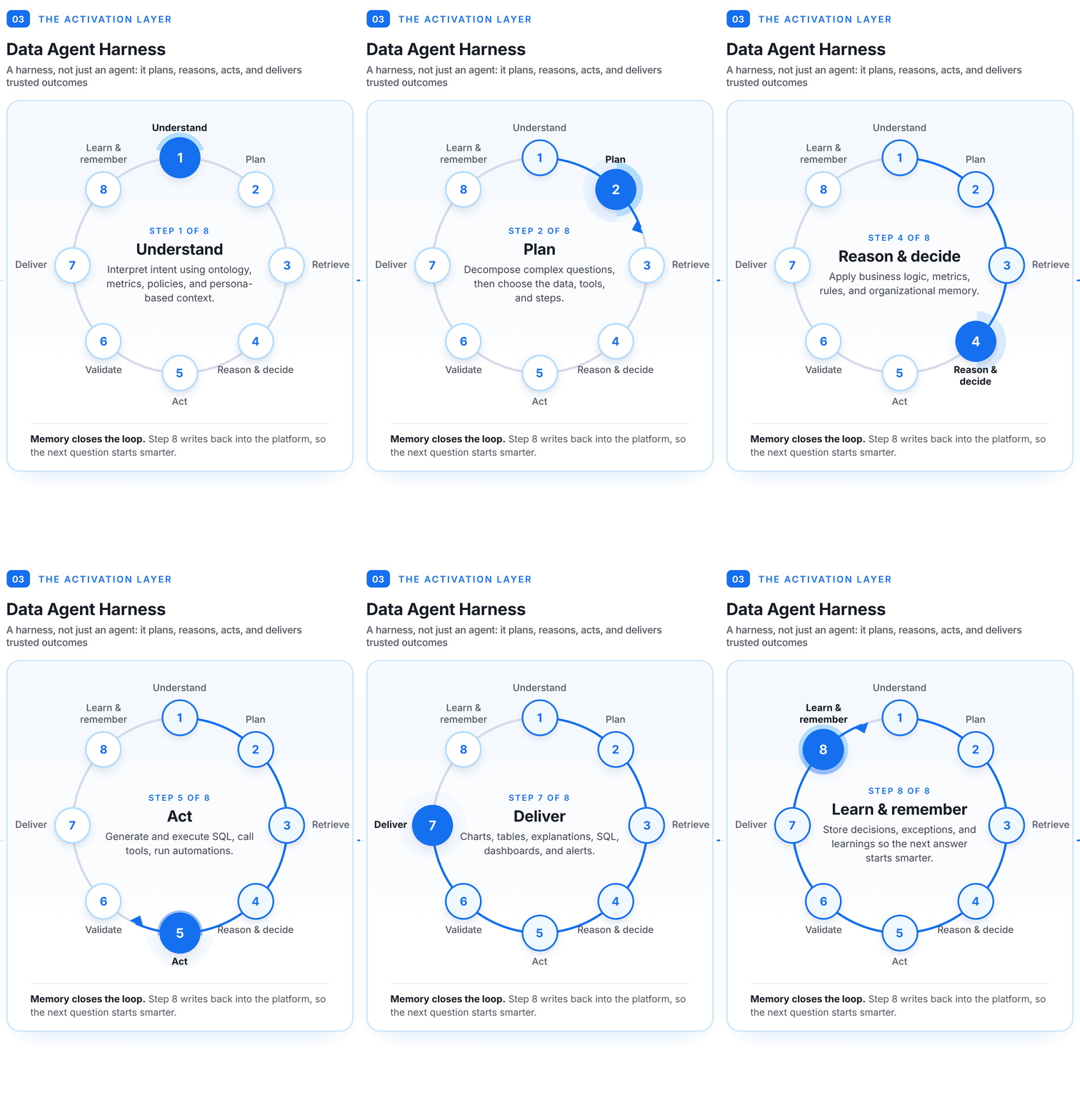
Once the context foundation is available, the agentic harness in Collate can address the actual business question.
It begins by interpreting the user’s intent in the context of their persona and permissions. It resolves the business concepts and metrics involved, retrieves the most relevant assets and knowledge, and creates a plan for the analysis.
The harness then selects the required execution tools, generates and runs the SQL, and observes what happens. A failed query, an empty result, an unexpected cardinality, a quality incident, or a missing field becomes feedback to the next step rather than the end of the process.
It can revise the query, choose a more appropriate asset, apply a different join path, ask the user for clarification, or explain that the available data cannot support the requested calculation.
Before returning the result, the harness checks the answer against the governed metric definition, the data-quality signals, the permissions of the user, and the assumptions used in the analysis. It then delivers the result as a chart, table, SQL query, and explanation.
When a user corrects the answer or adds an important business rule, the harness can preserve that learning as governed memory.
That complete loop—understand, plan, retrieve, execute, observe, repair, validate, deliver, and remember—is what makes it an agentic harness rather than a one-shot data agent.
Why the Customer Lifetime Value Example Matters
The customer lifetime value (CLV) example shows the difference between connecting a model to data and grounding an agentic harness in an enterprise context platform.
CLV is not something a model can reliably infer from a table name or a few columns. The organization first has to establish what CLV means through a governed metric, glossary term, ontology, or knowledge article, and connect that definition to the data required to calculate it. One company may define CLV using revenue and tenure, while another may require margin, churn probability, acquisition cost, and expected lifetime.
Without that ground truth, a general-purpose model connected directly to Snowflake can only infer a plausible definition from the available schema and the wording of the question. Ask the question differently, and it may choose different tables, assumptions, or calculations. The model is probabilistic, but the definition of an important business metric should not be.
The Collate Agentic Harness resolves the question against the deterministic context already established by the organization. It retrieves the approved CLV definition, identifies the trusted assets and required inputs, and checks whether the available data can support the calculation. In this case, margin, expected tenure, and churn probability were missing.
Instead of manufacturing a convincing number, the harness explained that CLV could not be calculated reliably, identified what was missing, and used available financial signals only as a clearly labeled proxy. The correct answer was effectively: “I cannot calculate this yet without additional information.”
That behavior becomes especially important when AI-generated analysis is reused across users, dashboards, scheduled reports, and automations. Without a shared definition, the system can produce a different interpretation each time and scale those inconsistencies across the organization. The Context Platform provides the governed ground truth; the Agentic Harness makes sure the probabilistic model uses it consistently and knows when the evidence is not sufficient.
Why We Built Self-Service AI Analytics Natively in Collate
Once customers had the context platform, we saw many of them begin building the same application layer.
They retrieved context, searched for trusted assets, generated SQL, created charts, stored conversations, added permissions, assembled dashboards, scheduled queries, and delivered the results through Slack or email.
Every team was rebuilding part of the same agentic harness.
That was the signal for us to build AI analytics natively in Collate.
A user can ask a business question, inspect the chart, table, and SQL, and continue the analysis through conversation. The conversation can be shared with other people, and useful results can be pinned to a dashboard.
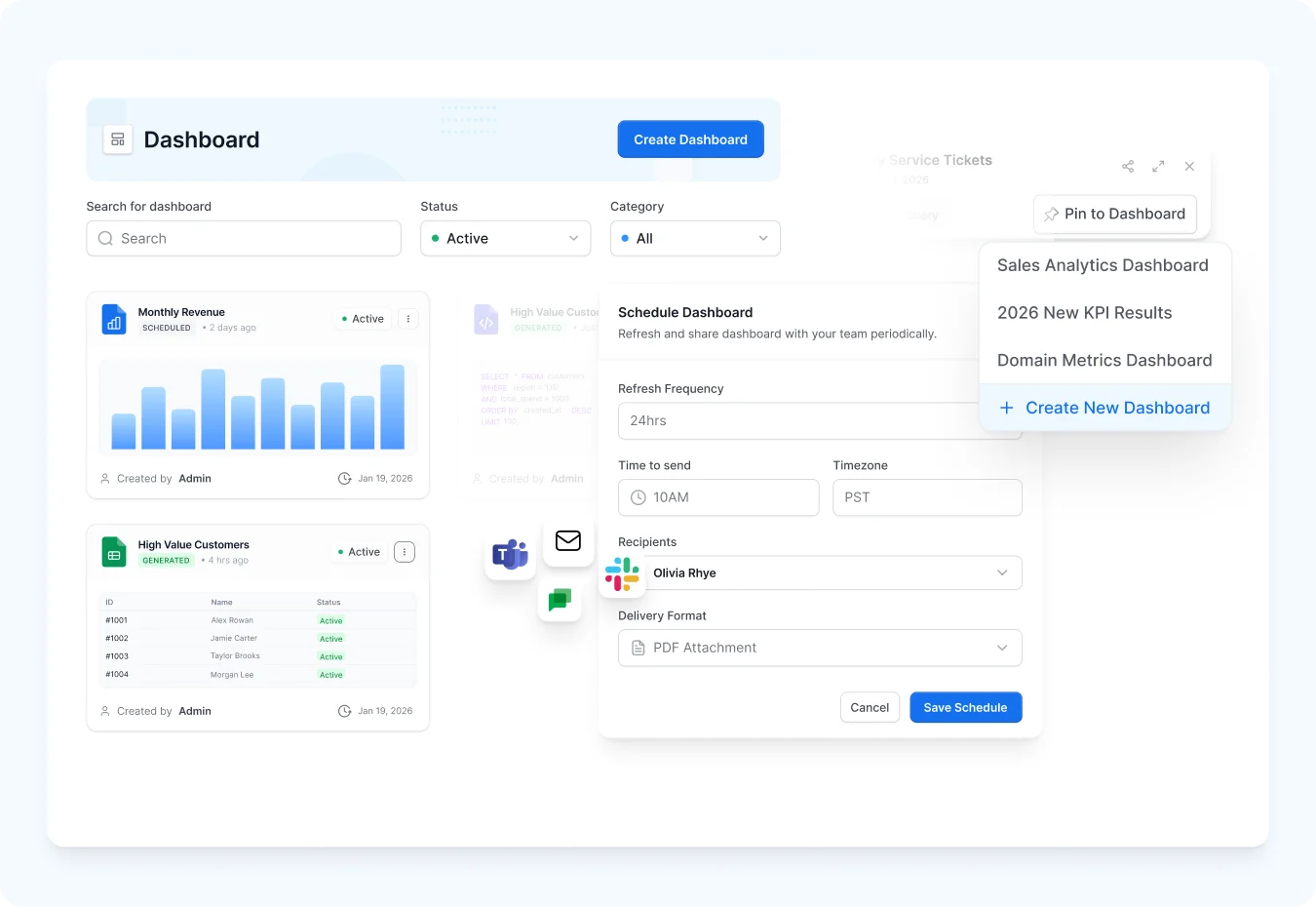
Pin, Schedule, Share: reusable dashboards
Every chart retains the conversation and build history behind it, so someone reviewing the result can see the question, assumptions, query, and revisions that produced it. Dashboards can be scheduled for refresh and delivered through email or Slack.
The result becomes a reusable analytical asset rather than another answer that disappears inside a chat.
Collate AI Analytics is the interactive use of the harness. Collate AI Automations use the same architecture for recurring work such as documentation, classification, tiering, data-quality management, governance, and incident investigation. Collate AI Studio allows organizations to create additional agents, personas, skills, plugins, and workflows without rebuilding the context, permissions, memory, and execution environment for each one.
Claude, Cortex Analyst, and Databricks Genie are Not Sufficient as Data Harnesses
Claude is a powerful reasoning model, and Claude Code demonstrates what is possible when that model is placed inside a well-designed coding harness.
But Claude by itself is not an enterprise data harness. The organization would still need to build the connectors, metadata graph, semantic mappings, quality layer, governance, permissions, memory, persona context, analytical tools, and validation loop around it.
Snowflake Cortex Analyst and Databricks Genie provide useful native analytics experiences. Their semantic views and metric views are strong ways to represent business meaning inside their respective platforms.
Most large enterprises, however, are heterogeneous.
They use several warehouses, BI systems, streaming platforms, object stores, operational databases, pipelines, documents, and code repositories. A business question often crosses those boundaries.
Snowflake, Databricks, or others should remain the systems where data is stored, transformed, governed, and executed.
The difference is that the context layer and the agentic harness for data are not tied to any single one of those systems, or to any single model that reads from them.
The Durable Asset Is Your Context, Not the Model
The model will not be the durable part of this architecture.
Models will improve, prices will change, and enterprises will use several of them. The chat interface will not be durable either. Interfaces can be copied quickly.
The durable asset is the organization’s understanding of its data: what exists, what it means, how it is connected, whether it can be trusted, who owns it, which policies apply, and what the organization has already learned about it.
OpenMetadata makes that foundation open and portable under Apache 2.0. Collate puts it to work through the native agentic harness behind AI Analytics, AI Automations, AI Studio, Context Center, dashboards, MCP, APIs, and SDKs.
Organizations should not have to rebuild this foundation and execution loop for every data agent they deploy.
They should spend their time defining the things that are specific to their business: their ontology, metrics, policies, workflows, and decisions.
Claude Code and Codex have shown that a successful coding experience is not simply a model answering questions about code. It is an agentic harness that understands the environment, uses tools, executes work, validates the result, recovers from failure, and carries the task to completion.
We believe enterprise data needs the same architecture.
That is why we built a native agentic harness for data on top of OpenMetadata, the Open Context Platform for AI.