Build AI You Can Trust with Knowledge Graph


AI agents are only as reliable as the semantic foundation they reason from. If a business concept like "Revenue" is ambiguous in your semantic context graph, disconnected from all the appropriate tables, owned by several distinct teams, or defined inconsistently across Finance and Sales, an AI agent won't flag the ambiguity. It will pick a definition and confidently return a wrong answer built on those assumptions.
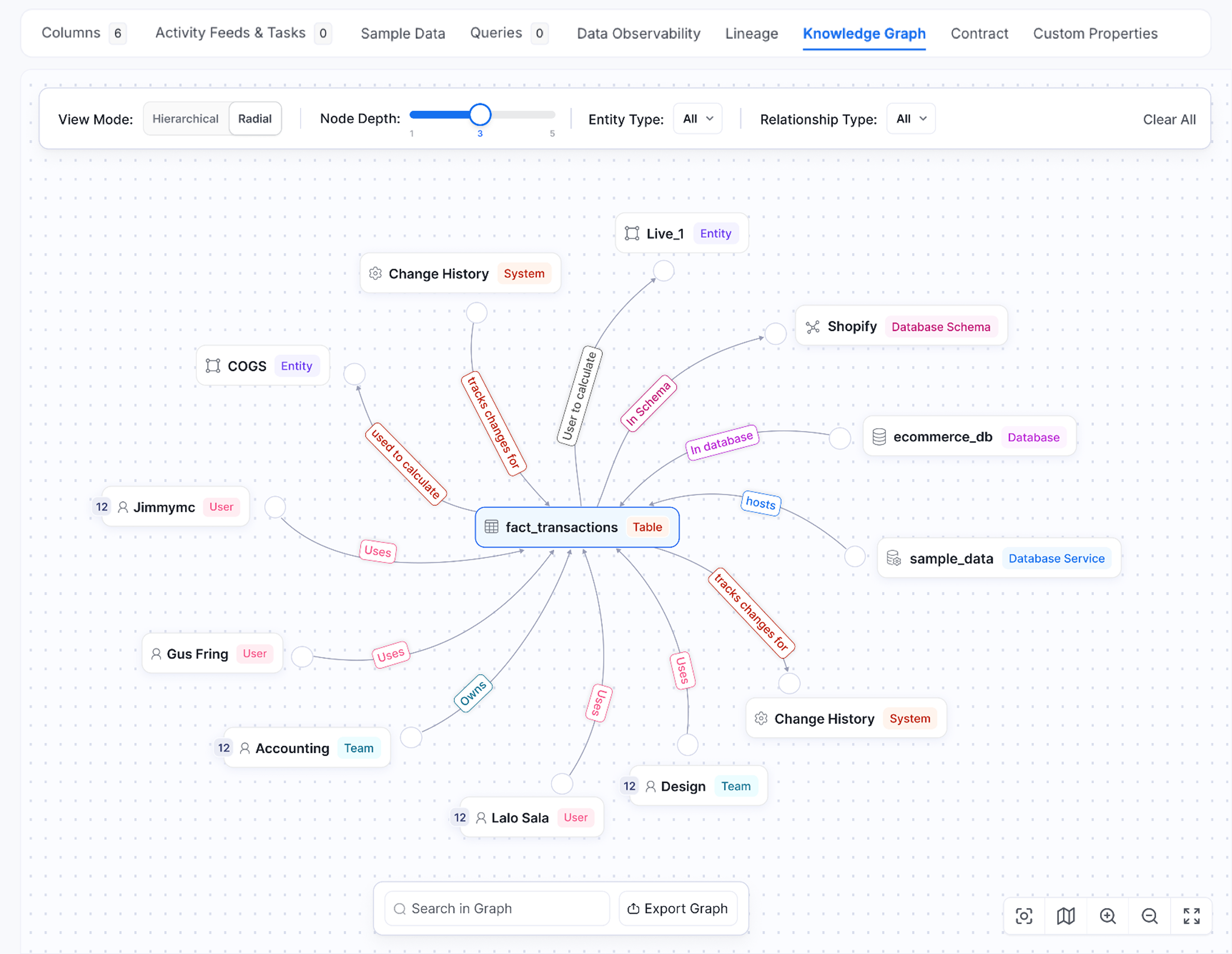
Knowledge Graph is how your team maintains and verifies the graph before AI reasons from it. For any business concept or data asset in Collate, you can see every formal relationship surrounding it, including ownership, domain, schema hierarchy, upstream sources, downstream consumers, and semantic connections to glossary terms, in a single interactive view. And because the graph updates in real time, every metadata decision your team makes, assigning an owner, adding a domain, tagging a glossary term, is immediately reflected as a new relationship in the graph. If "Revenue" maps to three different tables with no formal relationship between them, that shows up in the graph. You find the gap. You fix it before the AI agent incorrectly guesses from it.
This is an important complement to discovery and lineage. It is about verifying that the meaning your organization has built into the platform is complete, connected, and ready for machines to reason from accurately.
What Knowledge Graph Shows You
For any data asset, Knowledge Graph renders its full relationship context in a single interactive view with labeled edges that make every connection explicit. You and your AI can immediately see:
-
Ownership: The teams and individual users responsible for the asset.
-
Schema hierarchy: Where the asset lives, from service down to table.
-
Business semantics: The glossary terms and definitions the asset is mapped to.
-
Downstream consumers: The analysts, dashboards, and ML models using the asset.
-
Change history: When the asset was last modified and by whom.
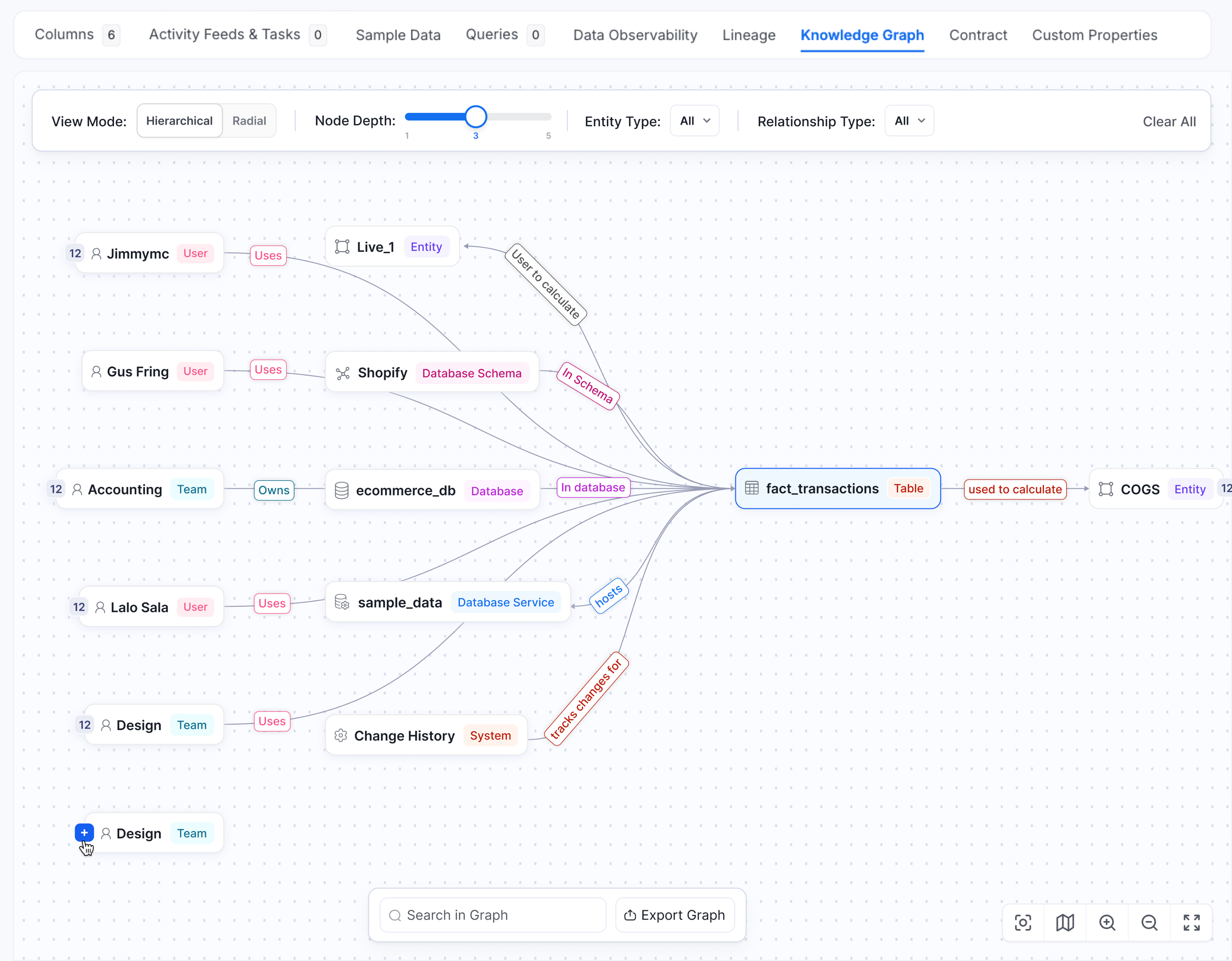
The depth slider lets you control how far the graph expands, from an immediate-neighbors view to a broad picture of your entire data ecosystem. And because Knowledge Graph is built on open semantic standards, it automatically infers relationships that were never manually declared. Ownership chains, reverse relationships, and pipeline associations are derived from the metadata already in your catalog. The graph also supports bidirectional queries. Instead of starting from an asset and asking what it connects to, you can start from a team, a domain, or a glossary term and ask what it owns or governs. What does the Accounting team own today? Which assets belong to the Finance domain? The graph answers both directions.
Knowledge Graph and Ontology Explorer
Knowledge Graph and Ontology Explorer, both shipping in Collate 1.13, are complementary views of the same underlying semantic context graph. Knowledge Graph is asset-centric: starting from any table, dashboard, or pipeline, it shows everything connected to that asset. Ontology Explorer is business glossary-centric: starting from your business concepts, it maps how they relate to each other. Together, they give you both directions of the same graph, from data assets upward into business meaning, and from business concepts downward into the data that implements them. The graph beneath both tools is built on open W3C standards including RDF, OWL, DCAT, DPROD, SKOS, PROV-O, and Schema.org. This brings decades of research in knowledge representation into your data platform in a way that is portable, interoperable, and accessible to any tool that speaks the same standards.
What This Means for Your Team
Data stewards and governance teams. The semantic graph is only as good as the work that goes into it. If "Revenue" is defined three different ways with no formal relationship between them, an AI agent reasoning from that graph will produce three different answers depending on which definition it picks up. Data stewards are the ones responsible for closing those gaps, and Knowledge Graph is how they find them. Navigate from any asset to see whether its business concept connections are formally established, which definitions are ambiguous, and where the gaps exist that would force an AI to guess. Fix the graph before the AI uses it.
Analysts and data scientists. Before you build a report or feed data into a model, you need to know that the assets you're working from are formally grounded. Knowledge Graph lets you open any table or dashboard and immediately see its full relationship context, who owns it, which domain it belongs to, which business concepts it implements, and whether those connections are complete. That verification step, which used to require Slack messages and tribal knowledge, now takes one click.
Get Started
Knowledge Graph is available now in Collate 1.13, with no additional infrastructure, no separate graph database, and no manual curation pipeline required. Try it in our live sandbox with sample data, or request a demo from a Collate product expert to see it running across your own environment.