Collate vs. Atlan
Collate's Semantic Context Platform delivers native AI agents, mature data quality, and open metadata standards in a single architecture. Atlan started as a data catalog and has been adding capabilities through modules and add-ons, and the architecture shows the difference.
Trusted by 4,000+ enterprise deployments worldwide








Why data teams choose Collate over Atlan


Shared understanding, faster insights
Shared meaning across people and AI so every team finds, interprets, and uses data the same way. Collate's semantic context graph powers AskCollate for conversational AI and 7 specialized agents (Ingestion, Lineage, Documentation, Classification, Tiering, Quality, SQL) that execute workflows autonomously. Atlan's AI assistant makes suggestions you review one at a time, while Collate's agents act.

One platform, total trust
Integrated lineage, quality, and observability in a single architecture from day one. Collate connects 130+ native connectors across AWS, Azure, GCP, and on-premises, with incremental extraction by default across every connector — keeping ingestion fast and source-system load low. Atlan includes a limited number of connectors in its base package with additional connectors as paid add-ons. Key capabilities like data quality, AI functionality, and data products are separate modules with separate pricing.

Activate AI with confidence
Automated governance, classification, and data contracts ensure compliance at scale. Collate uses JSON Schema and RDF/DCAT to make your metadata LLM-ready and portable from day one. Atlan is built on Apache Atlas with proprietary metadata formats that limit portability. You can export your Collate metadata anytime in industry-standard formats, while Atlan metadata requires transformation before it can be used with external tools or LLMs.
See your entire data estate in one place
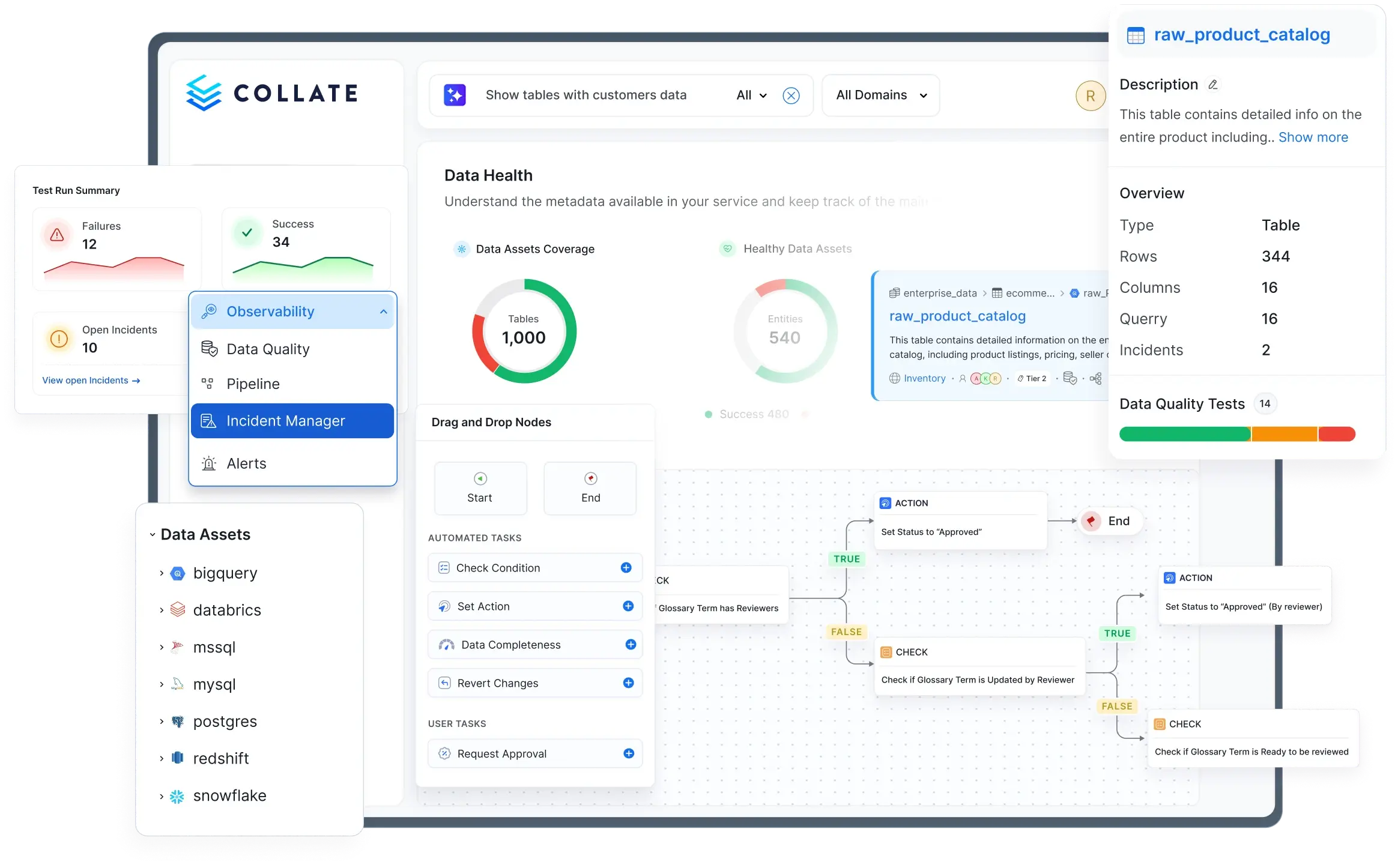
Collate's Semantic Context Platform gives data teams a single view of every asset across 130+ sources. Discover, govern, and monitor data quality from one unified interface that works the same way across AWS, Azure, GCP, and on-premises environments.
How Collate and Atlan compare
| Capability | Collate | Atlan |
|---|---|---|
| AI agent platform | ✓7 specialized agents (Ingestion, Lineage, Documentation, Classification, Tiering, Quality, SQL) | ◐AI assistant with documentation suggestions and lineage explanations; no autonomous agent execution |
| Conversational AI | ✓AskCollate — native, built on Semantic Context Graph | ◐Atlan AI for conversational metadata search; catalog-backed, not graph-backed |
| AI analytics | ✓Natural language to charts, dashboards, and analytical insights — cross-verified against metadata for accuracy | ◐Conversational analytics with NL-to-SQL and visualizations; no semantic graph for cross-verification |
| AI studio | ✓UI to build and deploy agents grounded in semantic context, no prompt engineering | ✗No equivalent agent-building environment |
| AI SDK | ✓Invoke Collate's agents and embed semantic context into external applications | ✗No equivalent AI SDK |
| MCP server | ✓Enterprise MCP with full governance layer enforced on every call | ◐Atlan MCP server for read-only metadata queries; no governance enforcement layer |
| Semantic context layer | ✓RDF/DCAT for portable, AI-ready semantics; formal ontologies for business concept mapping | ✗Built on Apache Atlas; no RDF/DCAT or ontology support |
| Metadata standards | ✓JSON Schema, RDF/DCAT, Open Data Contracts; Apache 2.0 open source | ◐Built on Apache Atlas (proprietary layer); Atlas not actively developed; metadata export requires transformation |
| Data quality & observability | ✓Mature from day one. 25+ test types, DQ as Code, anomaly detection, incident management, DataDiff — included | ◐Data Quality Studio (private preview, June 2025); Snowflake + Databricks only; separately licensed |
| Data contracts | ✓OpenMetadata contracts, supports and extends ODCS v3.1.0, enforcement and run history | ◐Atlan data contracts; no Open Data Contract Standard (ODCS) support |
| Data lineage | ✓Column and table-level lineage from source to dashboard with impact analysis | ✓Column-level lineage with impact analysis |
| Data product marketplace | ✓Build and publish via Open Data Product Standard; Domains with access control | ◐Data products as separately priced module; basic asset grouping; no ODPS standard |
| Connectors | ✓130+ native connectors, all included | ◐Limited native connectors in base package; additional connectors are paid add-ons; many listed connectors are API-powered (customer-built) |
| Incremental extraction | ✓Default across all connectors — only syncs what changed since last successful run | ◐Opt-in toggle on select connectors (Snowflake, Databricks); full scan default elsewhere |
| Deployment flexibility | ✓SaaS, Hybrid, BYOC — full feature parity across deployment models | ◐SaaS, BYOC with Self-Deployed Runtime (extraction only; core platform vendor-managed); Secure Agent uses 'bucket relay' with extra data hop |
| Pricing model | ✓Predictable package — users + data assets, all features included | ◐Modular with significant add-on fees for data products, AI, data quality, and additional connectors |
What data leaders say about Collate

“OpenMetadata gives us a trusted foundation for AI-driven decision-making, letting our teams innovate faster and more confidently across the business.”
Website Builder Company

“Collate has transformed the way Mango manages its data assets and how its data users work together, unlocking new opportunities for collaboration, growth, and innovation.”
Global Fashion Retailer

“Collate provides all the capabilities in one platform that allow us to carry out our metadata management activities efficiently to ensure consistent data usage and trust.”
Public Transport Operator for Paris
About the Platforms
Collate is the Semantic Context Platform and the company behind the OpenMetadata project. It turns metadata into shared meaning so people and AI can work from the same understanding of data. Collate applies that semantic foundation across discovery, lineage, quality, observability, and governance to enable trusted analytics, explainable AI, and automated governance at enterprise scale. Global 2000 companies and innovative startups rely on Collate to accelerate insights and build AI-ready data foundations. Headquartered in Silicon Valley, Collate is backed by world-class investors including Venrock, Unusual Ventures, and Karman Ventures.

Atlan is a metadata platform founded in 2019 by Prukalpa Sankar and Varun Banka. The platform offers data cataloging, governance, and collaboration capabilities for data teams. Atlan has raised $206M total across six rounds at a $750M valuation, with Series C led by GIC and Meritech Capital in May 2024 (other investors include Insight Partners, Salesforce Ventures, and Peak XV). Atlan is built on Apache Atlas as its underlying metadata store and uses a modular pricing model where capabilities like data quality, AI functionality, and data products are available as separately priced modules. Atlan has been recognized as a Leader in the Gartner Magic Quadrant and Forrester Wave for data governance, and serves Fortune 500 customers including Nasdaq, Autodesk, and General Motors.
FAQsCollate vs. Atlan
Collate offers AskCollate for conversational AI plus 7 specialized agents (Ingestion, Lineage, Documentation, Classification, Tiering, Quality, SQL) that execute workflows autonomously. Atlan offers an AI assistant that suggests documentation, explains lineage, and recommends data quality rules, but each suggestion requires manual review and approval. Collate also offers AI Studio for building custom agents on your metadata, a capability Atlan does not provide.
Atlan launched Data Quality Studio in June 2025 at Snowflake Summit and Data + AI Summit. It is available in private preview with limited platform support (Snowflake and Databricks only). Data quality is also Atlan's most expensive add-on module with undisclosed pricing. Collate has offered native, comprehensive data quality since day one with 25+ built-in test types, DQ as Code, anomaly detection, incident management, and DataDiff, all included at no extra cost.
Atlan uses Apache Atlas as its underlying metadata store, but the platform itself is proprietary. Apache Atlas makes up roughly 10% of Atlan's product, and Atlan does not contribute back to the Atlas project, which is no longer actively developed. Collate is built on OpenMetadata, a fully open-source project under the Apache 2.0 license with 13,500+ community members. Collate's founders created Apache Atlas at Hortonworks and chose to build a modern, standards-based platform from scratch rather than extend the legacy architecture.
Collate includes 130+ native connectors in every package with equal depth across AWS, Azure, GCP, and on-premises. Atlan includes a limited number of native connectors in its base package, with additional connectors available as paid add-ons. Many connectors listed on Atlan's website are API-powered, meaning customers build and maintain their own connectors using Atlan's API rather than getting a pre-built, supported integration.
Atlan uses modular pricing where key capabilities are separate add-ons. Data products, AI functionality, and data quality are each sold as separate modules with significant additional costs beyond the base platform price. Only a limited number of connectors are included in the base package. Collate includes all core capabilities in one predictable package based on users and data assets, with all features, AI agents, data quality, and 130+ connectors included.
Not in the way Collate offers. Atlan provides SaaS and BYOC, with a Self-Deployed Runtime (Kubernetes-based) for metadata extraction only — the core platform itself remains vendor-managed. Atlan's Secure Agent uses a 'bucket relay' pattern where metadata is staged in cloud storage before Atlan retrieves it, adding complexity and an extra data hop. Collate offers true self-hosted deployment via OpenMetadata, where the entire platform runs in your own infrastructure with full feature parity, plus managed SaaS and BYOC.
Collate uses incremental extraction by default across all connectors, syncing only the metadata that changed since the last successful pipeline run. Atlan supports incremental extraction as an opt-in toggle on select connectors (Snowflake, Databricks), with full scan as default behavior elsewhere. For large data estates with frequent ingestion cycles, the difference in compute costs and source system load can be substantial.
Collate uses JSON Schema for strongly typed, self-documenting metadata that is natively understood by LLMs. It supports RDF/DCAT for semantic richness and the Open Data Contract Standard for portable data contracts. Atlan uses a proprietary metadata layer built on Apache Atlas. While Atlan provides API access for data extraction, the format is proprietary and requires transformation for use with external tools or LLMs.
Collate offers full persona-based UX customization, allowing teams to tailor navigation, widgets, landing pages, and knowledge panels for each role. Data engineers can see pipeline status and quality dashboards while business users get simplified views with quick links. Collate also supports bidirectional linking between glossary terms and data assets. Atlan's personas primarily control which assets users can see and what actions they can take, with default landing page customization per persona and more rigid approval workflows.
Ready to see the difference?
See why data teams switch from modular catalogs to Collate's all-inclusive platform with native AI agents, mature data quality, and 130+ connectors included.
Deployments
Members
Contributors