Collate vs. Alation
Collate's Semantic Context Platform gives you native AI agents, mature data quality, and open-source transparency with full deployment flexibility. Alation offers strong governance packaging and analyst recognition, but its proprietary architecture and SaaS-only model limit your choices.
Trusted by 4,000+ enterprise deployments worldwide








Why data teams choose Collate over Alation


Open-source transparency you can audit and extend
Collate is built on OpenMetadata, a full Apache 2.0 open-source project with 13,500+ community members. Customers can inspect the source code, verify security, and extend the platform without waiting on the vendor. Metadata is stored in JSON Schema, a universal standard that every programming language and LLM natively understands. Alation is entirely proprietary and closed-source. Its architecture documentation is minimal, and its metadata formats are proprietary, making portability to another platform complex and costly.

Mature data quality built in from day one
Collate offers 25+ built-in data quality test types, DQ as Code, anomaly detection, incident management, and DataDiff across 30+ databases, included in the core platform at no extra cost. Alation's data quality supports 8 of 47 connected platforms and is a separately licensed add-on. Its CDE Manager is a further add-on purchase. Collate's data quality works across all deployment models with identical capabilities.

True deployment flexibility for regulated industries
Collate offers SaaS, Hybrid, and Bring-Your-Own-Cloud (BYOC) deployment across AWS, Azure, and GCP, with full feature parity — including AI agents, AI Studio, lineage, and quality — across every deployment model. Alation offers Customer-Managed Alation (on-premises) and Alation Cloud Service (SaaS on AWS), but their newer features and AI capabilities, such as Agent Studio, Aggregated Context API, and new user experience, are Cloud-only.
See your entire data estate in one place
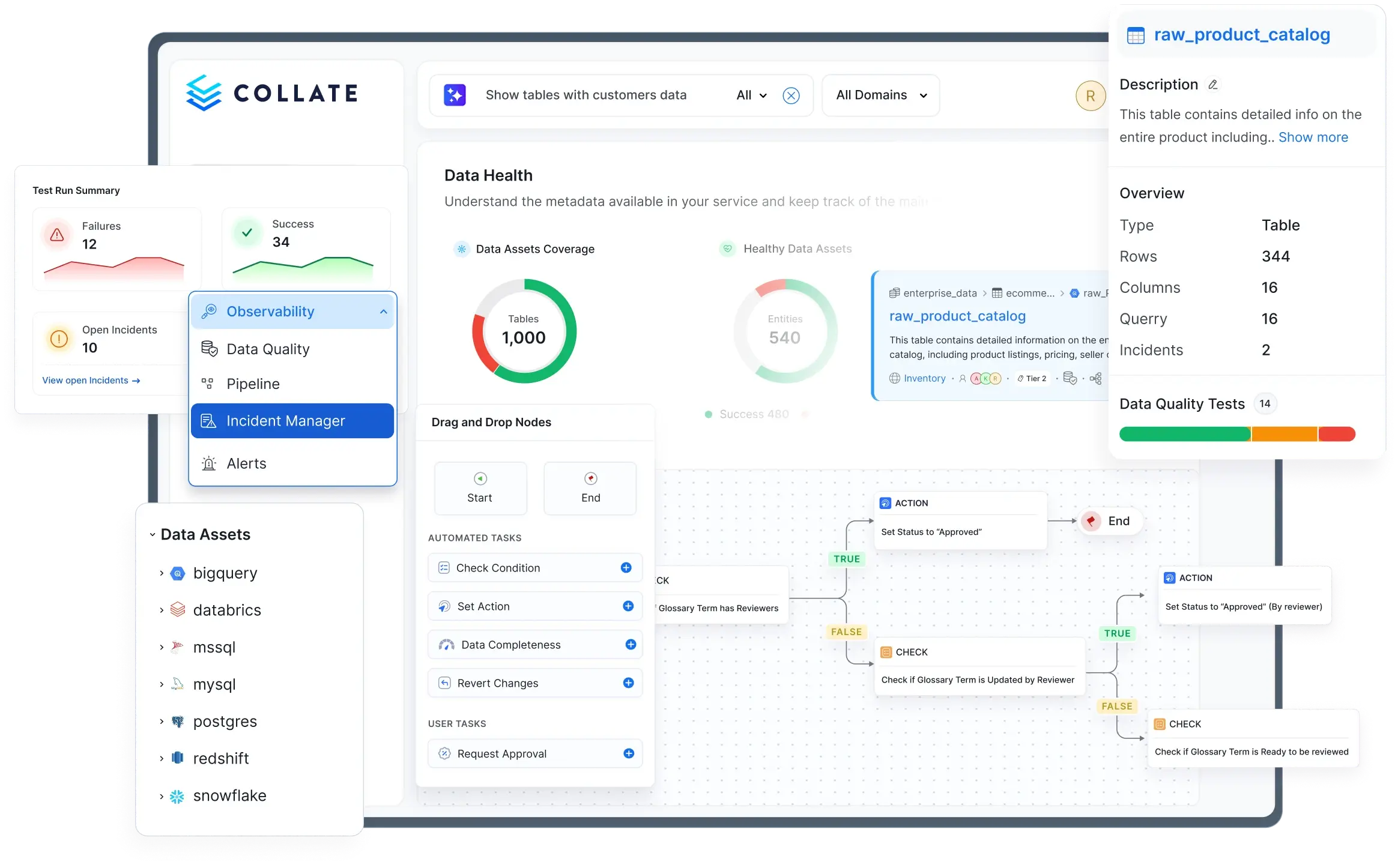
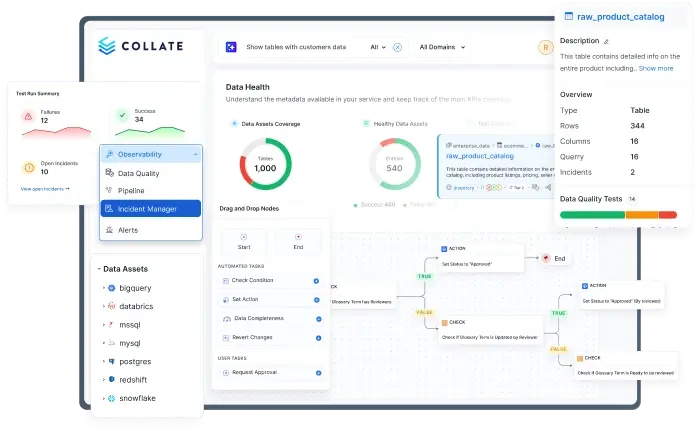
Collate's Semantic Context Platform gives data teams a single view of every asset across 130+ sources. Discover, govern, and monitor data quality from one unified interface that works the same way across AWS, Azure, GCP, and on-premises environments.
How Collate and Alation compare
| Capability | Collate | Alation |
|---|---|---|
| AI agent platform | ✓7 pre-built specialized agents (Ingestion, Lineage, Documentation, Classification, Tiering, Quality, SQL) | ◐Agent Studio with 4 pre-built agents (Query, Catalog Search, Dashboard, Deep Research) + Build-Evaluate-Plug framework for customer-built agents |
| Conversational AI | ✓AskCollate — native, built on Semantic Context Graph | ✓Ask Alation — conversational search and metadata queries |
| AI analytics | ✓Natural language to charts, dashboards, and analytical insights — cross-verified against metadata for accuracy | ✗No native AI analytics capability |
| AI studio | ✓UI to build and deploy agents grounded in semantic context, no prompt engineering | ◐Agent Studio with no-code builder; requires Build-Evaluate-Plug framework for testing |
| AI SDK | ✓Invoke Collate's agents and embed semantic context into external applications | ✓AI Agent SDK with LangChain integration |
| MCP server | ✓Enterprise MCP with full governance layer enforced on every call | ◐MCP available but limited; no governance enforcement layer |
| Semantic context layer | ✓RDF/DCAT for portable, AI-ready semantics; formal ontologies for business concept mapping | ✗No RDF/DCAT or ontology support |
| Metadata standards | ✓JSON Schema (LLM-native) + Open Data Contracts + RDF/DCAT | ◐Proprietary formats with limited portability |
| Data quality & observability | ✓Unified, native from day one. 25+ test types, DQ as Code, anomaly detection, incident management — across 30+ databases, included | ◐Cloud-only, separately licensed add-on. Supports limited number of data stores. |
| Data contracts | ✓GA — standalone ODCS v3.1.0 support | ◐Available only within Data Products framework |
| Data lineage | ✓Column and table-level lineage from source to dashboard with impact analysis | ✓Column-level lineage via query log analysis |
| Data product marketplace | ✓Build and publish via Open Data Product Standard; Domains with access control | ◐Data Products with Marketplace (separately licensed) |
| Connectors | ✓130+ native connectors, all included | ◐Mix of legacy and OCF connectors leads to inconsistencies in metadata coverage, with gaps in ETL connector support. |
| Incremental extraction | ✓Only syncs what changed (up to 89% faster) | ✗Full scan on every scheduled run |
| Deployment flexibility | ✓SaaS, Hybrid, and BYOC across AWS, Azure, and GCP — full feature parity (AI agents, AI Studio, lineage, quality) | ◐Customer-Managed Alation (on-prem) + Alation Cloud Service (SaaS on AWS); Agent Studio, Aggregated Context API, and new UX are Cloud-only |
| Open-source foundation | ✓Full Apache 2.0 (OpenMetadata), 13,500+ community | ✗Entirely proprietary, closed-source |
| Data governance breadth | ◐Unified platform with core governance | ✓22+ governance features, Workflow Center, Curation Automation |
| Analyst recognition | ✗Not yet included in Gartner MQ | ✓Dual Gartner MQ Leader (Metadata Management + Data & Analytics Governance) |
What data leaders say about Collate

“OpenMetadata gives us a trusted foundation for AI-driven decision-making, letting our teams innovate faster and more confidently across the business.”
Website Builder Company

“Collate has transformed the way Mango manages its data assets and how its data users work together, unlocking new opportunities for collaboration, growth, and innovation.”
Global Fashion Retailer

“Collate provides all the capabilities in one platform that allow us to carry out our metadata management activities efficiently to ensure consistent data usage and trust.”
Public Transport Operator for Paris
About the Platforms
Collate is the Semantic Context Platform and the company behind the OpenMetadata project. It turns metadata into shared meaning so people and AI can work from the same understanding of data. Collate applies that semantic foundation across discovery, lineage, quality, observability, and governance to enable trusted analytics, explainable AI, and automated governance at enterprise scale. Global 2000 companies and innovative startups rely on Collate to accelerate insights and build AI-ready data foundations. Headquartered in Silicon Valley, Collate is backed by world-class investors including Venrock, Unusual Ventures, and Karman Ventures.

Alation is a data intelligence company founded in 2012 and headquartered in Redwood City, California. With $340M in total funding (most recently a $123M Series E in November 2022 at a $1.7B valuation) and approximately $109M in 2024 revenue, Alation has built a strong presence in the enterprise data governance market. The platform offers cataloging, governance, data quality, and AI agent capabilities, serving enterprise customers including Cisco, Truist, AbbVie, Nasdaq, and Autodesk. Alation holds dual Gartner Magic Quadrant Leader positions in Metadata Management and Data & Analytics Governance Platforms. The platform is entirely proprietary and available as Alation Cloud Service (SaaS on AWS) and Customer-Managed Alation (on-premises); flagship AI features (Agent Studio, Aggregated Context API) are Cloud-only. Alation acquired Numbers Station AI on May 20, 2025 to strengthen its agent capabilities.
FAQsCollate vs. Alation
Both platforms have strong AI stories. Collate offers AskCollate for conversational AI plus 7 specialized agents (Ingestion, Lineage, Documentation, Classification, Tiering, Quality, SQL) that automate governance tasks out of the box. AI Studio provides Python, Java, and TypeScript SDKs for building custom agents. Collate's MCP Server works with Claude and any MCP-compatible tool. Alation offers Agent Studio with a no-code builder and 4 pre-built agents, Curation Automation, and an AI Agent SDK with LangChain integration. The key difference is foundation: Collate's agents operate on a unified semantic context graph that provides organizational context by default, while Alation's agents require configuration and testing through its Build-Evaluate-Plug framework.
Collate has native, unified data quality across 30+ databases with 25+ built-in test types, DQ as Code, anomaly detection, incident management, and DataDiff, all included in the core platform. Alation's data quality (ADQ) is a cloud-only, separately licensed add-on that supports 8 of 47 connected platforms (Snowflake, BigQuery, Redshift, Synapse, Databricks UC, SQL Server, PostgreSQL, Oracle). ADQ offers 6 quality dimensions with AI-recommended checks and ML-based anomaly detection. For organizations that need data quality across diverse data sources, Collate's coverage is significantly broader.
Yes, but with a major catch. Alation offers Customer-Managed Alation, where you host the platform on-premise. However, Alation's flagship AI features — Agent Studio, the Aggregated Context API for AI agents, and the new user experience — are only available on Alation Cloud Service. Customer-Managed is also subject to a 1-year version End-of-Life policy, forcing regular upgrades. Collate offers a SaaS, Hybrid, and Bring-Your-Own-Cloud (BYOC) deployment on AWS, Azure, and GCP with complete feature parity, including AI agents, AI Studio, lineage, and quality.
Collate offers 130+ native connectors, all included in the core platform, covering 40+ databases, 22+ ETL/ELT tools, and 18+ BI platforms. Alation offers 76 OCF connectors in the 2025.1 release (all GA), including ~50 data sources, 14 BI tools, and 6 ETL/ELT connectors. The ETL gap is notable: Collate supports 22+ pipeline tools while Alation covers 6 (Azure Data Factory, Informatica PowerCenter, Informatica CDI, Talend, dbt Gen2, Fivetran). Collate also uses incremental extraction by default, syncing only changed metadata for up to 89% faster ingestion. Alation performs full metadata scans on every scheduled run.
No. Alation is entirely proprietary and closed-source. Its architecture documentation is minimal, and customers cannot inspect, audit, or extend the platform code. Alation's Alation Skills plugins are open-source (Apache 2.0), but the core platform remains proprietary. Collate is built on OpenMetadata, which is fully Apache 2.0 licensed. Customers can audit the source code, contribute improvements, and export metadata in open standards (JSON Schema, RDF/DCAT) at any time.
Alation holds Leader positions in both the Gartner MQ for Metadata Management and the Gartner MQ for Data & Analytics Governance Platforms. That recognition reflects their enterprise installed base, customer references, and market presence built over more than a decade. However, analyst recognition tells you who is established in the market, not necessarily who is the best technical fit for your specific data estate, deployment requirements, and AI strategy. Technical evaluations consistently reveal differences in connector coverage, data quality depth, deployment flexibility, metadata portability, and open-source transparency that analyst reports do not capture.
Collate uses JSON Schema for strongly typed, self-documenting metadata that is natively understood by LLMs. It also supports RDF/DCAT for semantic richness and the Open Data Contract Standard (ODCS v3.1.0) as a standalone capability. Alation uses proprietary metadata formats with limited portability. While Alation provides API access for extracting data, the underlying format is proprietary and requires transformation for use with external systems and LLMs. Collate also includes metadata migration tools for Alation, Collibra, Atlas, and Amundsen, making the transition straightforward.
Collate pricing is straightforward: users plus data assets, with all core features included (AI agents, data quality, lineage, connectors, data products). Alation uses enterprise subscription pricing that is opaque and difficult to compare. Column-based pricing has been observed in field deals, meaning costs can escalate as data volume grows. Data quality (ADQ) and CDE Manager are separately licensed add-ons. Curation Automation includes 100K free actions per tenant but is metered after that.
Ready to see the difference?
See why data teams choose Collate's open-source transparency and native AI over proprietary catalogs, with mature data quality, 130+ connectors, and true deployment flexibility included.
Deployments
Members
Contributors