Ground Your AI in Standards-Based Knowledge with Ontology Explorer


As organizations rely more heavily on AI to answer business questions, the demand for accurate, consistent outputs has never been higher. Other platforms today address this through context engineering which entails retrieving metadata that looks similar to a query and surfacing it to the AI. That approach helps AI find things that seem relevant, but it breaks down when correctness, not similarity, is the priority. When Finance and Sales both have a Revenue definition and they look equally similar to the query, the system picks one based on similarity scores. It has no mechanism to know which one is correct for this context, this team, this question. You get an answer that is confidently delivered but potentially wrong.
Collate adds a layer that similarity-based approaches cannot provide: formally modeled relationships that tell the AI not just what looks like Revenue, but which Revenue definition is authoritative, who owns it, what governs it, and how it relates to every adjacent concept. Collate has long maintained a semantic context graph connecting data assets, lineage, ownership, and governance. Ontology Explorer, shipping in Collate 1.13, gives your team a dedicated interface to navigate and enrich that graph at the business concept level, making sure your AI has the structured knowledge it needs to be correct, not just similar.
The foundation beneath Ontology Explorer draws on decades of research in knowledge representation. Ontology Explorer is built on open W3C standards including RDF, OWL, DCAT, DPROD, SKOS, PROV-O, and Schema.org. These standards provide proven methods for structuring knowledge so machines can reason from it reliably. Collate builds on that foundation, making it practical for enterprise data teams without requiring a semantic web background.
Why Glossary Terms Alone Are Not Enough
A glossary term tells your AI what a concept means in isolation. It does not tell the AI how that concept relates to everything around it. Consider Customer Acquisition Cost (CAC). A definition tells the agent it is the total cost of acquiring a new customer. It does not tell the agent that CAC is calculated from Conversion Rate, required by LTV:CAC Ratio, governed by GDPR, and depends on PII data. A similarity-based system retrieves whichever CAC-related metadata scores highest and goes with it. It has no way to surface that GDPR governance applies, or that a change to Conversion Rate directly affects CAC, because those relationships were never formally modeled.
The governance implications go further. If CAC is tagged on 1,000 tables and you need every one of those tables to carry GDPR governance context, maintaining those tags becomes a significant ongoing burden. With a formally modeled ontology relationship, CAC -> governedBy -> GDPR, that compliance context propagates automatically to every asset that implements CAC. Define it once at the concept level. The semantic graph handles the rest. This is the difference between tagging as governance and ontology as governance.
As you build out your ontology, the isolated term counter tells you where the gaps are, specifically concepts with no formal relationships where AI reasoning is uncertain. A similarity-based system has no equivalent signal. It returns a confident answer regardless of whether its context is complete. Every relationship you add to the ontology improves precision permanently and propagates automatically, moving you steadily from approximation toward formally correct answers that are auditable and explainable. And when ambiguity exists even within a partially built ontology, Collate surfaces it rather than guessing. Instead of silently picking the most similar answer, it asks for clarification, giving the user the opportunity to guide it to the correct answer rather than receiving a confident but potentially wrong one.
What Ontology Explorer Shows You
Ontology Explorer's Overview shows your entire business vocabulary as an interactive graph, color-coded by glossary, with labeled edges that make every relationship type explicit. Hierarchy view reorganizes into a tree that reveals parent-child structures, making the ontological depth of your vocabulary visible at a glance. Cross Glossary view isolates only the relationships that span multiple glossaries, surfacing where business domains overlap or conflict. Toggling to Data view expands each term node to show the tables, dashboards, and pipelines it governs, with quality scores, lineage, and ownership surfaced on click.
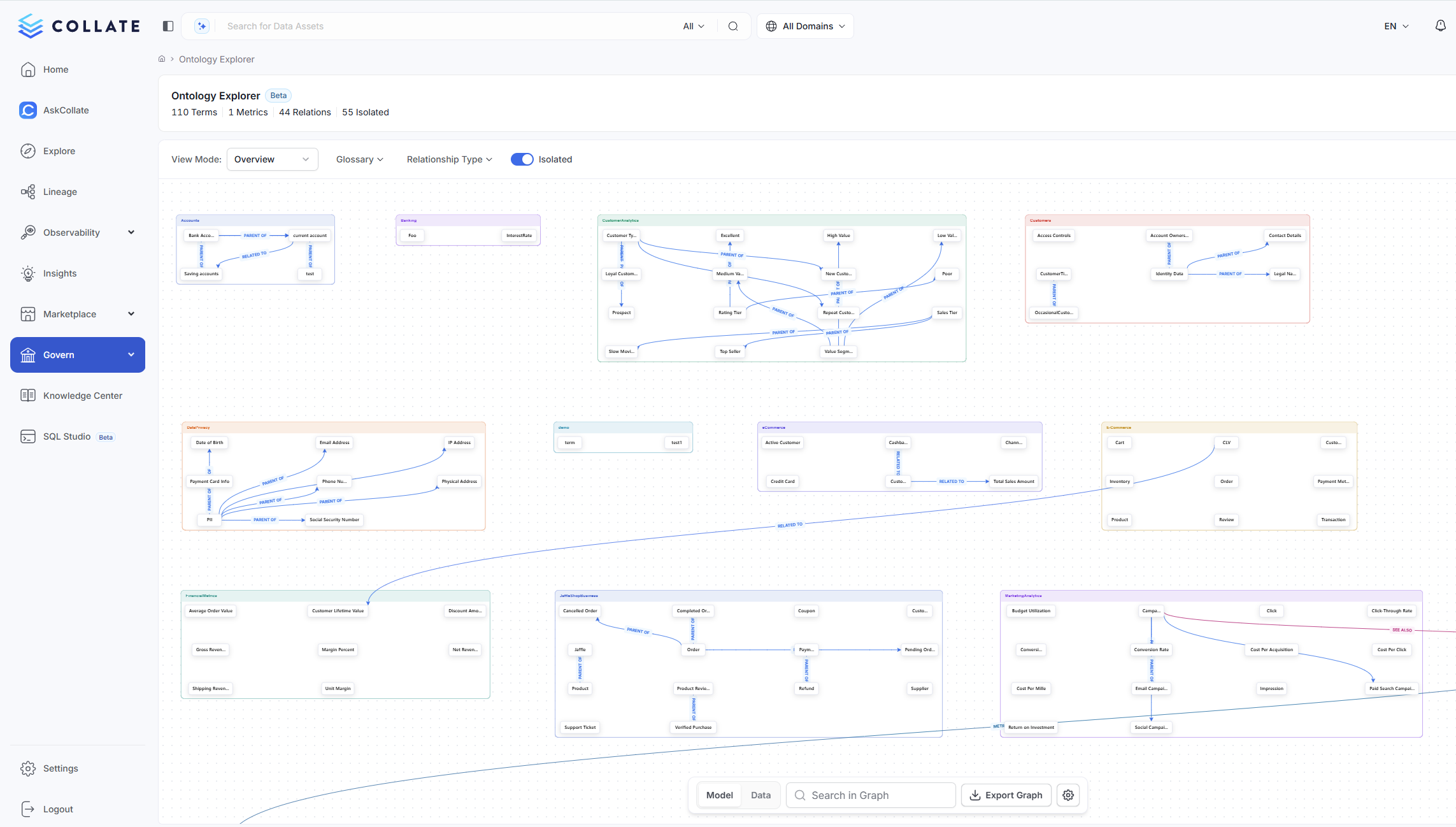
Ontology Explorer shows knowledge as relationships between business concepts.
Ontology Explorer and Knowledge Graph
Ontology Explorer and Knowledge Graph are complementary views of the same underlying semantic context graph. Ontology Explorer starts from business concepts and maps how they relate to each other and which assets implement them. Knowledge Graph starts from a data asset and shows everything connected to it. Together they make the semantic context graph navigable in both directions.
What This Means for Your Team
Data stewards and governance teams. For data stewards, Ontology Explorer is where the semantic graph gets built and maintained. Relationships between concepts can be created directly on the canvas without navigating away, and the graph updates immediately. Any graph state can be saved as a named view and shared with a specific audience. The compliance team sees certified terms and the Finance domain lead sees revenue concepts.
Analysts and data scientists. Before you build a report or train a model, you need to know which business concept your data represents and how it relates to everything around it. Ontology Explorer lets you navigate from a concept you understand to the assets that implement it, see how it connects to adjacent concepts, and confirm that the definition you are working from is the governed, canonical one, not one of several variants your organization created over the years and never reconciled.
Get Started
Ontology Explorer is available now in Collate 1.13. If your team has glossary terms already in the platform, you are ready to start navigating and enriching the semantic context graph your AI reasons from. Try it in our live sandbox with sample data, or request a demo from a Collate product expert to see it running across your own environment.