Data Quality Tools: Key Capabilities and Top 10 Options in 2026
What are Data Quality Tools?
Data Quality (DQ) tools are software that ensures data is accurate, complete, consistent, and reliable. They provide features like data profiling, cleansing, anomaly detection, monitoring, and metadata management to identify and fix flaws in data pipelines, supporting better business decisions, compliance, and AI/ML initiatives. Popular examples include Collate, Ataccama, and Informatica, with many leveraging AI/ML for proactive quality management.
Key capabilities of data quality tools:
- Data profiling: Analyzes data to discover patterns, statistics, and quality issues (e.g., completeness, uniqueness, validity).
- Data cleansing and standardization: Fixes errors, removes duplicates, and standardizes formats.
- Monitoring and alerting: Continuously checks data against rules and uses AI/ML to detect unexpected anomalies, notifying teams proactively.
- Data lineage and discovery: Tracks data flow to understand origins and impact, helping diagnose problems.
- Data contracts and testing: Defines and enforces data quality expectations between data producers and consumers.
Key Capabilities of Data Quality Tools
Data Profiling
Data profiling is the process of examining data to collect statistics, summaries, and insights about its structure, quality, and content. This capability allows organizations to understand baseline characteristics, identify anomalies, and detect patterns that may require corrective action. A data profiling tool typically reports on missing values, data type mismatches, uniqueness of values, frequency distributions, and potential outliers, helping teams pinpoint where data quality concerns exist.
By establishing a clear understanding of current data states, profiling supports the creation of effective data quality rules and informs downstream processes. It is an essential foundation for implementing controls and improving data trustworthiness across integrated systems. Continuous profiling, when automated, can catch quality issues early, even as new data is ingested, reducing downstream disruptions for analytics, reporting, and operational use.
Data Cleansing and Standardization
Data cleansing focuses on detecting and correcting errors or inconsistencies in datasets. This includes removing duplicate records, correcting typos, validating against reference values, and reconciling conflicting information across systems. Standardization complements cleansing by enforcing consistent naming conventions, formats, and units of measure so that data can be reliably used across various tools and processes.
Both cleansing and standardization are critical in environments where disparate systems or external data feeds are integrated, as inconsistent data types and formats undermine data usability. Automated data cleansing functions speed up the correction process, freeing teams from rote manual work while increasing the reliability of subsequent analytical and operational outputs. Effective standardization further ensures that organizations can uniformly interpret and act on their data, regardless of source or business unit.
Monitoring and Alerting
Continuous monitoring is a core feature of modern data quality tools, enabling organizations to track data health in real time. Monitoring functions automatically evaluate data streams or datasets against established quality rules, thresholds, or expectations, helping catch breaks, anomalies, or drift as soon as they occur. When a quality issue is detected, alerting capabilities notify relevant stakeholders immediately, allowing for prompt intervention before impacts propagate further downstream.
Timely alerts can be tailored to various severity levels, triggering remediation workflows or integrating with escalation systems for critical business data. In data-driven organizations, real-time monitoring and notification are essential for maintaining data reliability, ensuring regulatory compliance, and maintaining trust in reporting and machine learning outputs. By automating surveillance and response, monitoring and alerting reduce both business risk and the operational burden on data management teams.
Data Lineage and Discovery
Data lineage refers to the ability to trace the origins, transformations, and movements of data as it flows through various systems and pipelines. Discovery expands this by mapping relationships, dependencies, and context around data, making it easier to understand how data assets are connected across the organization. These capabilities are vital for impact analysis, audit trails, and regulatory compliance, ensuring that stakeholders have visibility into the path data takes from source to consumption.
Effective lineage tools not only visualize these flows but also document and enrich metadata, which aids in troubleshooting quality issues, identifying bottlenecks, and facilitating controlled data changes. Data discovery makes it easier for users to locate datasets, assess their trustworthiness, and ensure they fit the use case. When combined, lineage and discovery drive transparency, help prevent misuse or duplication, and raise overall confidence in data-driven operations.
Data Contracts and Testing
Data contracts define agreed-upon schemas, rules, and quality standards that govern how data should be structured, delivered, and managed between producers and consumers. Robust data quality tools facilitate the authoring, enforcement, and validation of these contracts, increasingly treating them as living artifacts that align stakeholders around shared expectations. This approach helps ensure that upstream producers understand downstream requirements, reducing friction and mitigating the risk of broken data pipelines.
Data testing complements contracts by enabling automated validation of both data and pipelines against specified expectations before data is promoted or consumed. Test automation helps catch schema changes, missing values, or data outliers early, preventing flawed data from reaching analytics or decision-making layers. Together, contracts and testing introduce rigor and reliability into data processes, driving better data engineering and analytical outcomes while minimizing surprises in production environments.
10 Notable Data Quality Tools
1. Collate®

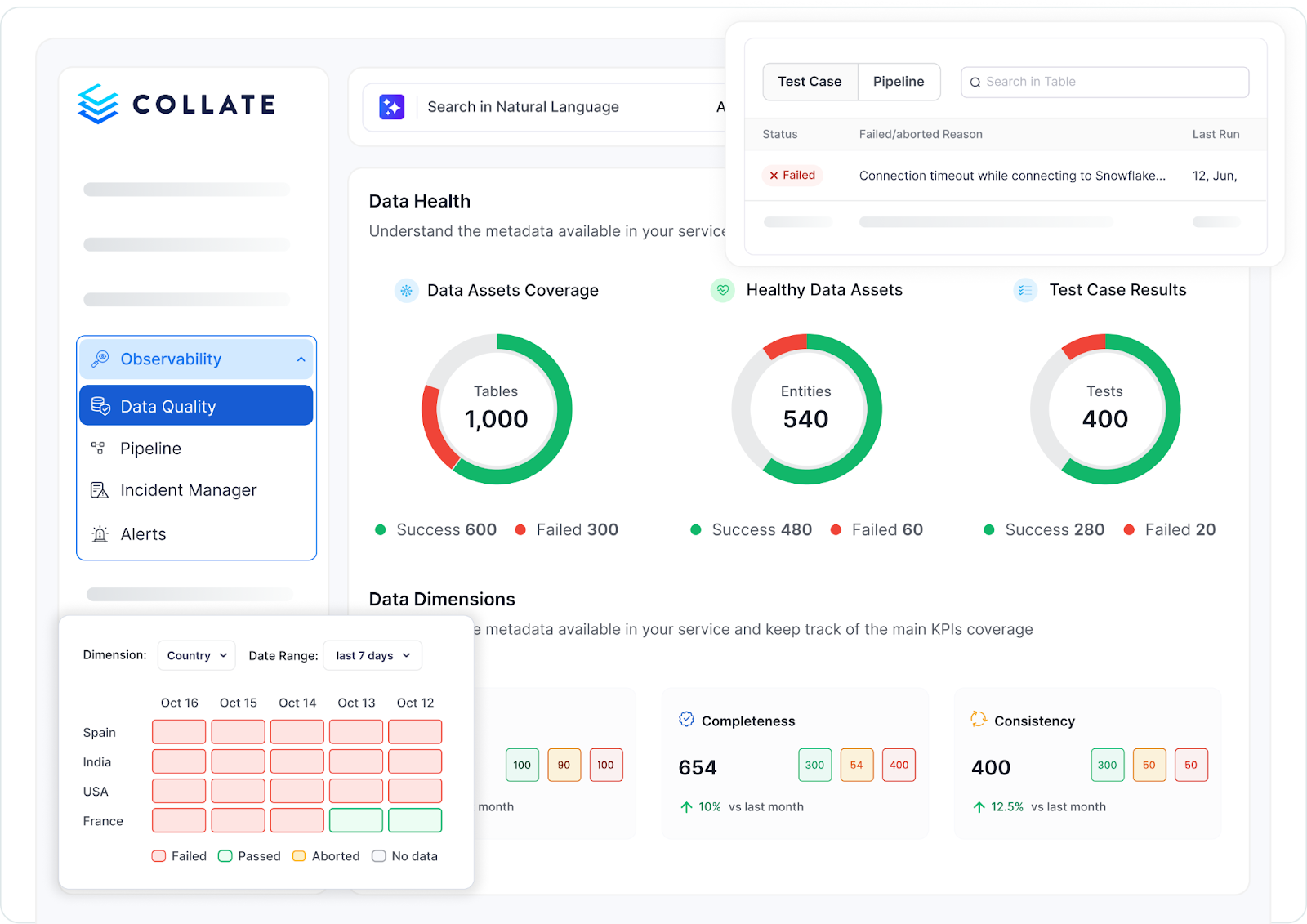
Collate, powered by the popular OpenMetadata open source project, provides AI-powered data quality, observability, discovery, and governance. It offers profiling, automated quality tests, lineage visualization, and collaborative workflows to help organizations build a unified view of data assets while maintaining quality standards across diverse environments.
Key features include:
- No-code, code, SQL, and custom quality tests: supports multiple testing approaches, from point-and-click, custom SQL queries, to shift-left Python-based validations integrated in data pipelines, enabling both technical and non-technical users.
- Automated AI testing: uses AI to recommend relevant quality tests based on dataset characteristics and usage patterns, as well as AI based anomaly detection.
- Data profiling and dashboards: automatically generates statistical profiles for datasets, including null counts, unique values, distributions, and data type validation, providing baseline insights that inform quality rule creation and highlight anomalies.
- Integrated incident management and collaboration: tracks data quality issues as incidents, allows users to assign ownership, add comments, and document resolutions within the platform, supporting accountability across teams.
- Lineage-aware quality monitoring: integrates quality test results with data lineage views, enabling users to trace quality issues upstream to root causes and assess downstream impact on dependent assets, reports, or applications.
2. Ataccama Data Quality
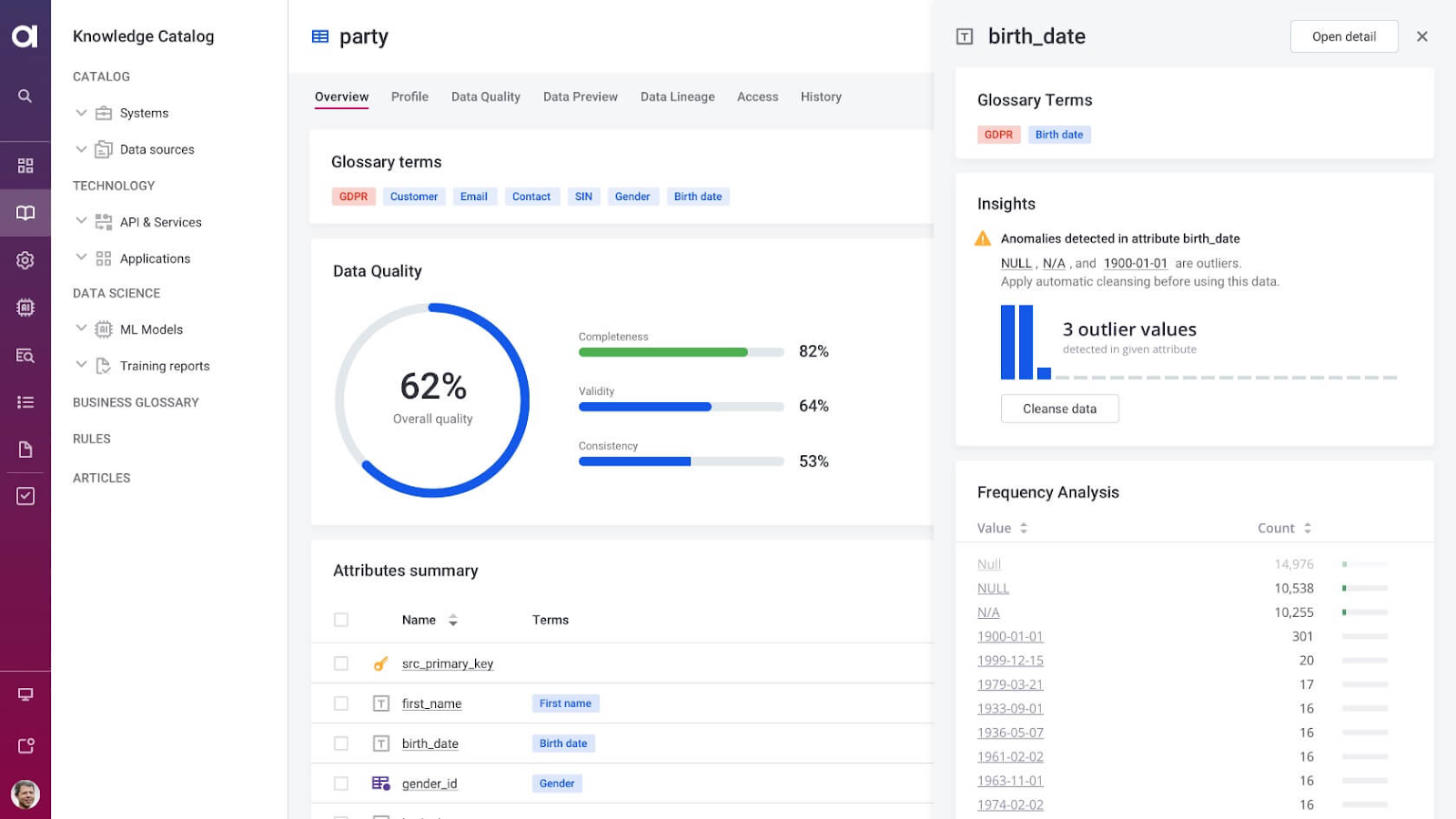
Ataccama Data Quality provides a data quality platform that supports data exploration, rule creation, monitoring, remediation, and prevention. It offers profiling, alerts, lineage, rule management, and automated cleansing to help organizations manage data across systems.
Key features include:
- Data profiling: examines datasets to detect distributions, patterns, and anomalies, generating insights that support rule definition and highlight quality concerns across large and diverse data sources.
- Data quality and observability alerts: monitors pipelines and datasets for issues, sending notifications about anomalies, schema changes, or threshold breaks so users can identify affected assets and determine required actions.
- Augmented data lineage: displays lineage with quality indicators and business context, enabling users to trace data from source to consumption and evaluate the impact of changes or upstream issues.
- AI-powered rule creation: generates data quality rules and test data from natural-language prompts, allowing teams to define simple or complex rules and apply them across multiple datasets.
- Data quality monitoring and reporting: tracks quality metrics across datasets and supports viewing reports in the platform or integrating results with external reporting tools such as Tableau or Power BI.
3. Informatica Data Quality and Observability

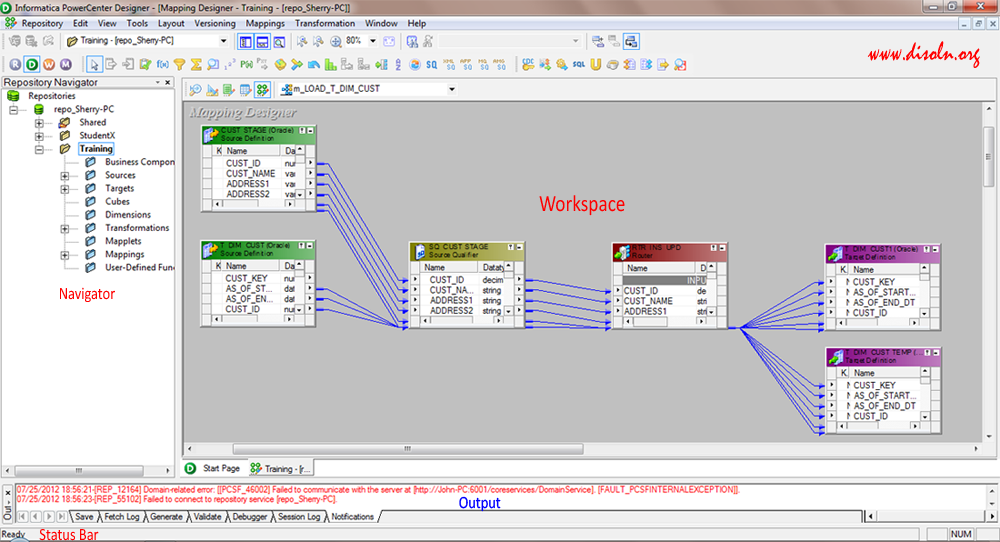
Informatica Data Quality and Observability provides tools for profiling, cleansing, rule automation, and monitoring to support the use of accurate and timely data across enterprise environments. It offers capabilities for detecting issues, improving reliability, and observing data and pipelines from multiple perspectives.
Key features include:
- Automated data profiling: performs continuous analysis of datasets to identify structural issues, detect anomalies, and generate insights that help teams understand data characteristics at scale.
- Cleansing and standardization: applies transformations that correct values, enforce consistent formats, and validate addresses, supporting reliability across diverse operational and analytical use cases.
- AI-powered rule generation: autogenerates common data quality rules for many data types and sources, reducing manual effort and expanding rule coverage across large data landscapes.
- Data observability for pipelines and assets: evaluates the health of data and pipelines through multiple operational and business lenses, helping teams detect breaks, delays, and quality degradations.
- Lifecycle automation: streamlines tasks from data collection to consumption by applying AI-driven automation that reduces repetitive work and supports continuous data refinement.
4. Talend Data Quality
Talend Data Quality provides profiling, cleansing, masking, and enrichment capabilities that operate in real time as data moves through enterprise systems. It offers machine-learning recommendations, a self-service interface, and mechanisms for protecting sensitive information while supporting both technical and business users.
Key features include:
- Automated data profiling: identifies data quality issues, detects anomalies, and highlights structural patterns using summary statistics and visual outputs that help users assess datasets quickly.
- Talend Trust Score: generates an explainable confidence metric for each dataset, indicating its overall reliability and highlighting areas that may require additional cleansing or review.
- Machine-learning cleansing: applies deduplication, validation, and standardization automatically, reducing manual intervention and supporting consistent processing of incoming data streams.
- Data enrichment: enhances records by joining them with external reference sources, such as postal codes or business identification data, to improve completeness and accuracy.
- Real-time data masking: protects sensitive information by masking personally identifiable data during processing or sharing, supporting compliance with privacy and security requirements.
5. Dataedo
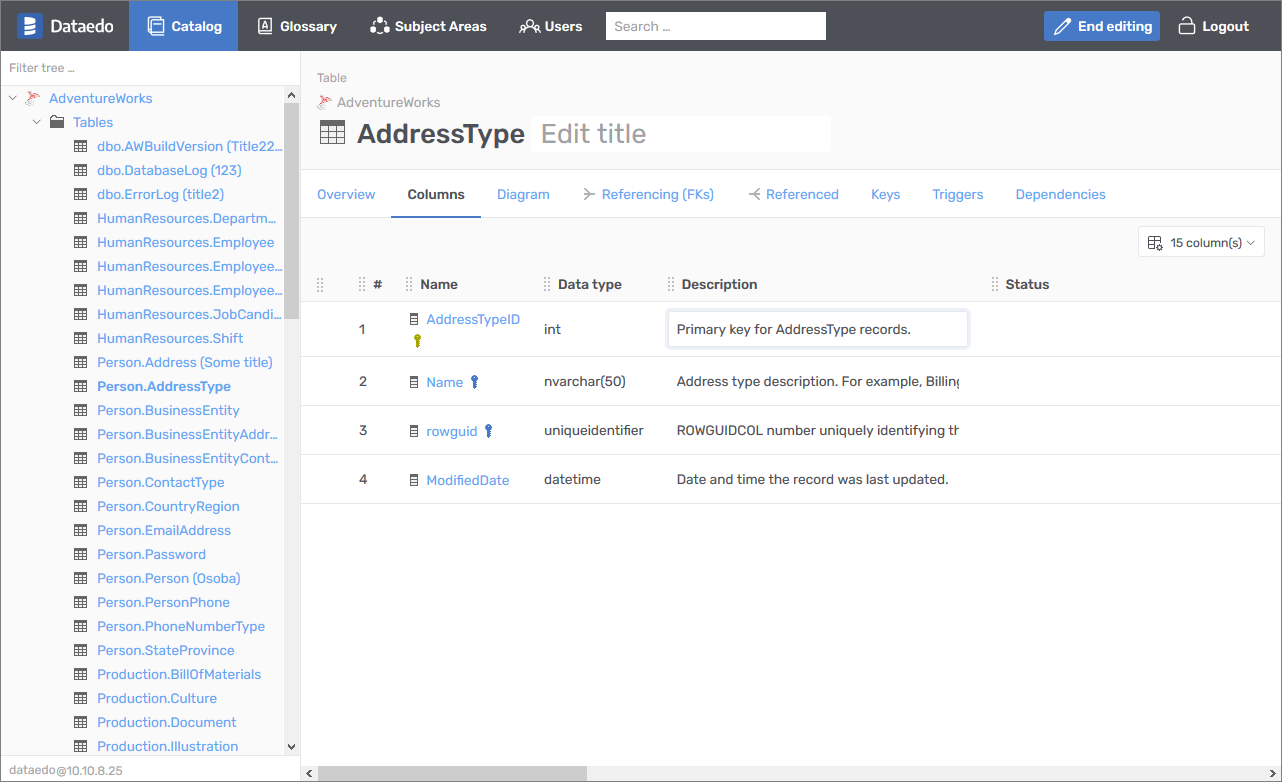
Dataedo provides a data quality tool integrated into its data catalog, offering built-in rules, custom validation, profiling, dashboards, and scheduled checks. It supports automated detection of issues, interactive reporting, and community feedback to help users assess and monitor data across systems.
Key features include:
- Built-in validation rules: applies 90+ predefined checks to detect missing values, incorrect ranges, and other common issues, enabling immediate evaluation of dataset quality without custom scripting.
- Custom SQL rules: allows users to define business-specific logic and compliance conditions with SQL, providing flexibility to validate requirements that go beyond standard automated checks.
- Interactive dashboards: displays data quality scores, test histories, and trends through visual dashboards that help users identify recurring issues and prioritize remediation work across datasets.
- Automated quality checks: runs tests on demand or on a schedule, supporting proactive monitoring that identifies issues early and reduces the impact on reporting and operational workflows.
- Data profiling tools: generates statistics, distributions, and uniqueness metrics that help users examine dataset structure, detect anomalies, and refine quality rules based on observed patterns.
6. Monte Carlo Data Quality

Monte Carlo Data Quality provides AI-driven monitoring, testing, and alerting designed to scale coverage across modern data environments. It offers automated baselines, rapid monitor deployment, lineage-enriched insights, and recommendations that help teams detect issues from ingestion through consumption.
Key features include:
- Automatic baseline coverage: generates immediate monitoring for freshness, volume, and schema issues, using AI to establish baselines and expand detection without extensive manual configuration.
- Rapid monitor deployment: creates and applies monitors within seconds through point-and-click tools, YAML configurations, or AI-generated definitions, enabling fast scaling across large data estates.
- Monitoring agent assistance: allows users to prompt an agent to recommend and deploy suitable monitors for each table, reducing manual effort and supporting broader ownership of pipeline reliability.
- Granular alert routing: sends targeted notifications to the correct stakeholders with lineage grouping and root-cause context, reducing alert noise and improving triage accuracy.
- Lineage-enriched insights: combines alerting with upstream and downstream lineage information, helping users identify impact areas and trace issues back to their sources more efficiently.
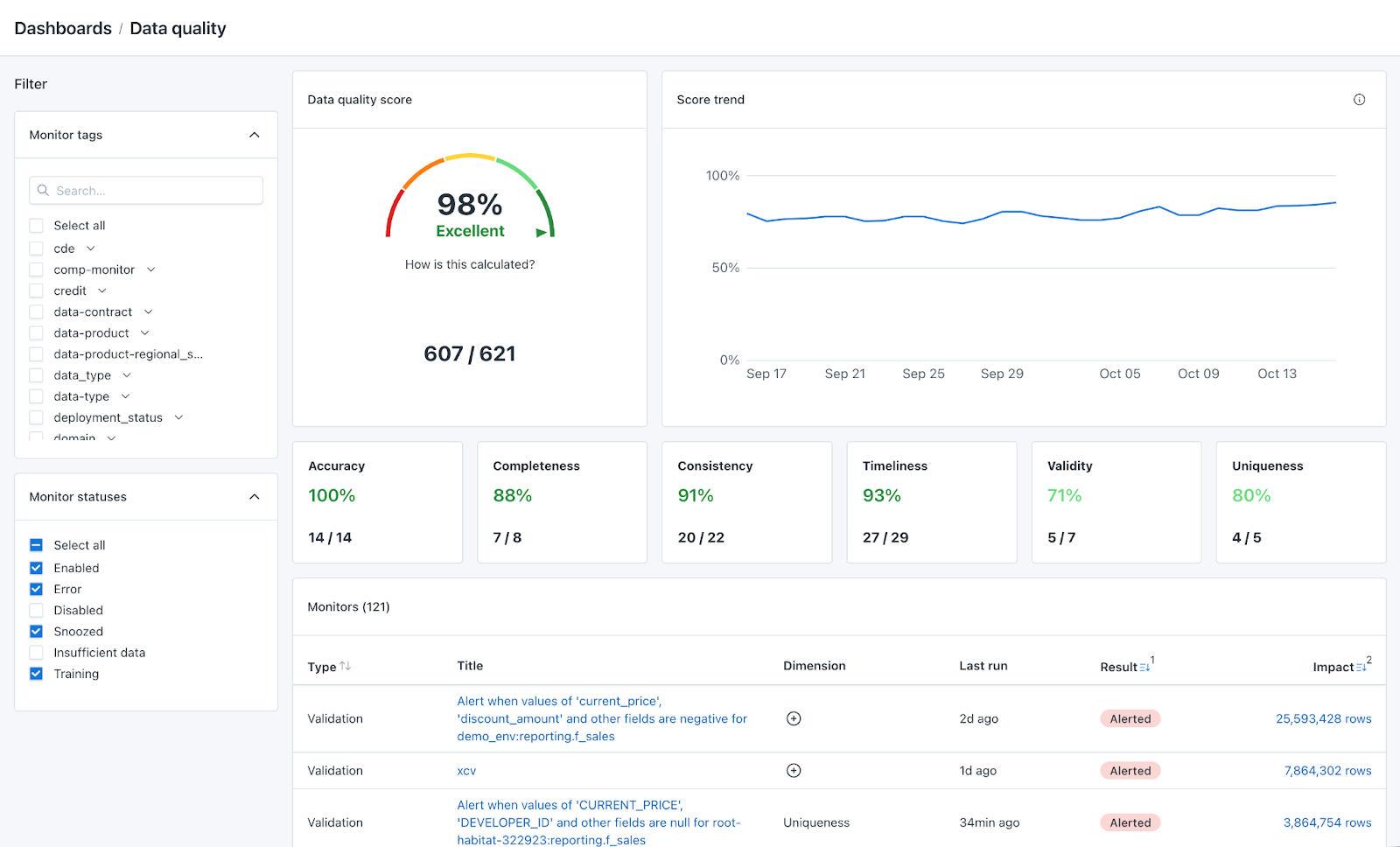
7. Experian Aperture Data Studio
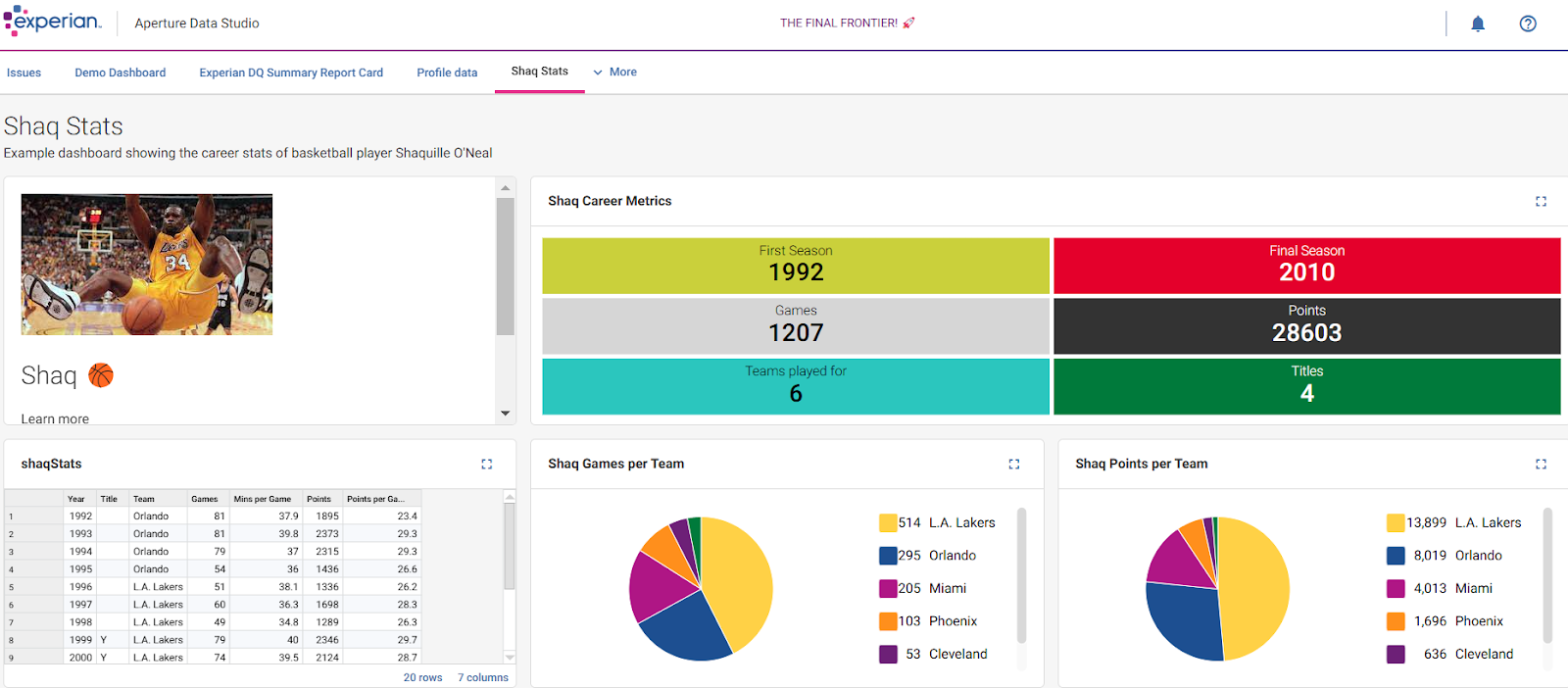
Experian Aperture Data Studio provides a data intelligence platform that combines data quality, enrichment, and governance capabilities. It offers tools for resolving errors, validating and standardizing data, mapping data flows, assigning ownership, and analyzing the operational or financial impact of data issues.
Key features include:
- Data validation and standardization: applies business rules to validate, transform, and standardize data, helping teams address gaps, inconsistencies, duplications, and errors across large and diverse datasets.
- Data profiling and visualization: enables users to explore, interrogate, and visualize data to identify trends, quality issues, and improvement opportunities that require operational or governance attention.
- Data flow mapping and ownership: maps data flows and assigns ownership to provide oversight of critical processes, connecting data assets with accountable teams to support governance requirements.
- Financial impact assessment: quantifies the monetary impact of data issues by linking them to business processes, allowing organizations to understand cost drivers and prioritize remediation effectively.
- Reference and enrichment data integration: incorporates extensive reference and enrichment datasets, enabling users to enhance data completeness and accuracy based on externally sourced context.
8. Deequ
Deequ provides a library built on Apache Spark for defining “unit tests for data.” It enables users to specify constraints, compute metrics at scale, and validate assumptions about large tabular datasets before they reach downstream systems.
Key features include:
- Spark-based data validation: runs data quality checks as Spark jobs, allowing users to evaluate constraints efficiently on very large datasets stored across distributed filesystems or warehouse environments.
- Declarative constraint definitions: uses a verification suite where users specify expectations such as completeness, uniqueness, allowed values, and quantile thresholds to verify whether datasets meet required conditions.
- Support for diverse data formats: works with any tabular data that can be loaded into a Spark dataframe, including CSV files, logs, flattened JSON, or database tables containing millions or billions of rows.
- Programmatic rule evaluation: computes metrics and applies assertion functions to determine whether constraints pass or fail, enabling automated detection of data gaps, invalid values, or structural inconsistencies.
- Detailed verification results: returns structured outputs that summarize constraint successes or failures, allowing users to inspect messages, identify violated assumptions, and prioritize corrective actions.
9. Great Expectations

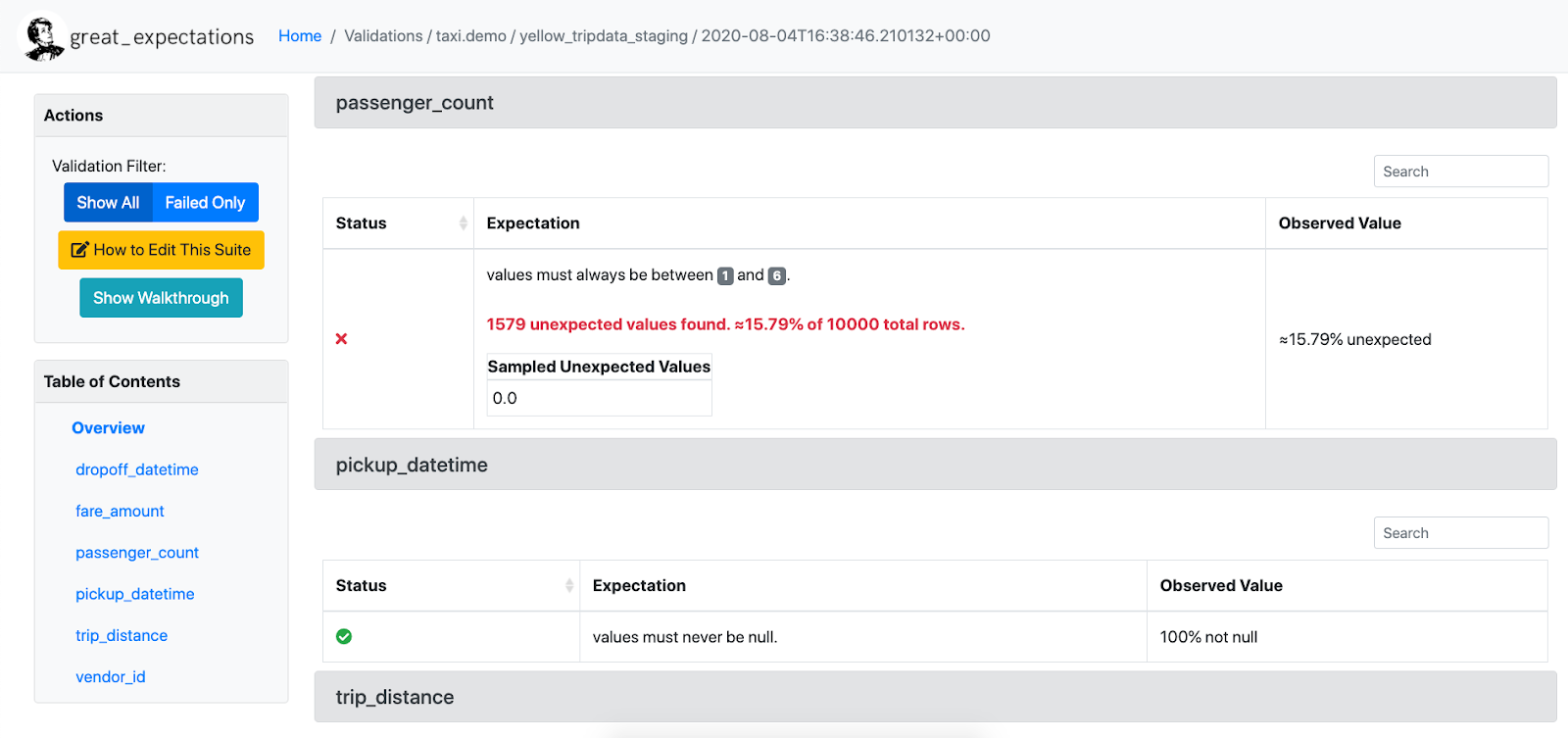
Great Expectations provides a data quality platform and open-source framework for validating datasets, monitoring data health, and aligning technical and business teams around shared quality expectations. It offers cloud-based tooling, automated test generation, real-time observability, and Python-based workflows for defining and evaluating data tests.
Key features include:
- Expectation-based validation: defines tests that express business logic and quality requirements, allowing teams to validate critical data across pipelines and detect issues during development or production.
- ExpectAI test generation: autogenerates tests for new or existing datasets, reducing manual rule creation and helping teams establish broad coverage with minimal initial configuration.
- Real-time data health monitoring: tracks quality indicators and pipeline drift, providing continuous visibility into data reliability and alerting users before errors propagate downstream.
- Collaboration and shared context: offers tools that help business and technical teams communicate using a common language for data quality, supporting shared understanding of failures and required fixes.
- No-infrastructure cloud platform: provides a managed environment that integrates with existing data stacks, allowing teams to set up validation quickly without operating backend services.
10. Soda Core
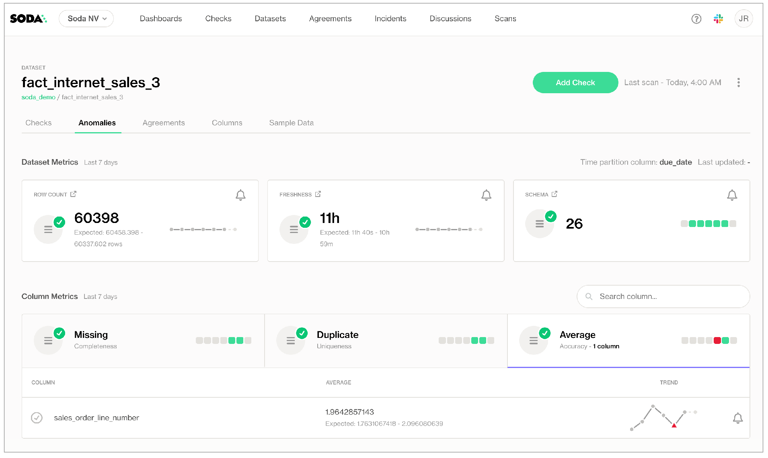
Soda Core provides an open-source command-line tool and Python library for testing data quality across SQL, Spark, and pandas environments. It uses the Soda Checks Language to translate user-defined rules into executable queries and identify invalid, missing, or unexpected data during scans.
Key features include:
- SodaCL-based test execution: converts user-written checks into aggregated SQL queries, enabling structured validation of missing values, invalid entries, duplicates, ranges, and other rule-based conditions.
- Pipeline and development integration: supports execution within data pipelines or standalone development workflows, allowing scans to run programmatically or on scheduled intervals for continuous testing.
- Schema validation checks: detects forbidden, missing, or mismatched columns by comparing expected schema definitions against dataset structures and surfacing warnings or failures when discrepancies appear.
- Freshness and referential integrity checks: evaluates data timeliness and verifies that values in one dataset exist in another, helping users monitor source freshness and relational consistency.
- Multi-source compatibility: connects to several data platforms through source-specific packages, allowing users to configure scans across different SQL engines, Spark contexts, or pandas datasets.
Selecting the Right Data Quality Tool
Choosing a data quality tool involves evaluating technical, operational, and organizational requirements to ensure the selected solution aligns with current and future data management needs. A poorly matched tool can result in underutilization, integration challenges, or limited scalability. The following considerations help guide effective tool selection:
- Data environment compatibility: Ensure the tool supports your data platforms (e.g., cloud data warehouses, on-prem databases, streaming systems). Compatibility with your ecosystem reduces integration overhead and speeds up deployment.
- Use case fit: Identify whether the tool supports your primary needs: profiling, cleansing, validation, monitoring, or observability. Some tools specialize in one or two capabilities, while others offer broader feature sets.
- Scalability and performance: Assess whether the tool can handle the volume, velocity, and variety of your datasets, especially if you're working in high-scale or real-time environments.
- Automation and intelligence: Consider how well the tool supports automation through AI, machine learning, or rule generation. Intelligent recommendations and self-healing workflows reduce manual intervention and increase coverage.
- Governance and compliance support: Look for features that enable data lineage, auditing, data ownership tracking, and policy enforcement. These are critical for regulated industries or organizations with strict governance requirements.
- Ease of use and adoption: Tools with intuitive interfaces, no-code/low-code features, or collaborative capabilities are more accessible to business users and foster broader adoption across teams.
- Integration with toolchain: Evaluate how well the tool integrates with your existing stack: ETL platforms, data catalogs, observability systems, BI tools, and CI/CD pipelines.
- Custom rule definition: Ensure the tool allows you to define and manage custom data quality rules (e.g., via SQL, Python, YAML) for organization-specific requirements that go beyond out-of-the-box checks.
- Monitoring and alerting flexibility: Check for configurable alerting, severity thresholds, and routing logic that fits your team's operational workflows.
Related content: Read our guides to data quality management and data quality dimensions
Conclusion
Data quality tools play a critical role in ensuring that data is fit for use across analytics, operations, and machine learning. With growing data volumes and complexity, these tools help automate detection and correction of quality issues, enforce contracts, and improve trust across teams. By selecting the right solution based on environment, use case, and governance needs, organizations can enhance data reliability, reduce manual overhead, and increase the value they extract from their data assets.
Fashion Retailer Mango’s Data Journey with Collate
Read the case study

Sign up to receive updates for Collate services, events, and products.
Share this article


Ready for trusted intelligence?
See how Collate helps teams work smarter with trusted data