Best Data Governance Tools for Enterprise: Top 5 in 2026
What Are Data Governance Tools?
Enterprise data governance stools like Collate, Collibra, and Secoda help organizations manage data quality, security, and compliance by providing features such as data catalogs, metadata management, lineage tracking, and automated policy enforcement. These platforms simplify data operations from intake to disposal, enabling data stakeholders to collaborate and ensure data is accurate, trustworthy, and aligned with regulatory standards.
Effective data governance tools include a range of capabilities to manage the entire data lifecycle:
- Data cataloging & metadata management: Creates a searchable inventory of data assets, providing definitions, context, and classifications.
- Data lineage tracking: Visualizes the flow of data from origin to consumption, helping to understand its history and impact.
- Policy enforcement: Helps establish and automatically apply data policies, access controls, and security rules.
- Data quality & cleansing: Automates data validation, cleansing, and quality checks to ensure data is accurate and consistent.
- Compliance monitoring: Monitors data usage and adherence to regulatory standards like GDPR and CCPA, reducing risk.
- Business glossary: Develops a shared understanding of business terms and data definitions across the organization.
- Collaboration: Provides a central platform for business and technical data stakeholders to coordinate on data governance processes.
Selecting the right tool depends on an organization's data architecture, existing governance framework, and unique requirements. It's important to evaluate features such as metadata management, data lineage, policy automation, and collaboration capabilities to find the best fit.
Why Enterprises Need Data Governance Tools
Enterprises generate and consume vast amounts of data across departments, systems, and regions. Without governance, this data often becomes fragmented, inconsistent, and unreliable, undermining its value for decision-making and analytics. Data governance tools address this by enforcing consistency, control, and accountability across the data lifecycle.
Key drivers include:
- Regulatory compliance: With global data protection laws like GDPR, HIPAA, and CCPA, organizations must implement strict controls on data usage, access, and retention. Governance tools automate these controls, reducing the risk of violations and simplifying audit readiness.
- Operational efficiency: Poor data quality leads to rework, delays, and flawed insights. Governance tools help maintain clean, standardized, and trustworthy data, enabling teams to work faster and with greater confidence.
- Data visibility: Enterprises require better visibility into how data flows across systems. Governance tools offer data lineage and metadata management to clarify data origins, transformations, and dependencies. This transparency supports risk management, troubleshooting, and data-driven innovation.
- Data integrity: As organizations embrace AI and analytics, governed data becomes essential. Data governance tools ensure that the data fueling these initiatives is accurate, secure, and used responsibly, reducing risks and maximizing impact.
Key Capabilities and Features of Modern Data Governance Tools
Data Cataloging and Metadata Management
Modern data governance tools provide data cataloging and metadata management capabilities, which are vital for establishing a unified view of all available data assets across the organization. Through automated cataloging, these tools inventory datasets, track their locations, and capture critical metadata such as origin, format, and usage.
Metadata management extends beyond simple cataloging by offering insights into the structure, relationships, and quality of the data. With metadata repositories, governance platforms support automated tagging, lineage tracking, and impact analysis, making it easier for data stewards and business users to understand data context, dependencies, and change history.
Data Lineage Tracking
Data lineage tracking is a core feature of data governance tools, enabling organizations to visualize and document the flow of data across systems, processes, and transformations. By mapping out the lifecycle of data from its source to its destination, lineage capabilities help teams track data transformations, aggregations, and derivations.
This transparency is critical for troubleshooting data issues, understanding data provenance, and ensuring accountability in data handling workflows. Accurate data lineage also supports compliance initiatives by providing auditable trails of data movement, transformation, and access patterns.
Policy Enforcement
Policy enforcement is fundamental to effective data governance, and governance tools automate the application and monitoring of data policies across distributed environments. These tools enable organizations to define and centrally manage rules concerning data access, usage, retention, and privacy. Automated enforcement ensures that only authorized users can access data assets, and all actions on the data are logged and tracked for auditability.
Policy engines further enable dynamic application of policies in response to the evolving risk landscape or regulatory requirements. For example, data masking, encryption, and retention policies can be implemented at scale, minimizing human error and administrative overhead.
Data Quality and Cleansing
Ensuring high data quality is essential for decision-making, and data governance tools include features for profiling, validating, and cleansing enterprise data. Regular data quality assessments help organizations identify issues such as duplicates, inconsistencies, missing values, and anomalies that could undermine analytics or operational processes.
Cleansing functions then resolve these issues by standardizing, correcting, or enriching the data. Ongoing monitoring and automated remediation options further prevent the recurrence of data quality problems. Integration with other governance functions, such as metadata management and policy enforcement, allows these tools to deliver continuous improvement by flagging and fixing quality gaps as soon as they arise.
Compliance Monitoring
Compliance monitoring is vital for organizations subject to data protection and privacy regulations such as GDPR, CCPA, or HIPAA. Data governance tools automate the enforcement and reporting of compliance controls, enabling the continuous monitoring of how sensitive information is accessed, processed, and stored. They generate real-time alerts and detailed audit logs that help organizations demonstrate due diligence during audits or investigations.
Compliance features allow organizations to map data assets to regulatory requirements, trigger automated responses to policy violations, and ensure proper retention and data subject rights management.
Business Glossary
A business glossary in data governance tools serves as the authoritative repository for business terms, definitions, and data standards across the organization. It standardizes terminology, reducing confusion and miscommunication between business and technical teams. By connecting business concepts to data elements, the glossary bridges the gap between domain experts and data stewards, fostering shared understanding and accountability.
The business glossary also enforces consistency in the use and interpretation of data, which is crucial for reporting, analytics, and compliance. Governance tools often provide collaborative features for glossary management, allowing stakeholders to propose, review, and approve new terms or definitions.
Collaboration
Collaboration features in data governance tools simplify cross-functional engagement among data owners, stewards, users, and IT administrators. These tools provide shared workspaces, discussion forums, and workflow automation that make it easier to coordinate policy development, resolve data quality issues, or curate metadata.
Efficient collaboration accelerates data discovery, data stewardship, and the adoption of governance best practices across teams. It also supports knowledge sharing and drives accountability by documenting conversations and decisions about data. By integrating access controls, notifications, and task management, governance platforms foster structured participation.
Notable Data Governance Tools for Enterprises
1. Collate®

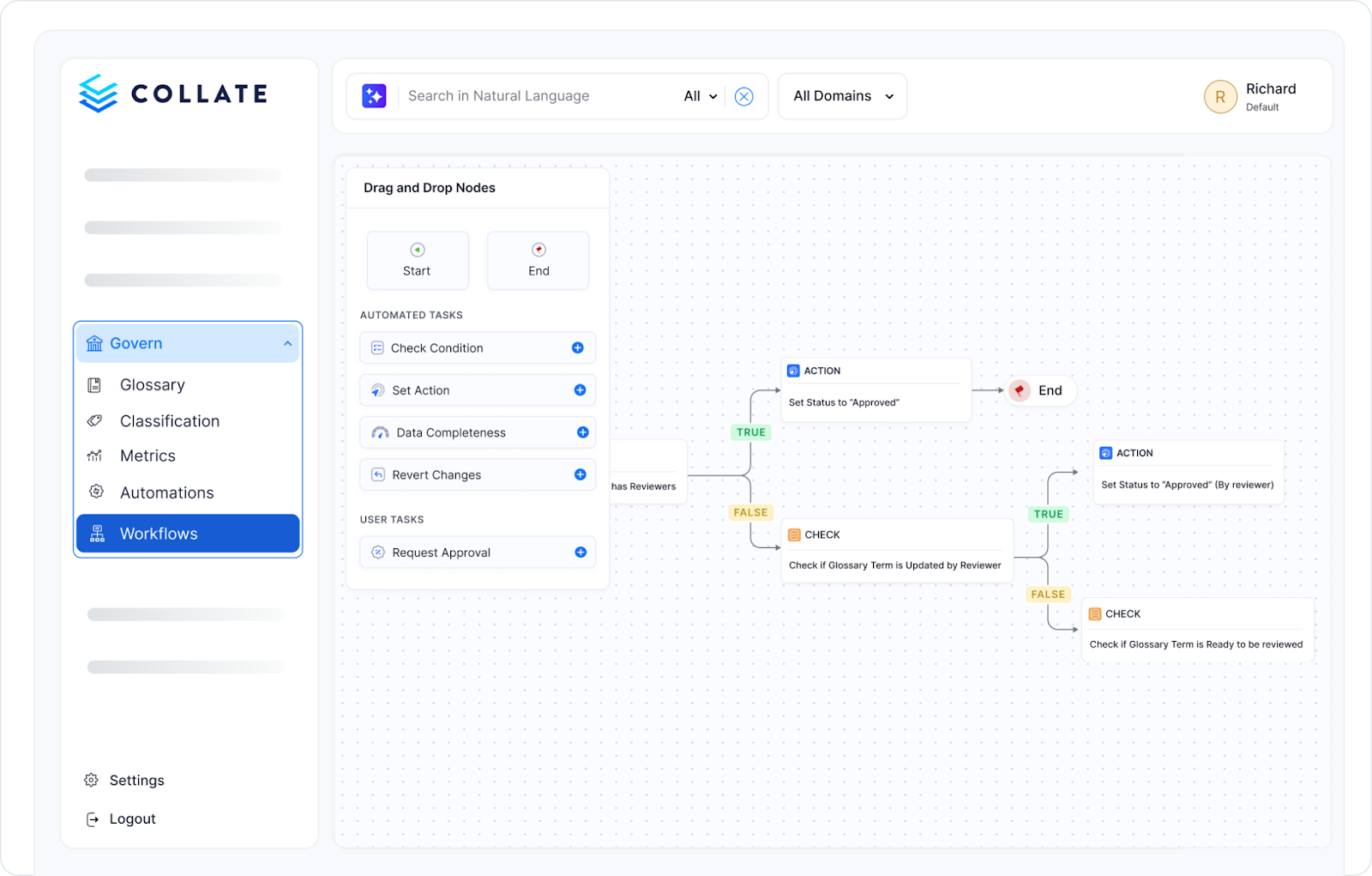
Collate, powered by the open source OpenMetadata project, is an AI-powered governance, observability, and discovery platform designed to centralize metadata management and enable collaboration across data teams. It provides a unified interface for cataloging data assets, tracking lineage, monitoring quality, and managing policies across diverse data sources. With its open architecture and community-driven development, Collate offers flexibility and transparency for enterprises seeking customizable governance solutions.
General features include:
- Automated metadata extraction from databases, warehouses, pipelines, and BI tools
- Centralized data catalog with search, filtering, and contextual documentation
- End-to-end data lineage visualization showing transformations and dependencies
- Integrated data quality framework with customizable tests and profiling
- Collaboration tools including annotations, tags, ownership assignment, and activity feeds
Enterprise features include:
- Visual governance workflow builder with custom conditions, automated actions, and human approvals
- Role-based access control (RBAC) with fine-grained permissions for governance workflows
- Data profiling and quality metrics with automated monitoring and alerting
- Business glossary for standardizing terminology and linking business concepts to data assets
- Custom policy templates for compliance with regulatory frameworks
- API-first architecture enabling integration with existing data infrastructure and toolchains
2. Collibra Data Governance
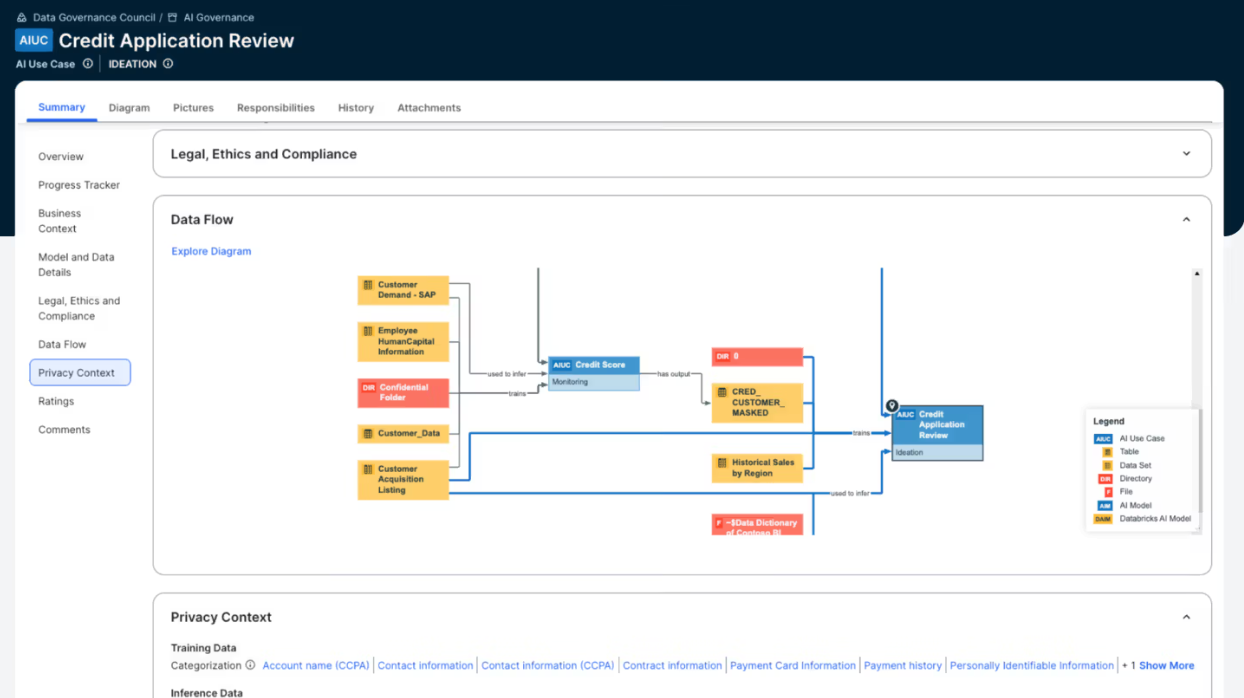
Collibra offers a data governance platform to help enterprises automate, standardize, and scale their governance initiatives across complex data environments. It enables organizations to define and enforce data policies, manage business terminology, and maintain data privacy through a centralized, automated system.
General features include:
- Centralized business glossary to standardize definitions and improve communication
- Role-based access control to enforce secure, authorized data usage
- Reference data management to reconcile inconsistencies across systems
- Metadata documentation to capture data origin, structure, and relationships
- Automated workflows for issue resolution and governance processes
Enterprise features include:
- Centralized policy management to define, review, and update compliance rules
- Automated enforcement of data privacy and regulatory policies
- Workflow-driven automation for consistent, scalable governance execution
- Audit-ready tracking of data issues and policy changes
- Federated governance model to support distributed teams and data environments
3. Informatica Data Governance

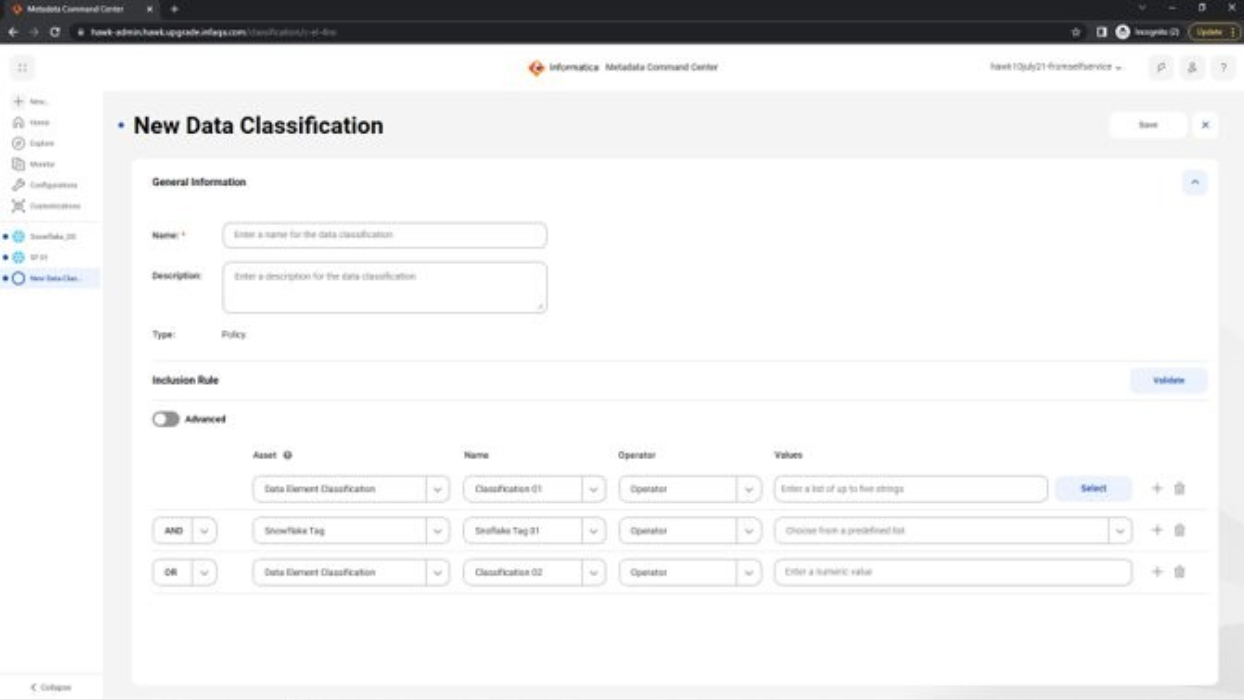
Informatica’s data governance platform helps enterprises ensure data consistency, compliance, and quality across cloud and hybrid environments. As part of the Informatica Intelligent Data Management Cloud (IDMC), it enables governed access to data, supports privacy regulations, and integrates AI-driven automation to simplify governance tasks.
General features include:
- Automated data governance processes powered by Claire® AI
- Metadata linked with business context for end-to-end transparency
- Centralized view of data quality metrics with integrated observability
- Governed data marketplace for safe and policy-compliant data sharing
- Access control and policy enforcement to protect sensitive data
Enterprise features include:
- Visibility and control to support compliance with regulations like GDPR
- Support for explainable AI through data lineage and model transparency
- Scalable cloud-native platform integrated with the broader IDMC suite
- Flexible, consumption-based pricing to adapt to enterprise growth
- AI-assisted discovery, classification, and governance of enterprise data
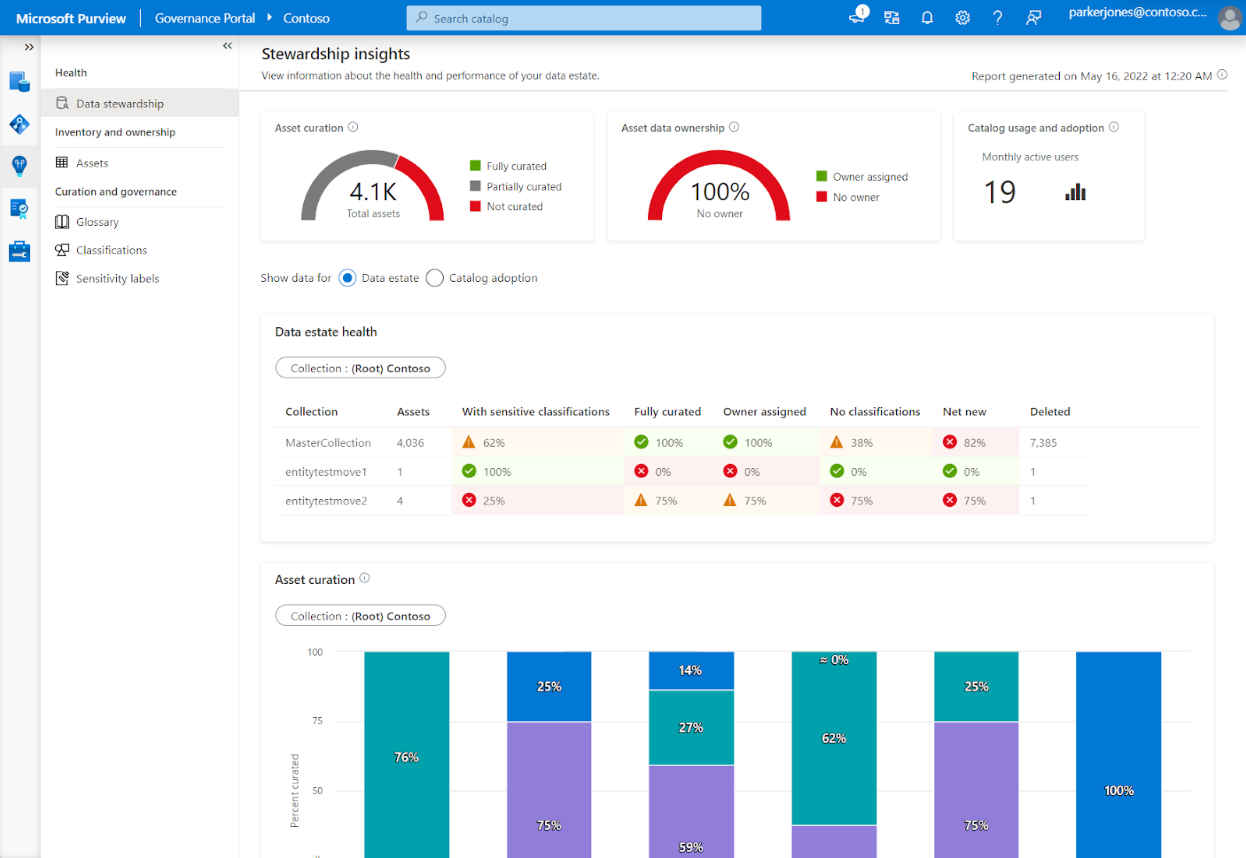
4. Microsoft Purview

Microsoft Purview provides data governance through two solutions: Data Map for scanning assets across multicloud sources to capture metadata, and Unified Catalog for curating data, managing quality and health, and granting access. Unified Catalog is a single-tenant SaaS catalog. Governance operates at the metadata layer, and permissions don’t grant access to underlying data.
General features include:
- Data Map scanning across multicloud sources to capture metadata
- Unified Catalog to curate data, manage quality, and grant access
- Metadata-only governance; roles do not grant access to underlying data
- Data lineage to trace relationships and diagnose quality issues
- Built-in data quality experiences to monitor and improve data health
Enterprise features include:
- Federated governance with centralized oversight and delegated domain control
- Role-based access control with reader and owner rights
- Data products to package assets by use case and share
- Search by business context and natural language, with Security Copilot
- Purview Analytics in OneLake to export catalog data and enable Fabric analytics
5. Secoda Data Governance
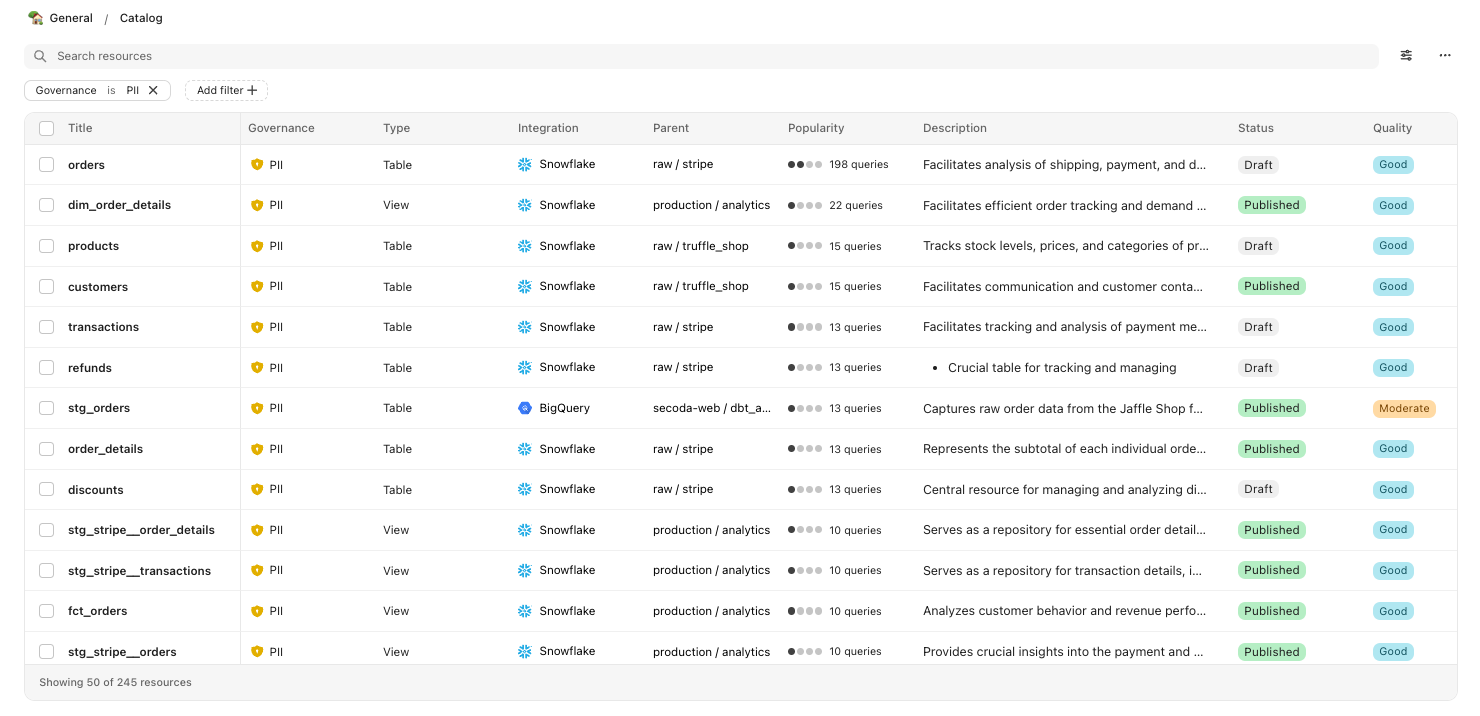
Secoda provides a platform for data governance, focusing on secure, compliant access to data across the data stack. It centralizes access control, simplifies compliance, and automates governance workflows to reduce risk and overhead. With built-in regulatory frameworks and customizable access roles, Secoda enables organizations to maintain data integrity.
General features include:
- Granular role-based access control (RBAC) for internal and external users
- Customizable access roles tailored to teams, departments, or contractors
- Simplified access request workflows with approvals, forms, and audit trails
- Unified command center for managing governance across the full data stack
- Automated identification and protection of personally identifiable information (PII)
Enterprise features include:
- Built-in compliance policies for standards like GDPR and HIPAA
- Automatic application of data protection controls across systems
- Audit-ready tracking of access and policy changes for accountability
- Scalable permissioning aligned with organizational structure
- Risk mitigation through proactive PII detection and access restriction
Evaluating and Selecting the Right Data Governance Tool for Enterprise
Here are some important considerations for choosing the appropriate tool for your organization.
1. Define Your Governance Objectives and Scope
Successful tool selection starts with clearly defining your organization’s data governance objectives and the scope of your initiative. Consider what you want to achieve—whether it’s regulatory compliance, improved data quality, increased data accessibility, or support for digital transformation projects. Establishing these goals up front shapes the evaluation process, ensuring that your chosen solution aligns with your compliance needs.
Scope definition should extend to identifying key data domains, business units, and stakeholders that will be affected by the governance initiative. By specifying which datasets and processes require governance, you prevent scope creep and select tools with features tailored to your organization’s unique requirements.
2. Assess Data Architecture and Existing Toolchain Compatibility
A thorough assessment of your existing data architecture and technology stack is necessary to determine which governance tools will integrate seamlessly. Inventory your data sources, data warehouses, analytics platforms, and business applications to understand the technical landscape. Evaluate the APIs, connectors, and integration points offered by governance tools to avoid costly workarounds or data silos.
Compatibility with your existing toolchain not only accelerates implementation but also maintains continuity in your organization’s data workflows. Consider factors like cloud versus on-premises deployment, support for multi-cloud or hybrid environments, and interoperability with preferred analytics and BI tools.
3. Evaluate Scalability, Usability, and Performance
Scalability is critical for enterprises expecting data volumes, sources, and users to grow significantly over time. Choose governance tools that can scale horizontally or vertically to handle expanding data assets and user populations. Review customer case studies, reference architectures, and benchmark reports to verify performance under workloads similar to your use case, ensuring that platform responsiveness remains high at scale.
Usability is another essential criterion because adoption hinges on user experience. Assess the tool’s interface, accessibility, and learning curve for both technical and business users. Features like intuitive search, contextual help, and workflow automation increase productivity and reduce onboarding time.
4. Estimate Total Cost of Ownership (TCO) and ROI
Estimating the total cost of ownership involves more than just licensing fees; factor in implementation costs, integration, customization, user training, ongoing support, and potential infrastructure upgrades. Accurately projecting all direct and indirect expenses helps prevent budget overruns and informs ROI calculations. Vendors should provide transparent pricing models, and organizations should plan for capacity increases.
To calculate return on investment, quantify the expected benefits such as reductions in regulatory risks, improved data quality, increased operational efficiency, or faster time to insights. Document the baseline before implementation and set clear success metrics for the governance program.
5. Conduct Proof of Concept (PoC) and Vendor Comparison
A proof of concept is a practical step for evaluating governance tool effectiveness in your real-world environment. Shortlist vendors, define core scenarios, and test each solution against business workflows and technical requirements. Assess performance, integration, usability, and outcomes against defined criteria. Engaging actual users in PoC trials uncovers usability issues and ensures requirements are met before full-scale rollout.
Vendor comparison is equally essential, considering factors like roadmap alignment, customer support, community engagement, and service-level agreements. Document strengths and trade-offs for each option, focusing on long-term fit rather than just current features. A structured PoC and side-by-side vendor evaluation minimize risks, highlight the best fit for your organization, and foster a smooth transition to enterprise-grade data governance.
Conclusion
Data governance tools give enterprises the structure and automation needed to manage growing volumes of complex data. By supporting data quality, security, compliance, and collaboration, these tools help maintain control over data assets and ensure responsible data use across the organization. A well-implemented governance tool becomes a foundational component of enterprise data strategy, enabling data to be a trusted and compliant asset for operations and innovation.
Fashion Retailer Mango’s Data Journey with Collate
Read the case study

Sign up to receive updates for Collate services, events, and products.
Share this article


Ready for trusted intelligence?
See how Collate helps teams work smarter with trusted data