Best Data Governance Solutions: Top 5 Options in 2026
What Is a Data Governance Solution?
Data Governance solutions are systems and processes that help organizations manage and control their data by establishing policies, roles, and technologies to ensure data is accurate, secure, and compliant. Key capabilities include data cataloging, lineage tracking, security enforcement through role-based access, and automation of data quality management. Examples of tools that provide data governance capabilities include those from Collate, Informatica, Collibra, Microsoft, and Alation.
Core functions and capabilities include:
- Data Quality: Ensure data is accurate, consistent, and reliable for decision-making.
- Data security and compliance: Enforce data protection rules and meet regulatory requirements through automated policies and controls.
- Data cataloging and discovery: Automatically discover and classify data assets, making them searchable and understandable for users.
- Data lineage: Track the origin, movement, and transformation of data to ensure transparency and accountability.
- Access control: Manage who can access data based on their role to protect sensitive information.
- Workflow automation: Simplify data governance processes, such as data validation and access requests, to improve efficiency.
Deploying a data governance solution helps organizations gain control over the volume, variety, and velocity of their data. It provides structure for data stewardship, clarifies roles and responsibilities, and fosters consistent data practices company-wide. Solutions support data discoverability and transparency, support auditability, and enforce policy through automation and monitoring.
Core Components and Functions of a Modern Data Governance Solution
Data Quality
Data quality management is fundamental to reliable analytics and decision-making. Modern data governance solutions include features for profiling, cleansing, and monitoring datasets. These tools detect anomalies, inconsistencies, missing values, and duplications, then automatically apply remediation steps according to established rules. Quality metrics are tracked continuously, with automated alerts to data stewards when thresholds are breached, allowing swift correction to preserve data integrity.
Beyond correction, data governance platforms offer dashboards and reporting tools to communicate quality levels to stakeholders. This transparency reassures business and technical users that data is trustworthy enough for operational and analytical tasks. Over time, organizations use data quality feedback to optimize source systems, enhance data collection standards, and reinforce a culture of accuracy and accountability throughout the enterprise.
Data Security and Compliance
Security and compliance are vital pillars for any data governance solution, driven by regulations such as GDPR, CCPA, and HIPAA. These solutions implement granular access controls, encryption, and masking to prevent unauthorized access to sensitive information. Audit trails and activity logs monitor who interacted with data and when, supporting rapid forensic investigations and regulatory inquiries. Policy-driven automation reduces manual intervention, ensuring consistency in enforcement across environments.
Compliance features include data retention policies, consent management, and reporting capabilities tailored to legal requirements. Solutions often integrate with security information and event management (SIEM) tools for unified risk visibility. As regulations evolve, governance solutions streamline policy updates, applying new controls at scale without major disruptions to business operations. Continuous compliance checks and automated reporting lower regulatory risks while reducing operational burden.
Data Cataloging and Discovery
A data catalog serves as the central inventory for all organizational data assets, enabling users to find, understand, and trust available data. Cataloging functions use metadata harvesting, classification, and business term definition to document where data lives, its structure, origin, and usage context. This rich metadata layer makes it easier for data scientists, analysts, and business users to search and evaluate datasets without tribal knowledge or manual curation.
Discovery tools within catalog platforms often feature search engines, filters, and knowledge graphs, helping users see relationships across datasets and understand data lineage. Automated classification assigns sensitivity labels or business tags, speeding up onboarding and reducing risk of mishandling sensitive data. By sharing context and documentation, cataloging eliminates data silos, reduces duplication, and accelerates delivery of data-driven projects.
Data Lineage
Data lineage functionality enables organizations to visualize how data moves and transforms across systems, from ingestion to consumption. Lineage maps track processing steps, transformations, and data dependencies, offering a detailed, end-to-end view of the data lifecycle. This visibility helps data engineers and analysts identify sources of errors, understand the impact of changes, and support root cause analysis in the event of data issues.
Lineage features are also critical for compliance and auditing, proving where regulated data originated and how it has been manipulated over time. Solutions automatically generate and update lineage diagrams using code parsing, logs, and integration with ETL tools, minimizing manual effort. This capability accelerates incident response, supports impact assessments, and enforces traceability required by modern data governance policies.
Access Control
Access control is central to data governance, determining who can view, modify, or share specific data assets. Governance solutions provide fine-grained access policies managed via role-based access control (RBAC), attribute-based access control (ABAC), or a combination. These policies can be applied at the field, dataset, or resource level, accommodating both broad and nuanced data access scenarios common in large organizations.
Automated access approval workflows and policy enforcement minimize manual errors and help demonstrate adherence to security and privacy obligations. Solutions usually integrate with enterprise identity systems to synchronize user roles and permissions. Real-time access monitoring and alerting log suspicious behavior, supporting proactive threat detection and compliance audits. Effective access control ensures the right users have the right data at the right time, while keeping sensitive information protected.
Workflow Automation
Workflow automation streamlines repetitive and policy-driven tasks in data governance, reducing the manual workload on data stewards and IT staff. These tools create configurable approval cycles for data requests, policy reviews, certification, and remediation processes. By automating task assignments, notifications, and escalations, organizations ensure governance controls are enforced reliably and consistently.
Automated workflows support faster onboarding of new data assets, drive timely response to data quality or access issues, and support change management when data models or policies evolve. Integration with other enterprise systems, like ticketing tools, data lakes, or data warehouses, further accelerates governance processes and fosters collaboration between business and technical teams. Automation not only boosts operational efficiency but also standardizes governance practices to meet audit and compliance needs.
Notable Data Governance Solutions
1. Collate®

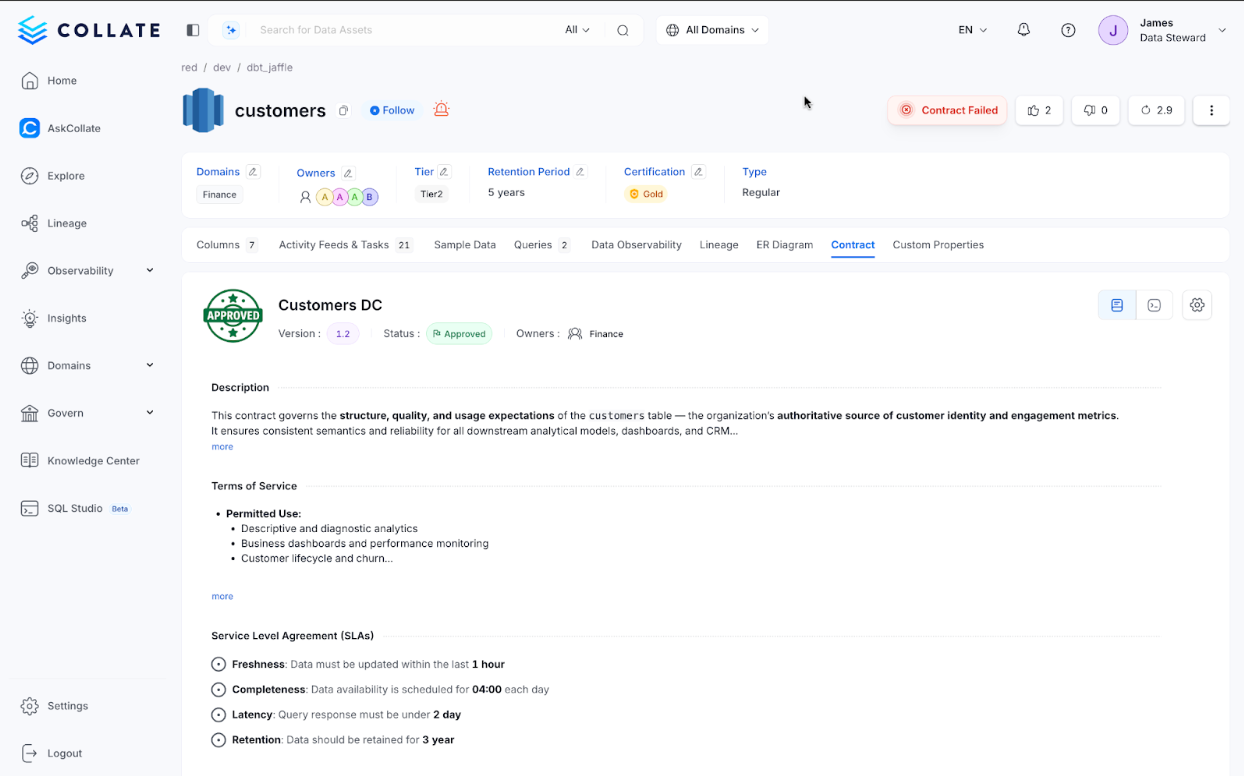
Collate centralizes data discovery, observability, and governance into a unified AI-powered platform for modern data teams. Built on the fastest-growing open source metadata platform OpenMetadata and enhanced with enterprise-grade features, Collate provides agentic governance capabilities that automate trust and collaboration without scaling headcount.
Key features include:
- AI-powered governance: Uses intelligent agents and AskCollate conversational AI to automatically document data, bulk generate quality tests, classify sensitive data, and generate BI visualizations that reduce manual stewardship.
- Native data contracts: Proactive governance through collaborative agreements between data producers and consumers prevents breaking changes from impacting downstream systems.
- Reverse metadata sync: Pushes governance decisions from Collate back to source systems, ensuring classifications, tags, and policies are consistently enforced.
- Unified metadata graph: Organizes all data landscape metadata in a unified graph for comprehensive understanding, eliminating the need for separate tools for cataloging, lineage, and observability.
- Enterprise-scale with open source foundation: Community innovation and freedom from vendor lock-in, with managed service scalability to millions of assets.
2. Microsoft Purview

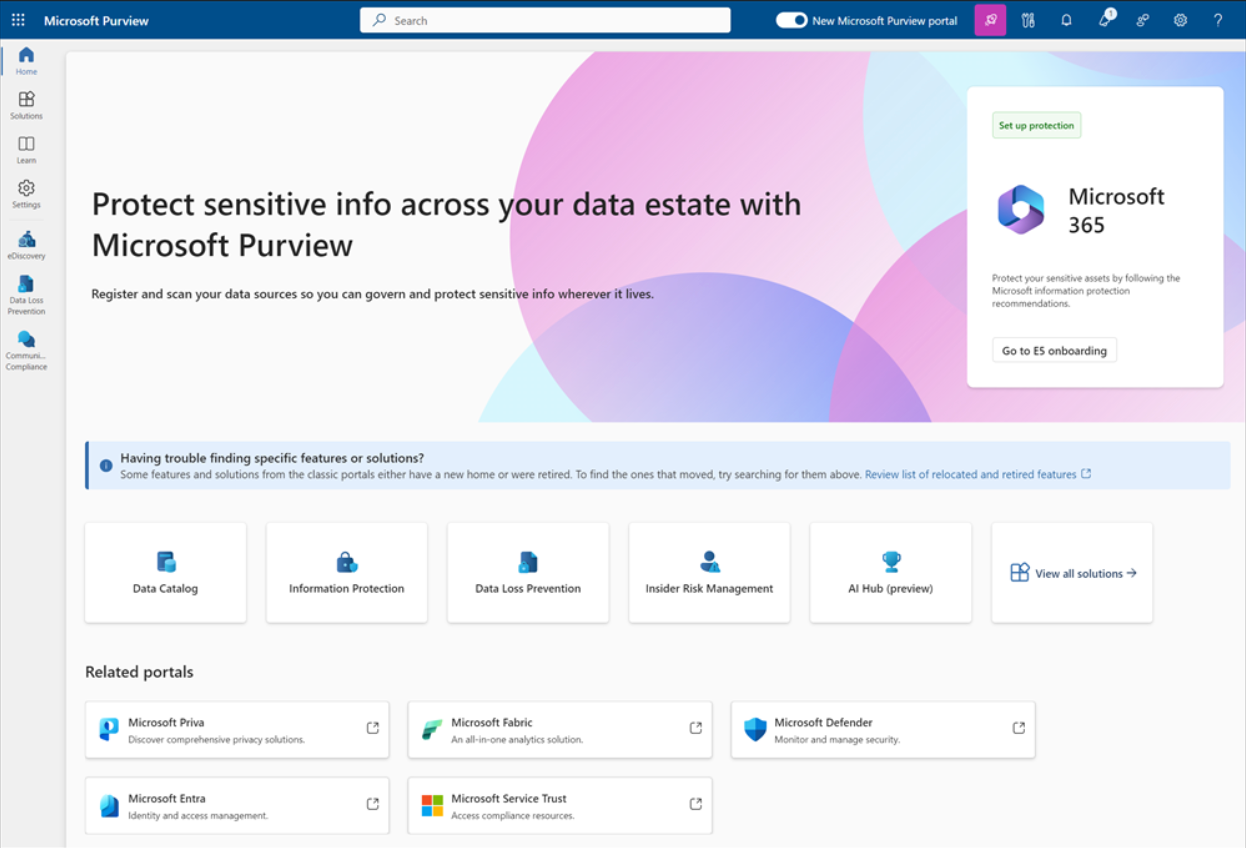
Microsoft Purview offers a role-aware data governance solution for organizations operating in AI-driven environments. With its Unified Catalog and Data Map components, Purview enables teams to discover, manage, and protect data across multicloud environments while ensuring regulatory compliance and business alignment.
Key features include:
- Unified catalog: Centralized, searchable SaaS-based catalog that curates data products, tracks data health, and offers AI-powered recommendations for data quality and curation
- Data map: Scans and captures metadata from multicloud data sources, enabling visibility into the data landscape
- Federated governance model: Balances centralized policy control with distributed data ownership, allowing domain experts to manage and govern data locally
- Data lineage: Visualizes the flow and dependencies of data assets, supporting root cause analysis and improving trust in data pipelines
- Data quality management: Allows data owners with tools to monitor, validate, and improve data quality within the platform
3. Informatica Data Governance

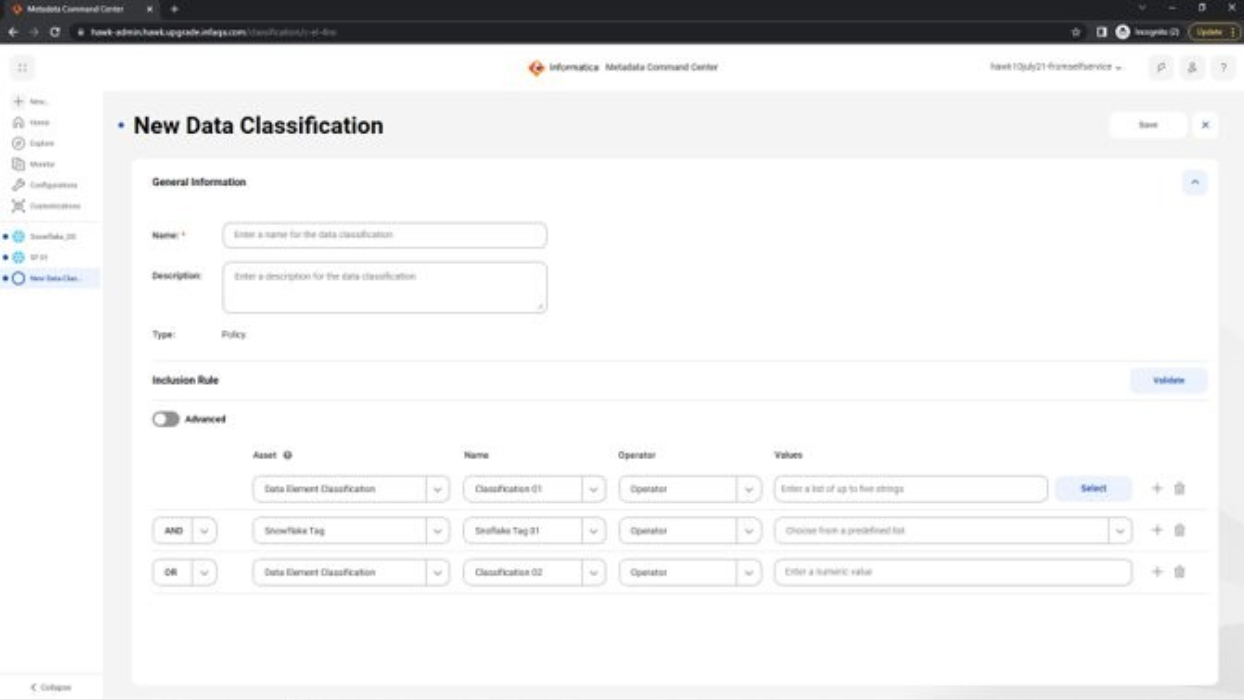
Informatica Data Governance is part of the Informatica Intelligent Data Management Cloud (IDMC), delivering AI-powered tools for governing, accessing, and protecting data. It helps organizations automate governance workflows, improve data quality, ensure regulatory compliance, and provide safe, governed access to data across business and technical teams.
Key features include:
- AI-driven governance with CLAIRE®: Uses AI and machine learning to automate metadata management, policy enforcement, and data discovery, reducing manual efforts and accelerating outcomes
- Data quality and observability: Provides integrated profiling, scorecards, and monitoring tools to assess and improve data quality
- Business-technical alignment: Automatically links technical metadata with business context to support shared understanding and strategic alignment
- Governed data marketplace: Enables secure, policy-controlled data sharing across the organization through a centralized data marketplace
- Regulatory compliance support: Offers visibility and control to help meet requirements such as GDPR, helping teams validate data use and ensure privacy
4. Alation Data Catalog

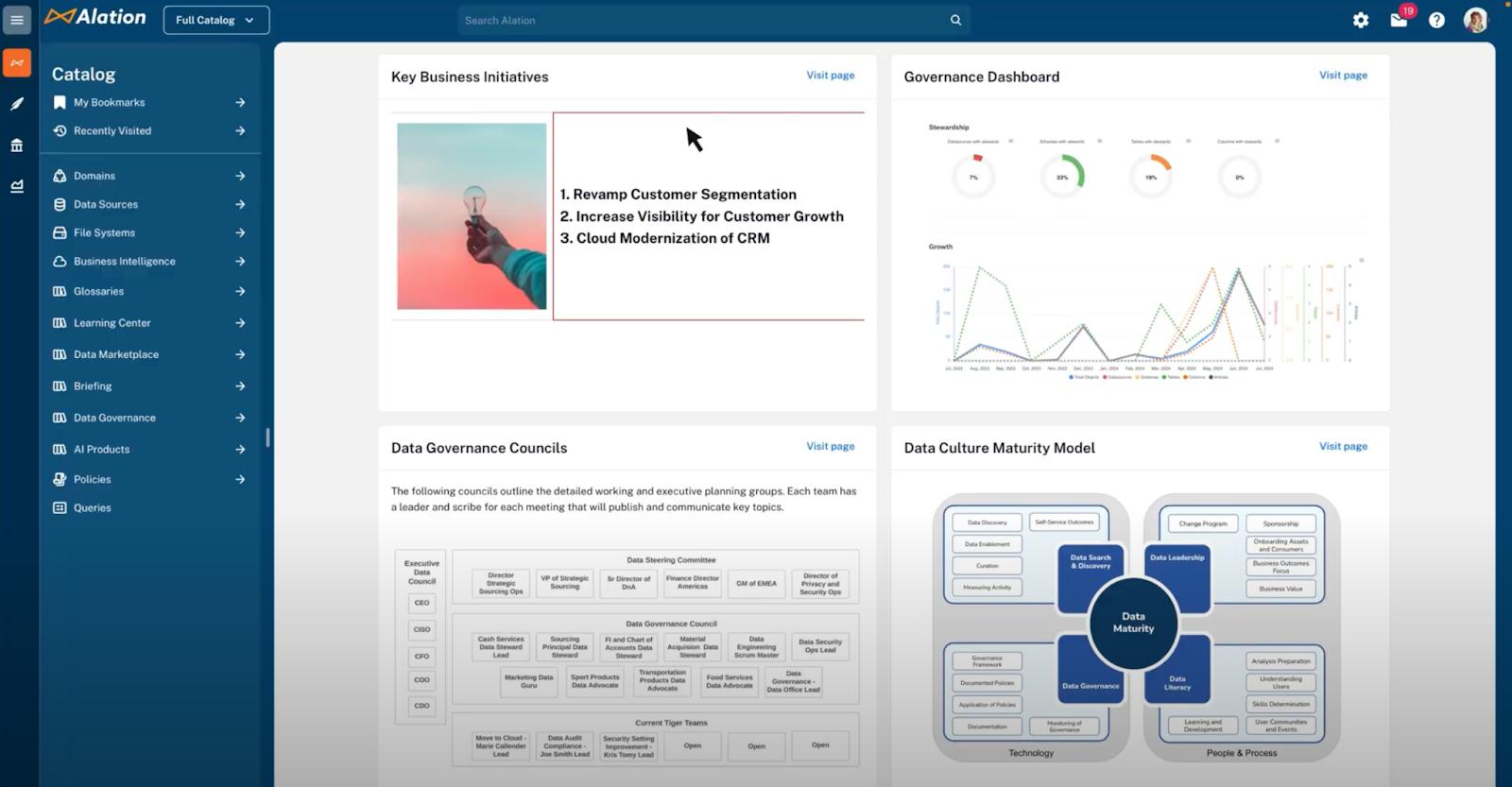
Alation Data Catalog is a component of Alation's data governance ecosystem, intended to make data more discoverable, trustworthy, and actionable across an organization. It centralizes metadata, automates classification, and embeds governance policies into data discovery.
Key features include:
- Centralized metadata management: Breaks down data silos by integrating metadata from across systems into a single, searchable catalog
- Suggested descriptions: Uses automation to generate helpful context and definitions, accelerating data curation and understanding
- Trust flags and linked policies: Guides users to approved, compliant datasets by visually marking trusted data and associating it with usage policies
- Policy center: Consolidates governance policies into a central location, enabling consistent enforcement and easier compliance
- Automated classification with catalog sets: Dynamically categorizes data and applies relevant governance policies as new assets are added
5. Collibra Data Governance
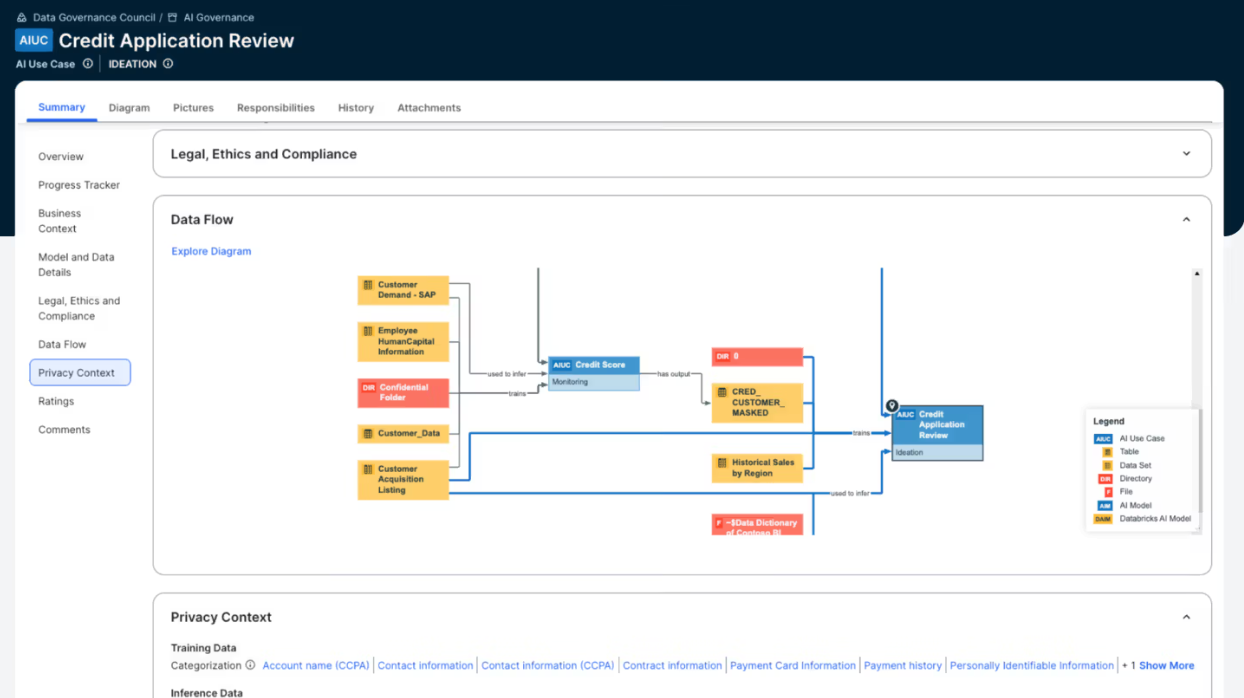
Collibra Data Governance provides a federated, automated approach to managing data at scale. Intended to support collaboration between data owners, stewards, and business users, the platform helps organizations reduce data risk, improve data understanding, and maintain compliance.
Key features include:
- Business glossary: Standardizes business terms, definitions, and rules to reduce ambiguity and improve cross-functional data understanding
- Role-based data access: Assigns roles and responsibilities to control who can access which data assets, enhancing security and compliance
- Reference data management: Identifies and reconciles inconsistencies across systems to support accurate reporting and analytics
- Centralized policy management: Maintains and governs data policies in one place, helping organizations meet compliance obligations
- Automated governance workflows: Simplifies governance operations by automating processes like approvals, reviews, and updates
Related content: Read our guide to data governance tools
Emerging Trends in Data Governance Solutions
Governance for Generative AI and LLMs
The rise of generative AI and large language models (LLMs) is driving specialized governance demands. Data governance solutions now integrate tools for tracking the training data used in AI models, documenting data provenance, and monitoring for bias or compliance issues. These functions are critical as organizations embed models into business processes, where data drift or bias can translate to significant ethical and regulatory risks.
Governance platforms are beginning to offer model cards, risk scoring, and explainability metrics for LLMs alongside traditional data stewardship. These capabilities enable organizations to demonstrate responsible AI usage to regulators and customers. By embedding governance directly into model development and deployment workflows, organizations can reduce the risk that proprietary or sensitive data is inadvertently used outside of intended context.
Data Mesh and Domain-Oriented Governance
Data mesh is transforming data governance by promoting decentralized, domain-based ownership of data. Governance solutions are evolving to allow federated policy enforcement, local stewardship, and domain-driven cataloging. This means data product owners manage quality, access, and compliance for their respective domains while adhering to global governance standards coordinated by a central team.
Modern governance platforms provide templates, guardrails, and automation for aligned yet decentralized governance structures. These systems support cross-domain data discovery, lineage, and marketplace-style sharing, enabling agility without compromising governance rigor. As data architectures become more distributed, supporting mesh operating models is key to scaling governance efficiently in large organizations.
Automated Data Lineage via ML and Graph Models
Machine learning and graph models are significantly improving automated lineage extraction and analysis. New governance solutions can parse codebases, monitor dataflow, and infer relationships between datasets without extensive manual mapping. Graph-based approaches create detailed, queryable networks of data dependencies and transformations, supporting impact analysis, root cause diagnostics, and efficient policy enforcement.
ML-powered lineage tools also adapt to dynamic data architectures, maintaining accuracy as pipelines evolve or new integrations are added. This automation accelerates compliance response, improves trust in analytical outputs, and reduces the effort required to keep lineage records current. As organizations increase adoption of complex data pipelines, automated and intelligent lineage is becoming an expected feature in governance platforms.
Privacy-Enhancing Computation and Secure Collaboration
Privacy-enhancing computation (PEC) techniques, such as homomorphic encryption, secure multiparty computation, and differential privacy, are emerging as essential features in data governance solutions. These technologies enable secure collaboration on sensitive data without exposing raw information, expanding opportunities for cross-organizational analytics and innovation. Modern governance platforms integrate PEC to support regulatory requirements for data minimization and confidentiality.
In addition to encryption, secure data sharing frameworks and federated analytics foster responsible collaboration between partners and departments. Governance solutions monitor and log collaborative activities, applying data masking or access restrictions as needed. By embedding privacy controls at the computation layer, organizations can achieve data utility while maintaining strict compliance with privacy laws and stakeholder expectations.
Data Governance as a Service (DGaaS) and Outsourced Models
Data Governance as a Service (DGaaS) offers a cloud-based, managed approach to implementing data governance without the overhead of building and maintaining infrastructure in-house. DGaaS platforms deliver core governance capabilities—such as metadata management, data cataloging, access control, and compliance monitoring—via SaaS delivery models. This allows organizations to quickly onboard governance capabilities, scale them as needed, and minimize upfront costs and staffing requirements.
Outsourced models typically include services for governance strategy development, data stewardship, and ongoing policy management, delivered by external providers. These models are especially useful for organizations lacking in-house expertise or seeking faster time-to-value. Providers often bring industry best practices, regulatory knowledge, and pre-built templates to accelerate implementation and reduce risk.
DGaaS solutions also offer pre-integrated connectors to popular data platforms, enabling rapid integration into hybrid and multicloud environments. They include automated updates, built-in security controls, and service-level agreements (SLAs) that support operational reliability. For enterprises seeking agility or those operating under resource constraints, DGaaS and outsourced governance provide a practical path to effective, scalable data governance.
Conclusion
Effective data governance is essential for organizations looking to manage risk, ensure compliance, and enable confident data use across the enterprise. As data environments become more complex and decentralized, modern governance solutions provide the structure, automation, and transparency needed to maintain control. By embedding governance into everyday workflows and aligning it with strategic priorities, businesses can turn data into a trusted, actionable asset that supports innovation and growth.
Fashion Retailer Mango’s Data Journey with Collate
Read the case study
Sign up to receive updates for Collate services, events, and products.
Share this article


Ready for trusted intelligence?
See how Collate helps teams work smarter with trusted data