Best Data Governance Software: Top 5 Options in 2026
What Is Data Governance Software?
Data Governance software helps organizations manage the quality, security, and lifecycle of their data by providing tools for data cataloging, lineage tracking, policy enforcement, and compliance. Key players in the market include Collate, Collibra, Alation, Ataccama, and OneTrust, with solutions ranging from comprehensive enterprise platforms to open-source options like Apache Atlas. These tools enable businesses to improve data reliability, ensure regulatory compliance, and enable data discovery and use across the enterprise.
Data governance software is useful for:
- Data cataloging: Creates a centralized inventory of an organization's data assets, making it easier to find and understand data.
- Data lineage: Visualizes the journey of data from its origin to its current state, which is crucial for auditing and compliance.
- Policy enforcement: Allows for the implementation and enforcement of rules and standards to ensure data is reliable, secure, and used appropriately.
- Compliance and privacy: Helps organizations meet regulatory requirements and protect sensitive data.
- Data quality: Automates data quality checks to ensure data is accurate, consistent, and reliable.
- Collaboration: Supports collaboration between technical and business users, making data more accessible and trustworthy for everyone.
Companies face mounting pressures related to data privacy, regulatory compliance, and business efficiency; data governance software provides a centralized system to address these challenges. It helps organizations catalog their data assets, monitor how data is used, track historical changes, and enforce security, privacy, and quality standards at scale.
What Data Governance Software Does
Data Cataloging
Data cataloging is a component of data governance software. It involves scanning data sources across the organization and building an organized inventory of all data assets—databases, tables, files, and more. The catalog creates a searchable repository with rich metadata about each asset, such as descriptions, owners, classifications, data types, and usage statistics.
With this level of structured cataloging, data becomes discoverable and understandable to users across the business. Stakeholders can identify what data exists, where it lives, and how it can be used, improving data access while minimizing duplication and inconsistencies. Automated cataloging also lays the groundwork for successful analytics, compliance, and policy enforcement initiatives.
Data Lineage
Data Lineage tracks the flow and lifecycle of data as it moves through various systems, processes, and transformations. Governance software visually maps out these data journeys, showing where data originates, how it is transformed, and where it ultimately lands. This end-to-end traceability is critical for understanding data quality issues, performing root cause analyses, and maintaining trust in analytical outputs.
With automated data lineage capabilities, organizations can also streamline impact analysis and risk management. When a data source changes, stakeholders can quickly assess which reports, dashboards, or downstream applications will be affected. Data lineage is also essential for regulatory compliance, as it provides auditable records of data handling and transformation.
Policy Enforcement
Policy enforcement tools within data governance software allow organizations to systematically apply data usage rules and business policies. Organizations can define and enforce role-based access rules, data retention timelines, security classifications, and usage limitations. These built-in checks ensure data is only accessible to authorized individuals and is handled in accordance with internal policies and legal mandates.
Automated policy enforcement reduces manual oversight and the risk of accidental breaches or regulatory infractions. When policies are embedded directly into data workflows, organizations can minimize human error and demonstrate reliable controls to auditors and stakeholders.
Compliance and Privacy
Organizations today must navigate a complex landscape of privacy laws and regulatory mandates, such as GDPR, CCPA, or HIPAA. Data governance software helps companies comply by centrally managing data processing records, providing features for consent tracking, and facilitating data subject rights management. Organizations can automate many compliance activities, minimizing reliance on manual processes.
Privacy controls embedded in governance tools also help restrict sharing of sensitive or personally identifiable information. By identifying and flagging regulated data, setting fine-grained permissions, and maintaining audit trails, these platforms help reduce the risk of non-compliance. Regular monitoring and alerting functions further support ongoing regulatory adherence as laws or business requirements change.
Data Quality
Data quality capabilities are essential to enforce standards around completeness, consistency, accuracy, and timeliness of data. Governance software provides tools for automated data profiling, validation, cleansing, deduplication, and ongoing monitoring. By defining quality rules and thresholds, organizations can automatically detect and remediate anomalies as data enters the ecosystem.
Prompt resolution of data quality issues limits downstream disruptions to analytics and operational decision-making. Continuous monitoring and reporting provide visibility into quality trends, enabling proactive improvement efforts. A strong data quality program also boosts confidence in data-driven insights, ensuring that business users and systems rely on fit-for-purpose information.
Collaboration
Data governance platforms support collaboration among business users, data stewards, analysts, and IT staff. Features like role-based workflows, glossary management, discussions, and crowdsourced metadata enrichment make it easier for teams to work together around data assets. These functions help bridge the gap between business needs and technical details.
Collaboration features also facilitate knowledge transfer, onboarding, and organizational alignment on data definitions and uses. As more stakeholders contribute to and consume governance resources, organizations benefit from richer context, faster decision-making, and a more data-literate workforce.
Notable Data Governance Software Solutions
1. Collate®

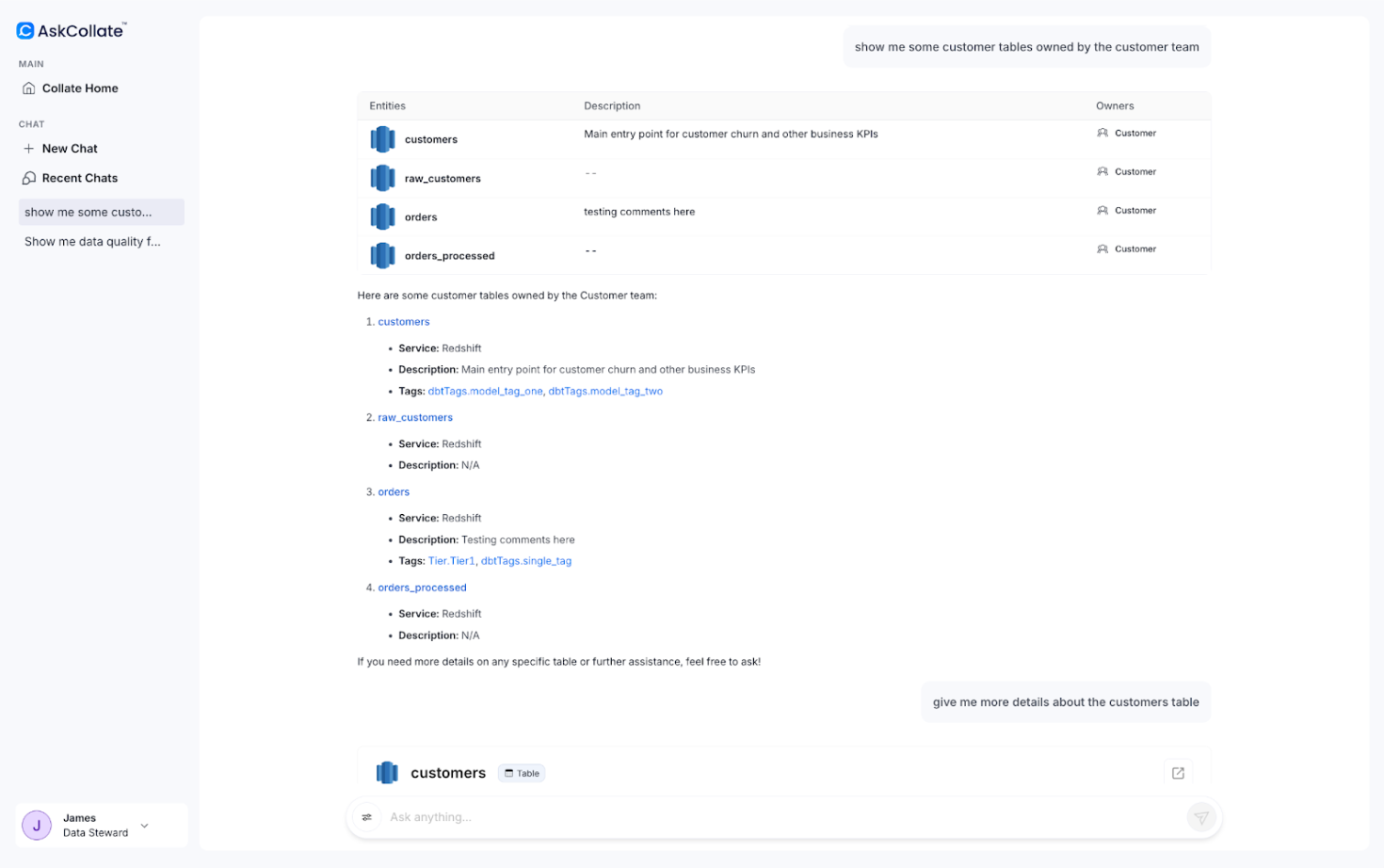
Collate is a managed OpenMetadata service that unifies data discovery, observability, and governance into a single platform for modern data teams. Built by the founders of Apache Hadoop, Apache Atlas, and Uber Databook, Collate extends the open source OpenMetadata project with enterprise-grade features, AI-driven automations, and fully managed cloud deployment. The platform is designed to help organizations scale data trust and collaboration without scaling headcount, making metadata management accessible to both technical and business users.
Key features include:
- Conversational AI with AskCollate: Provides a natural language interface for managing, understanding and governing data across systems by simply asking questions in plain language.
- AI-powered data classification and automation: Uses machine learning models to automatically identify and tag personally identifiable information, classify sensitive data, and tier assets based on quality and usage metrics.
- Native data contracts: Establishes formal agreements between data producers and consumers to prevent breaking changes, maintain reliability, and automate compliance verification.
- Reverse metadata sync: Pushes governance decisions from Collate back to source systems for automated and consistent policy enforcement across the entire data stack.
- Enterprise-scale architecture: Supports millions of data assets with customizable dashboards, certification workflows, domain organization, and granular access controls for distributed ownership.
2. Collibra Data Governance
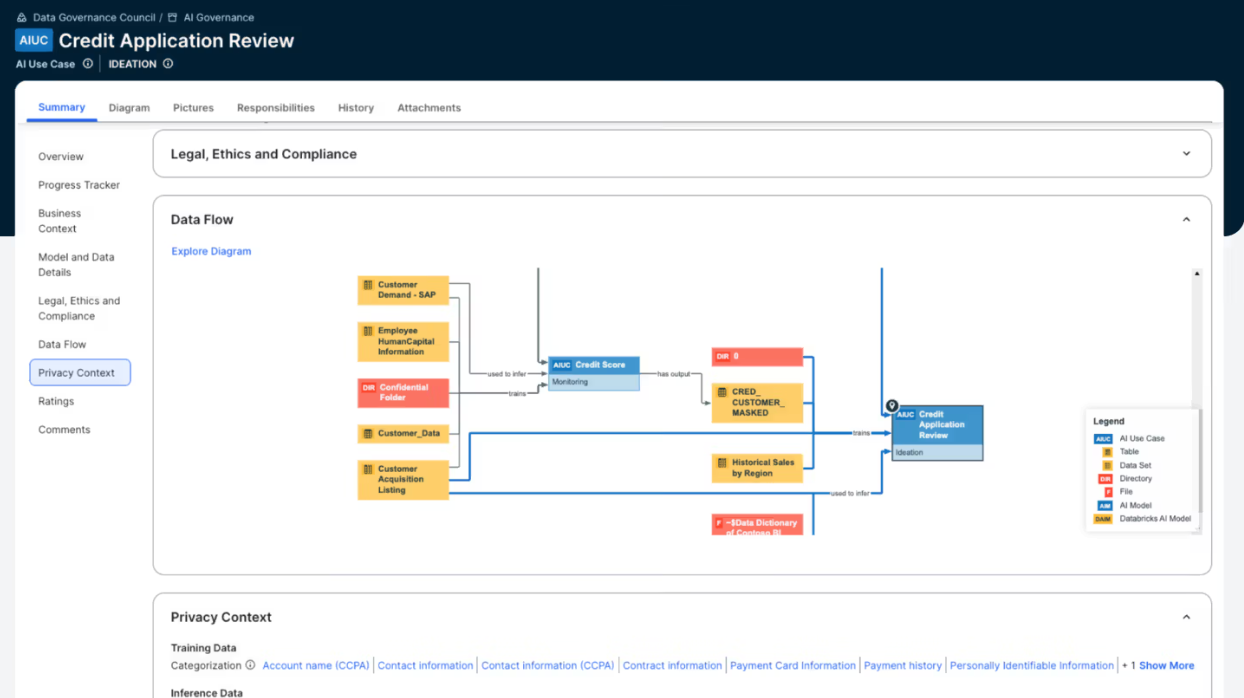
Collibra provides a platform for federated data governance, helping organizations standardize data processes, automate compliance activities, and reduce risk across distributed environments. Its tools support the creation of shared business definitions, automated workflows, and centralized policy management.
Key features include:
- Business glossary: Standardizes definitions, rules, and regulations to improve clarity and reduce data misuse
- Role-based access control: Assigns responsibilities and enforces access restrictions to protect sensitive data
- Reference data management: Helps identify and reconcile inconsistencies across systems for better reporting
- Centralized policy management: Enables policy creation, review, and updates to support regulatory compliance
- Workflow automation: Automates governance tasks to align with business goals and reduce manual effort
3. Alation Data Governance

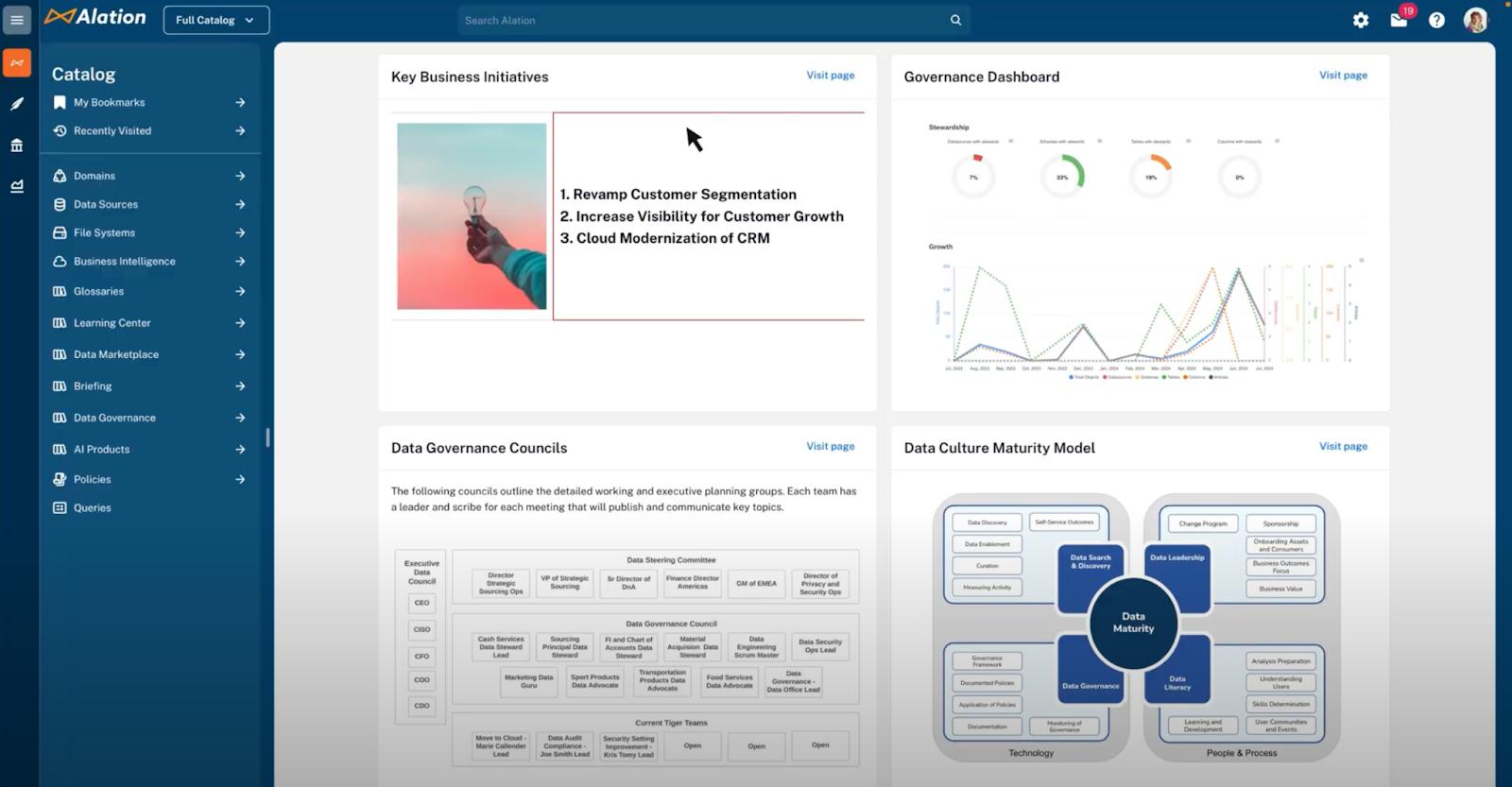
Alation Data Governance enables organizations to safely use data by balancing accessibility with compliance. Its platform helps teams use data confidently without compromising regulatory requirements or security. By integrating policy management, metadata curation, and AI governance, Alation helps prevent data governance from becoming a bottleneck.
Key features include:
- Metadata repository: Breaks down silos by centralizing metadata from across systems into a single, searchable source of truth
- Policy center: Organizes and stores governance policies in one place to improve accessibility and ensure consistent compliance
- Workflow automation: Assigns, tracks, and automates governance tasks like policy renewals and updates to reduce manual overhead
- Trust flags and linked policies: Guides users to compliant, approved datasets by visually marking trusted data and attaching relevant policies
- Sensitive data protection: Enforces row-level access controls and dynamic masking to secure personally identifiable or regulated information
4. Ataccama Data Governance
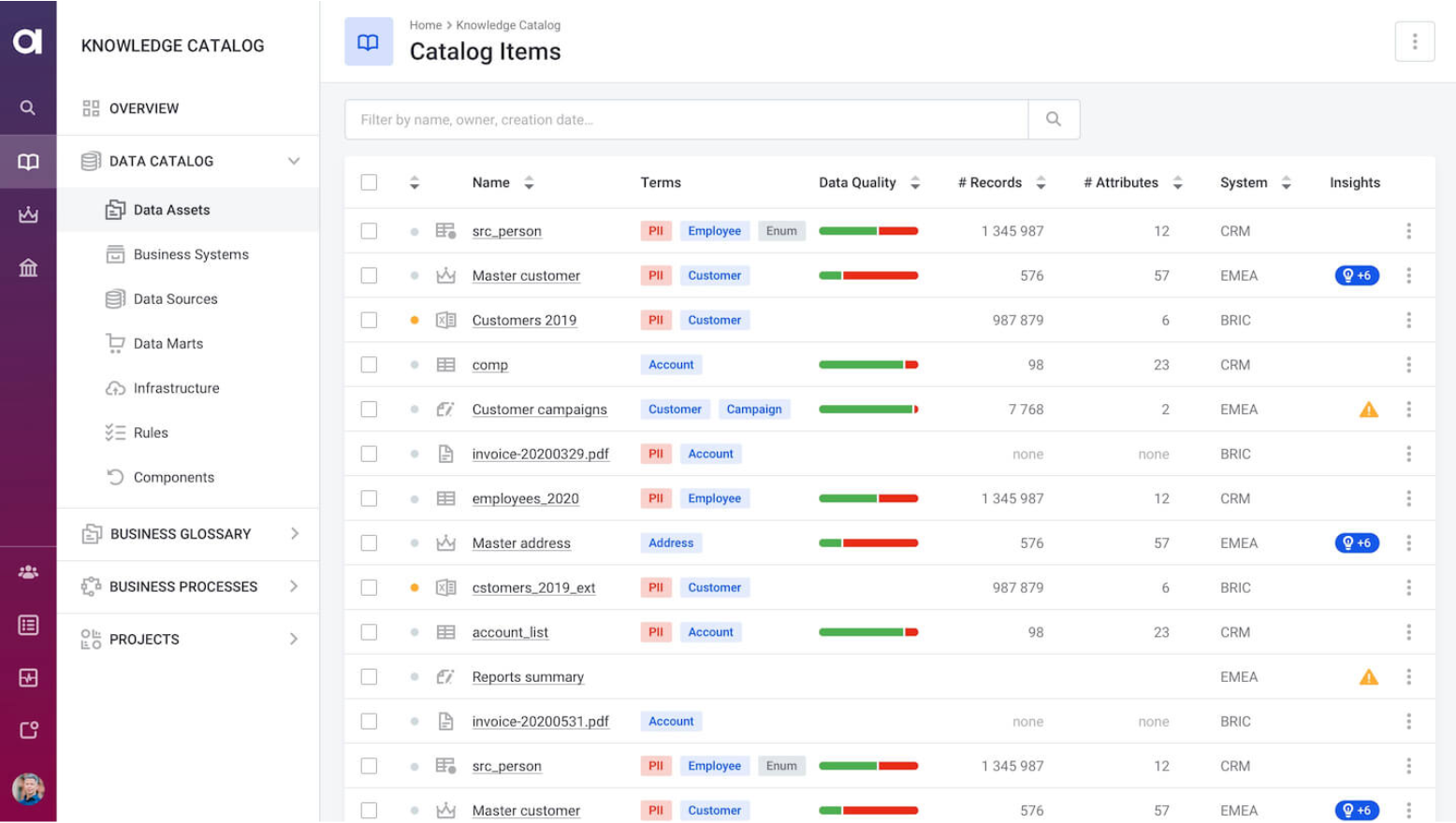
Ataccama Data Governance, powered by the Ataccama ONE platform, offers an integrated and automated approach to managing data across the enterprise. It simplifies the data governance lifecycle, from discovery and classification to policy enforcement and compliance, enabling teams to make data-driven decisions.
Key features include:
- Automated data discovery and classification: Scans and categorizes data across systems, identifying sensitive information and calculating quality metrics to prioritize governance initiatives
- AI-driven data quality management: Monitors, cleanses, and enriches data automatically to remove errors, detect anomalies, and maintain reliable datasets
- Business glossary: Centralizes business terms, rules, and definitions to promote consistent understanding and collaboration across teams
- Augmented data lineage: Captures and visualizes data flows end-to-end, enriched with data quality insights to improve transparency
- Regulatory compliance automation: Simplifies adherence to GDPR, CCPA, HIPAA, and other regulations through automated consent management and policy enforcement
5. OneTrust Data Governance

OneTrust Data Governance is for AI-driven data environments where speed, compliance, and responsible data use must coexist. It replaces manual, access-based processes with scalable, policy-centric governance. By embedding policy enforcement into data and AI systems, OneTrust helps ensure that data is governed according to its purpose.
Key features include:
- Real-time policy enforcement: Automates governance across data systems, enabling compliance without disrupting AI or analytics workflows
- Purpose-based governance: Applies policies based on intended data use at the project level, aligning governance with business goals from the start
- Machine-readable labels: Tags data with metadata that systems can interpret, enabling scalable and automated policy application
- Data classification: Uses AI to classify structured and unstructured data based on business, regulatory, consent, and contextual signals
- Integrated policy system of record: Centralizes governance policies to serve as a consistent reference across teams and tools
How to Choose the Right Data Governance Software
Alignment with Your Business Objectives and Data Governance Maturity
Before evaluating vendors, organizations must clarify their primary goals, such as compliance, data quality, or improved analytics, and assess where they are on the data governance maturity curve. Some platforms are for large enterprises with established governance programs, while others cater to organizations just starting their journey. Choosing a solution that matches your current and anticipated requirements prevents over-investment and supports smoother adoption.
This alignment also ensures that the selected tool will deliver tangible value, addressing immediate gaps and providing a path for future growth. It is important to involve both technical and business stakeholders in defining requirements, establishing metrics for success, and ensuring buy-in from all parts of the organization.
Ease of Use and Adoption by End-Users
A data governance platform is only effective if it is used consistently by the intended audience. Solutions with intuitive interfaces, strong search and discovery capabilities, and guided workflows reduce onboarding time and support broader participation. Features like in-line help, contextual recommendations, and accessible documentation can greatly improve overall user experience.
End-user adoption is critical for sustaining governance efforts and avoiding shadow IT or policy lapses. Platforms that provide role-based access and customizable dashboards enable different user groups—data stewards, analysts, business managers—to engage with governance processes in a way that suits their workflows. Consider pilot testing with representative users to identify and address barriers to adoption early.
Deployment Options and Architecture Fit
Modern data governance solutions offer a variety of deployment models, including SaaS (cloud), hybrid, or on-premises setups. The right deployment option should match the organization’s IT policies, data residency requirements, security standards, and scalability needs. Cloud-native solutions may offer faster updates and reduced infrastructure overhead, while on-premises deployments provide direct control for highly regulated or data-sensitive environments.
Architecture fit also includes evaluating how well the solution will scale with data volumes and user numbers, as well as its compatibility with current and planned analytics and storage platforms. Integration with identity management and access control systems is also critical for simplified administration and security alignment.
Integration and Ecosystem Compatibility
A governance platform must integrate with the diverse data sources, analytics tools, and business applications in your environment. Assess the system’s cataloging connectors, API availability, workflow automation capabilities, and support for enterprise standards. Seamless integration accelerates time-to-value by connecting governance to existing data pipelines and business processes.
Compatibility with ecosystem partners, such as data quality, security, and privacy tech vendors, adds flexibility and extends core governance capabilities. Selecting a platform with strong vendor partnerships, a developer community, and frequent updates helps ensure long-term viability and eases the adoption of new technologies or compliance requirements as they arise.
Cost and Total Cost of Ownership
While initial licensing fees are important, organizations should evaluate the entire cost of ownership, including implementation, integration, training, support, and ongoing maintenance. Cloud-based solutions can lower infrastructure costs, but consider the pricing model (per user, per data volume, or tiered features) as it may impact scalability and actual budget needs.
Also factor in the resources required for data mapping, onboarding, customization, and change management. A system that saves staff time or reduces compliance risk may justify a higher upfront investment. Comprehensive cost analysis helps prevent hidden expenses and supports an accurate ROI calculation, ensuring that the chosen platform delivers both value and sustainability over time.
Conclusion
Choosing the right data governance software is critical to ensuring that data remains a secure, reliable, and strategic asset across the organization. As data environments grow in complexity, effective governance tools provide the structure and automation needed to manage risk, enforce policies, and unlock value from data. The best solutions balance flexibility with control, enabling organizations to adapt governance practices as their data strategy evolves.
Fashion Retailer Mango’s Data Journey with Collate
Read the case study

Sign up to receive updates for Collate services, events, and products.
Share this article


Ready for trusted intelligence?
See how Collate helps teams work smarter with trusted data